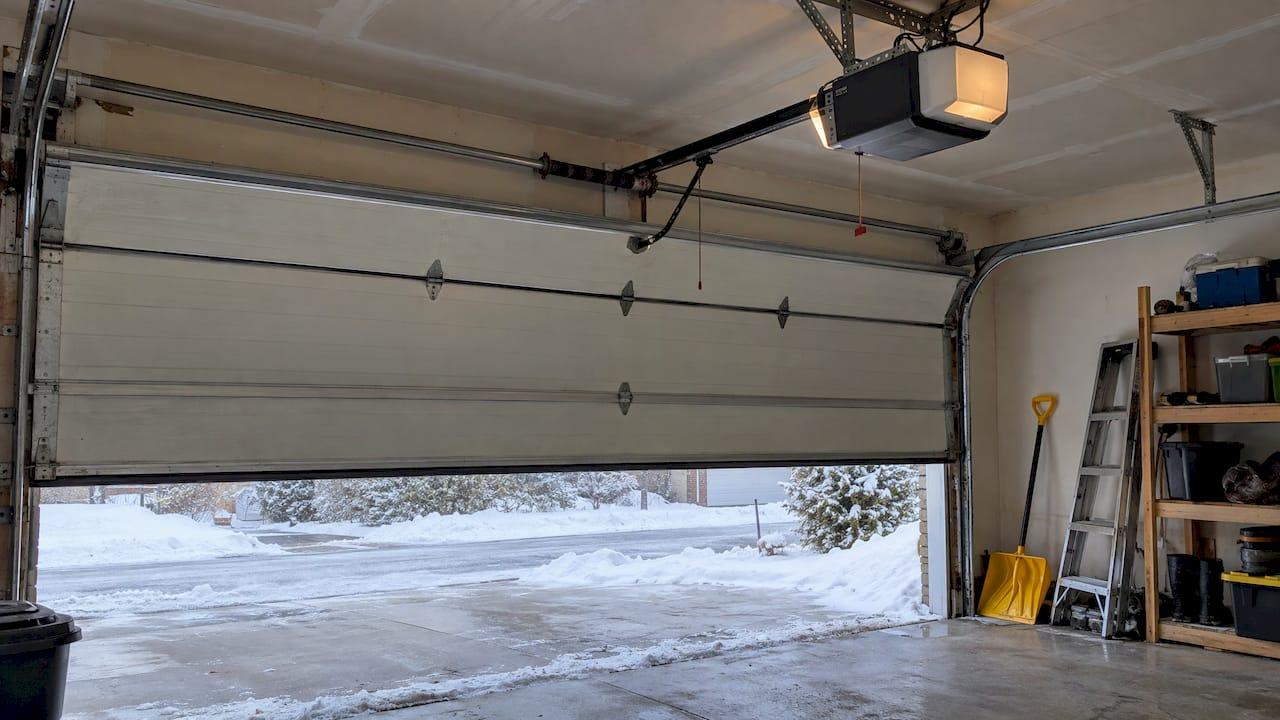
When a garage door opener quits on a freezing Loveland morning, the cause is almost always one of four things: thickened lubricant, metal that has tightened up and raised friction, weak remote batteries, or ice and frost on the seal and sensors. Most of these are simple to spot. Springs, cables and anything under tension are not, and those belong with a professional. Here is how to tell the difference, what is safe to check yourself, and what to look for in an opener built for winter. If your door won't budge and you need help, our crew at Mike's Garage Door Repair completes 90% of repairs the same day.
TL;DR
- Cold thickens grease, tightens metal parts and drains batteries, so an opener that works in October can struggle in January.
- A door that opens a little and stops usually has either a mechanical drag or force and travel settings that no longer match the door. A quick manual test tells you which.
- Never force a frozen door, never cycle the opener to break an ice bond, and leave springs and cables to a professional.
- For a new opener, look for a DC motor, thermal protection, automatic force adjustment and battery backup.
- We offer 24-hour emergency repair across Loveland and Northern Colorado.
Table of Contents
- Why a garage door opener acts up in the cold
- Why the door opens a little and then stops
- Why the door won't close in the cold
- Safe morning checks before you call
- What to look for in a cold-weather garage door opener
- Winter maintenance that prevents cold-morning failures
- Our perspective
- When you'd rather have it fixed today
- FAQ
- Sources
Why a garage door opener acts up in the cold
An opener is a motor, a drive (chain, belt or screw), and a set of sensors that decide when to stop. A garage door is a heavy assembly of panels, rollers, hinges, tracks and springs. Cold changes how every one of those parts behaves, and the opener is the first to complain because it is the part that senses resistance.
Thickened lubricant. Grease on rollers, hinges and the drive rail stiffens as the temperature drops. The motor has to push harder to move the same door. When it senses too much resistance, it stops or reverses, which is exactly what it is designed to do for safety.
Contracting metal. Tracks, hinges and brackets shrink slightly in the cold. A track that was fine in August can bind a little in January. A small increase in friction is enough to trip an opener whose force setting has little margin.
Weak batteries. Remotes and keypads run on small batteries that lose output in the cold. If your remote works from three feet away but not from the driveway, the battery is the first suspect. A wall button that works while the remote doesn't confirms it.
Frost, ice and moisture. Snow melts against the bottom seal during the day and freezes overnight, gluing the door to the concrete. Frost or condensation on the photo-eye lenses can also break the beam so the door refuses to close.
One more thing we see in Colorado: our big temperature swings. A sunny 50-degree afternoon followed by a single-digit night means melt, then freeze, every day. That cycle is harder on a garage door than steady cold.
Why the door opens a little and then stops
This is one of the most common winter complaints, and it has two broad causes.
The door is dragging. Hardened lubricant on the rollers or in the track makes the door heavy to move. The opener starts, meets resistance and quits. Manufacturer guidance on why an opener stops or reverses lists an out-of-balance door, wrong force settings, detected resistance and travel limits that no longer match the door's position.
The opener's settings no longer fit. Force and travel limits are set at installation. If the door's behavior changes with the temperature, the opener can misread the door's position or decide the load is too great.

The same manufacturer guide gives a useful way to separate the two. A door that moves smoothly by hand and stays where you leave it points more toward the opener. A door that feels heavy, sticks or drops points toward balance or a mechanical problem. That second situation is where springs come in, and springs are not a homeowner repair.
How to run the manual test
- Close the door fully.
- Pull the red emergency release cord to disconnect the opener from the door.
- Lift the door by hand to about waist height, then let go.
- A balanced door stays put or drifts only slightly. A door that slams down or shoots up has a spring or cable problem.
We walk through the lift test in more detail in our guide to the garage door balance test, including the opener reversal check. If the door fails the balance test, stop there. A door that fails is carrying hundreds of pounds on springs under tension, and the safe next step is a call, not a wrench.
Why the door won't close in the cold
A door that goes down partway, then reverses, usually has one of three problems.
- Ice under the door. The bottom seal has frozen to the slab, or a ridge of ice sits where the seal meets the floor. The door reads the obstruction and goes back up.
- Sensors. Frost, condensation, dirt or a bumped bracket breaks the beam between the two photo-eyes. The opener will usually flash its lights or blink when this happens, and the door won't close from a remote.
- Brittle wiring. Cold can make old sensor wiring stiff. A cracked wire or loose connection can drop out intermittently, which is why the door closes some mornings and not others.
To check the sensors, wipe both lenses with a soft cloth, make sure nothing is blocking the beam, and see that the indicator lights on both units are steady. If one light is out or flickering after cleaning, look at the wire for damage along its length. A damaged wire is a repair, not a guess.
Safe morning checks before you call
This order goes from easiest to most involved, and it keeps your hands away from anything under tension.
- Try the wall button. If it works and the remote doesn't, replace the remote battery. Press-and-hold behavior in the cold is a common sign of a weak cell.
- Check power. Confirm the opener is plugged in, the outlet works, and the breaker or GFCI hasn't tripped. A U.S. troubleshooting rundown puts the remote, wall switch and power supply at the top of the list for good reason: they cause a lot of no-start calls.
- Look at the bottom seal. If ice is holding the door down, don't keep pressing the button. Cycling the opener against an ice bond can strain the opener, the door and the cables. Clear snow and slush away first.
- Release ice gently. Chip away loose ice with a plastic scraper. Don't pry at the rubber seal with metal tools, and don't pour ice melt around the door, since salt is hard on the bottom panel and the hardware.
- Clean the sensors. Wipe the lenses and check alignment.
- Disconnect and test by hand. Use the release cord with the door closed, as described above.
Stop if the door feels unusually heavy, catches in the track, makes a loud bang, or one side sits lower than the other. Those are signs of a broken spring, a slipped cable or a bent track, and forcing the door can turn a repair into an injury. A broken torsion spring turns your door into dead weight. Please don't try to lift it with the opener, and don't try to fix springs yourself. Call us instead, and we'll give you an upfront estimate over the phone before anyone drives out.
What to look for in a cold-weather garage door opener
If your opener is old, loud or constantly struggling in winter, replacement can make more sense than another repair. The features that matter most for cold climates are practical ones, and you can verify them on a spec sheet.
| Feature | Why it helps in winter |
|---|---|
| DC motor | Smoother start and stop, and soft operation when the door is stiff |
| Automatic thermal protection | Guards the motor when it works harder than usual |
| Auto-force adjustment | Adapts to changes in door movement from weather and conditions |
| Integrated battery backup | Keeps the door operable through winter power outages |
| Low-temperature remote rating | Keeps remotes working on the coldest mornings |
| Permanent lubrication | Fewer drive parts that can stiffen with grease |
These features appear together in current manufacturer literature. The LiftMaster 6580L product guide lists a DC motor, automatic thermal protection, auto-force adjustment for changing weather, integrated battery backup and remote operation down to -40°F. The 4690L sell sheet lists a 12V DC motor, thermal protection, auto-force adjustment, battery backup and a remote temperature range of -40°F to 150°F.
The drive type matters too. Chain drives are the traditional choice, and belt drives run quieter. For an attached garage with a bedroom above it, noise is often what decides it. Whichever you choose, the door itself has to be in good shape. A new opener on a door that is out of balance will fight it every winter morning, which is why we check balance, tracks and hardware whenever we install an opener.
We handle opener repair and installation for homes and businesses across Loveland and Northern Colorado, and we can walk you through what suits your door.
Winter maintenance that prevents cold-morning failures
Most cold-weather calls are avoidable. The work is simple and takes an afternoon in October or November, before the first hard freeze.
Lubricate the right parts. Use a lubricant made for garage doors on hinges, rollers and springs, and avoid heavy grease that stiffens in the cold. Wipe off old, gummy residue first. More is not better: excess grease collects dirt and thickens in the cold. Skip the track itself, where lubricant tends to collect debris. Rollers with nylon wheels need very little.

Inspect, don't adjust. Look over cables, rollers, hinges and brackets for fraying, rust, cracks or loose bolts. Tighten loose hinge and bracket bolts. Never touch the bottom brackets or the spring assembly, which are under high tension. Our guide to garage door track alignment checks shows what a safe look at the tracks involves.
Check the bottom seal and weatherstripping. A cracked or flattened seal lets in meltwater, which then freezes. Replacing worn weatherstripping is a small job that prevents a big headache. If you're sealing up the whole house for winter, a good home exterior maintenance calendar helps you schedule it alongside gutters and other seasonal tasks, and the principles in air sealing and weatherstripping apply to any door or window gap.
Test the safety features. Run the reversal test: place a 2x4 flat on the floor under the door and close it. The door should reverse when it touches the board. Check the photo-eyes by waving an object through the beam while the door closes. If either test fails, call us before you rely on the door.
Refresh batteries. Replace remote and keypad batteries before winter, and replace the backup battery in your opener on the schedule its manual gives.
Schedule a tune-up. A professional tune-up checks the balance, springs, cables, rollers and opener settings together, which is the one part of this list you can't safely do alone. For a seasonal timeline, see our garage door maintenance schedule.
Our perspective
Most winter calls we get start the same way: the opener is blamed, and the real problem is the door.
An opener is built to push or pull a balanced door. When cold stiffens the lubricant and tightens the tracks, a door that was already a little off balance becomes obvious. Replacing the opener without checking the springs and rollers means you buy a new motor and keep the old problem.
That's why we look at the whole system. We test balance, check the hardware, and then decide whether the opener needs a repair, an adjustment or replacement. We'd rather tell you over the phone what a job is likely to involve than surprise you with a bill at the door, and our technicians are experienced with everything from broken springs to faulty openers.
We're a family-owned company, and our neighbors in Loveland and across Northern Colorado are the reason we do the work the way we do. Our repairs come with written warranties on parts and labor, and veterans get a 10% discount. If your door fails in the middle of a January cold snap, our 24-hour emergency repair means you aren't left waiting for business hours.
Eddie
When you'd rather have it fixed today
Some mornings you just need the door to work. Maybe you're late, or the car is stuck inside, or it's a commercial property with deliveries waiting. That's when a call is faster than an hour of troubleshooting in the cold.
Mike's Garage Door Repair handles spring repair, opener repair and installation, tune-ups, commercial garage doors, custom doors and parts, and 24-hour emergency repair. We give you an upfront estimate over the phone, and 90% of our repairs are completed on the same day. You can see everything we do on our garage door services page.

If your opener is acting up, call before you force anything. Describe what the door does, and we'll tell you what it likely needs.
FAQ
What type of garage door opener is best for cold weather?
Look for a DC motor, automatic thermal protection, auto-force adjustment and integrated battery backup. Current LiftMaster product literature lists remote operation down to -40°F on these features. We can recommend and install an opener matched to your door and your garage.
Why won't my garage door opener work in cold weather?
The usual causes are thickened lubricant, contracted metal that adds friction, weak remote batteries, and ice or frost on the seal or sensors. Start with the wall button, the power supply and the sensor lenses. If the door is heavy or uneven when you lift it by hand, call a professional.
Why does my garage door open a little and then stop in cold weather?
The opener is sensing resistance or a mismatch with its settings. Manufacturer guidance points to balance, force settings, resistance and travel limits as the main causes. Disconnect the opener with the door closed and lift by hand. A heavy or sticking door means a mechanical or spring problem.
Why won't my garage door close in cold weather?
Check for ice or packed snow under the bottom seal first, then clean and realign the photo-eye sensors. Cold can also make old sensor wiring brittle. If the sensor lights stay dark or flicker after cleaning, the wiring or sensor may need repair.
Can I use ice melt or force a frozen door?
No. Forcing a door frozen to the floor can damage the seal, panel, cables and opener, and ice melt is hard on the door and hardware. Clear loose ice gently with a plastic scraper, and call us if the door still won't move.
Sources
- Garage door opener fails to travel fully: Chamberlain support
- LiftMaster 6580L product guide
- LiftMaster 4690L sell sheet
- Garage door won't open in the morning? 7 things to check