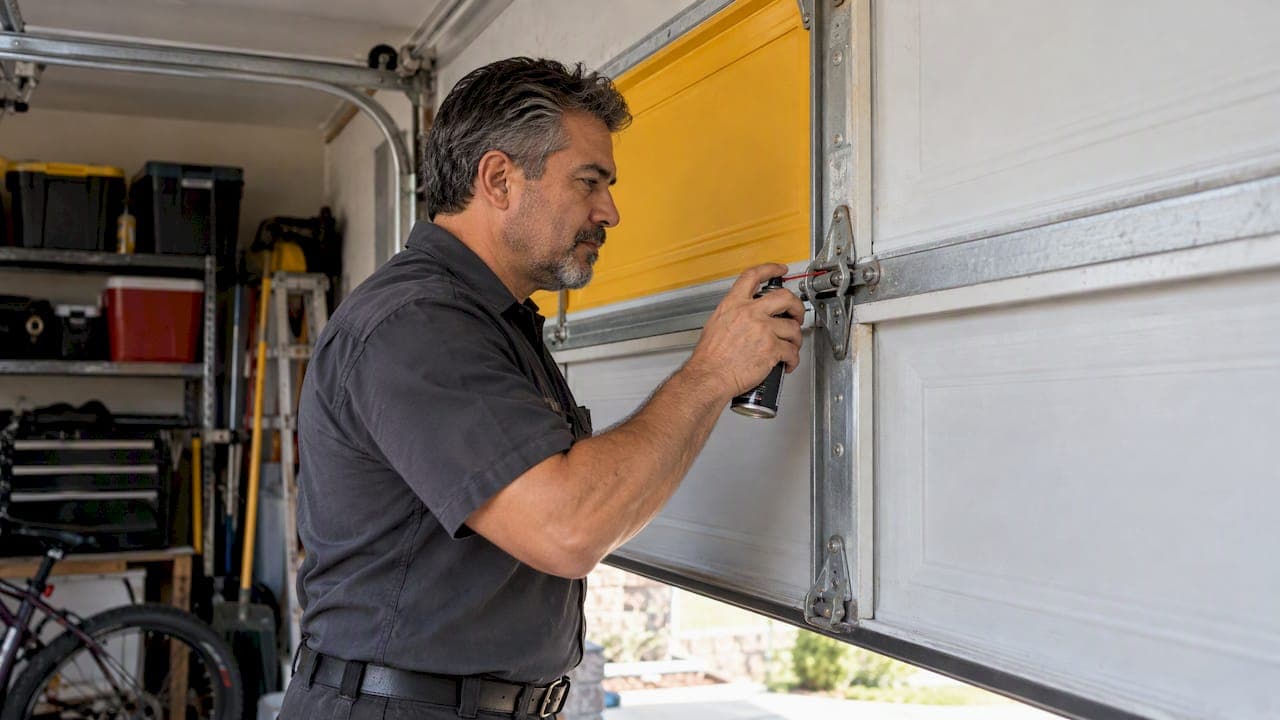
Here is the short version of a good garage door maintenance schedule. Test the auto-reverse every month. Look and listen every week or two. Clean, lubricate and tighten twice a year. Have a professional check the springs, cables and opener once a year. That rhythm catches most problems while they are still cheap.
We repair garage doors in Loveland and across Northern Colorado, so we see what happens when the schedule gets skipped. It is rarely dramatic at first. A squeak gets ignored, a roller wears flat, the door starts to run a little heavy. Then one cold morning a spring lets go and the car is stuck inside. This guide lays out the schedule we would give a neighbor, what you can safely do yourself, and where the line sits.
TL;DR
- Every month: run the two-inch auto-reverse test and check the photo-eye sensors.
- Every week or two: watch and listen to the door as it runs, from inside the garage.
- Twice a year (we like fall and spring): clean the tracks, lubricate moving parts, tighten hardware, check weatherstripping and test the balance.
- Once a year: book a professional inspection of the springs, cables, rollers and opener. Never adjust springs or cables yourself.
Table of Contents
- The schedule at a glance
- Monthly: the safety checks that matter most
- Every week or two: look and listen
- Twice a year: the clean, lube and tighten visit
- Once a year: the professional inspection
- Why Colorado weather changes the schedule
- How often is right for your door?
- Our perspective: maintenance saves you the bad day
- Let us handle the annual visit
- A simple year, month by month
- FAQ
- Sources
The schedule at a glance
Most home garage doors cycle two to six times a day, so a door is working harder than almost anything else in the house. Here is the calendar we recommend. The timing is ours, built on common manufacturer and retailer guidance, and we explain each line below.
| How often | Task | Who does it |
|---|---|---|
| Monthly | Auto-reverse test and sensor check | You |
| Every 1 to 2 weeks | Watch and listen to a full open and close | You |
| Twice a year | Clean tracks, lubricate, tighten hardware, check weatherstripping, balance test | You |
| Once a year | Full inspection of springs, cables, rollers, hinges and opener | A professional |
| Yearly or as needed | Wash the door and touch up paint or finish | You |
| When something looks or sounds wrong | Repair | A professional |
The Home Depot's guide to garage door upkeep also recommends routine maintenance at least twice a year, covering balance, hardware, lubrication and safety systems. Twice a year is the floor, not the ceiling, for a door that gets daily use.
Monthly: the safety checks that matter most
This is the one task that protects people, not just parts. Federal rules require every automatic residential opener made on or after January 1, 1991 to have entrapment protection. The Consumer Product Safety Commission explains the rule under 16 CFR Part 1211. But a rule on the box does not mean the safety system still works after years of vibration, a nudged sensor or a worn gear.
The auto-reverse test
The CPSC has long advised families to test the reversing feature monthly. Here is how:
- Make sure nobody, and no pet, is near the door.
- Lay a solid object about two inches tall, such as a wood block or a small brick, flat on the floor in the center of the door's path.
- Close the door with the remote or wall button.
- When the door touches the object, it should reverse right away.
If it stops and stays down, or keeps pushing, stop using the opener. The CPSC calls non-reversing openers a hazard, and so do we. Disconnect the opener, close the door by hand only if it is balanced and safe to do so, and call a pro. We cover the full procedure, including the timing, in our guide on how to pass the reversal test.
The photo-eye check
The two small sensors near the floor on each side of the door are your second safety layer. Wave a broom handle across the beam while the door is closing. It should reverse. Also confirm both sensors are lined up and their indicator lights are steady. Wipe the lenses with a soft cloth. A dusty or knocked-out-of-line sensor is the most common reason a door will not close, and it is a free fix when it is just alignment.

Every week or two: look and listen
You do not need tools for this. Stand inside the garage and run the door through a full cycle. You are looking for four things:
- Smooth motion. The door should travel up and down at an even pace, without jerking or tilting to one side.
- Sound. A new grinding, popping or scraping noise is information. Loud bangs deserve attention right away.
- Gaps. Watch the bottom edge as it lands. A crooked landing points to a cable or spring issue.
- The opener. Does it strain, hesitate, or hum without lifting?
Our 9 signs your garage door needs repair is a handy checklist when something seems off but you are not sure it is serious.
Twice a year: the clean, lube and tighten visit
Pick two anchor dates. In Loveland we suggest October, before the first hard freeze and snow, and April or May, after the freeze-thaw swings settle down. Block out one to two hours for the first pass, and less once you know your door. The Home Depot guide puts a full DIY inspection and tune-up at roughly two to four hours, which is a fair estimate if you are going slowly.
Before you touch anything
Disconnect the opener from power first. Home Depot's advice is that working on the door while it is connected to the opener risks accidental activation, so keep the door down and the power off during small jobs. If you ever need the door raised while you work, clamp the track just below a roller so it cannot slide down. Pulling the emergency release while the door is up can send it crashing down, so leave that cord alone unless the door is fully closed.
The twice-a-year checklist
- Clean the tracks. Wipe out dirt, old grease and debris with a rag and a mild degreaser. Do not coat the track itself with grease. It collects grit.
- Lubricate. Use a lubricant made for garage doors, such as a silicone or white lithium spray. Apply a light coat to hinges, roller bearings and the spring coils if you see bare metal. Wipe off the extra. Skip the track and skip the opener chain unless your manual says otherwise.
- Tighten hardware. Vibration works bolts loose. Snug the bolts and brackets on hinges, track mounts and the opener rail with a socket wrench. Snug is enough. Over-tightening can crack a panel.
- Inspect rollers and hinges. Look for cracked, chipped or flat-spotted rollers and bent or cracked hinges. Note them for your annual pro visit rather than replacing the bottom-bracket parts yourself, because those are tied to cable tension.
- Check weatherstripping. The rubber seal on the bottom of the door should be flexible and unbroken. Hard, cracked rubber lets in cold air, snowmelt and mice.
- Run the balance test. With the door down and the opener disconnected, lift it by hand to about waist height and let go. A well-balanced door stays put or drifts very slowly. If it slams down or shoots up, the springs need a pro. Our 30 to 60 second balance test walks through it step by step.
What lubrication should and should not do
A noisy door is often a dry door, but not always. If a good lube job does not quiet it, look for loose hardware or worn rollers. We put together a noisy garage door fix that sorts the harmless squeaks from the warning noises.
The same logic of fixed intervals applies across a house. If you already keep a calendar for something like a septic maintenance schedule, put the garage door dates on the same page, so the tasks do not depend on memory.
Once a year: the professional inspection
A yearly visit from a trained technician is where you catch the things a homeowner cannot safely judge. The research and the experience of the trade agree on this point: maintenance and repair are different jobs. Cleaning and lubricating are friendly to DIY. Springs, cables and pulleys are not.
The Home Depot guide is blunt about it: never adjust, repair or replace springs, cables or pulleys yourself, because the tension involved can cause catastrophic injury or death. Red-painted parts on the assembly mark the components that need specialized professional work. If you see rust, fraying, broken strands or misalignment, leave them alone and call.
A good annual visit should cover:
- Torsion or extension spring condition and balance
- Cable wear and drum seating
- Rollers, hinges and brackets
- Track alignment
- Opener force and travel settings
- Reversing and sensor performance
- Weatherstripping and bottom seal
And you should get a clear answer on what is worn, what is fine, and what it will cost before any work starts.
Why Colorado weather changes the schedule
Northern Colorado is hard on a garage door in a specific way. Big temperature swings, snow, ice and dry air stress metal, rubber and grease. Cold stiffens old lubricant, so a door that ran fine in September can groan in January. Rubber seals harden and crack. Springs carry the full weight of the door and take the shock when a cold, stiff door is forced open by the opener.
Two practical adjustments for our area:
- Do the fall visit before the first freeze. Fresh lube, a good bottom seal and a balanced door make winter mornings easier on the opener.
- Add a mid-winter listen. If your door is cycled daily and starts sounding rough in January, a quick lube of hinges and rollers on a dry day can help. If it keeps getting worse, stop and call.
Doors that sit under a living space, face north, or take wind off the plains may need attention a bit sooner than the calendar suggests.
How often is right for your door?
The schedule above fits a typical family. Adjust for how hard the door works.
| Situation | Suggested change |
|---|---|
| Door cycles 6 or more times a day | Pro inspection every 6 to 12 months, and lube more often |
| Door cycles once or twice a day | The standard schedule is fine |
| Opener older than 10 years | Test the reversal more carefully and ask about replacement at your next visit |
| Garage has a bedroom or living space above | Treat noises and balance changes as urgent, and keep up the annual inspection |
| Commercial or shared doors | More frequent service, tied to usage and downtime costs |
For businesses, the cost of a stuck door is lost hours, not just inconvenience. If you manage a property, our guide to scheduling commercial garage door maintenance shows how to set service intervals around your busiest days.
Our perspective: maintenance saves you the bad day
We are a family-owned shop, and we would rather see your door on a calm Tuesday for a tune-up than at 6 a.m. in January for an emergency. Both visits are our job. Only one of them is a good day for you.
Here is what we have learned from the work. Most of the broken-spring calls we get involve a door that was giving hints for months: a slower lift, a little drift when the opener stopped, a new groan. People are busy, and a door that still goes up feels fine. So we tell customers to build the check into the calendar and treat it like changing the furnace filter.

We are also direct about the DIY line. Wiping tracks, lubricating hinges and running the reversal test are all things we want you to do. Springs, cables and sensors that fail the safety test are not. We would rather you call us for a five-minute phone conversation than climb a ladder next to a wound spring. On the phone we give you an upfront estimate, so you know the cost before a truck rolls. About 90% of our repairs are finished the same day, so a problem you catch does not have to ruin your week. Our work comes with written warranties on parts and labor, and we take 10% off for veterans.
If you remember one thing from this page, make it the monthly reversal test. It takes two minutes, and it is the one habit that protects the people in your house.
— Eddie
Let us handle the annual visit
If you would rather not spend a Saturday under the door, we do tune-ups, spring repair, opener repair and installation, custom doors and parts, commercial service and 24-hour emergency repair across Loveland and Northern Colorado. You can see everything on our garage door services page, or call and describe what your door is doing. We will give you an honest estimate over the phone.
A simple year, month by month
If you like having it written out, here is a version for Larimer County.
- October: Full fall visit. Clean, lube, tighten, check the bottom seal, balance test. Book the annual pro inspection if you have not had one this year.
- November to February: Monthly reversal test. Quick listen every week. If the opener struggles on the coldest days, note it and mention it at your next service.
- March: Look for damage from winter, such as cracked weatherstripping or loose hardware.
- April or May: Spring visit. Same checklist as fall, plus a wash of the door and a look at the finish.
- June to September: Monthly reversal test. Keep an eye out for any change in noise or travel.
Set recurring phone reminders for the first of each month. The monthly test is the one most people forget.
FAQ
How often should you service a garage door?
Have a professional inspect it once a year, and do your own cleaning, lubrication and hardware check twice a year. Homes with heavy daily use may want a pro visit every six to twelve months. Run the auto-reverse test monthly regardless.
Do automatic garage doors need maintenance?
Yes. The door, springs, rollers and opener all wear with use, and the safety reversing system has to be verified. A monthly reversal test and a twice-yearly tune-up keep the system dependable. Anything involving the springs or cables should go to a professional.
What is routine maintenance on a garage door?
Routine maintenance means watching and listening to the door, cleaning the tracks, lubricating moving parts, tightening hardware, checking the weatherstripping, testing the balance and testing the reversing and sensor safety features. Repairs, such as replacing springs, cables or a worn opener, are a separate job for a trained technician.
What can I do myself, and what should I leave to a pro?
You can safely clean, lubricate, tighten loose bolts and run the reversal and balance tests with the opener disconnected. Leave springs, cables, pulleys and anything with red-painted brackets to a professional. If the door fails the reversal test, stop using the opener until it is fixed.
Sources
- Garage Door Maintenance Tips, The Home Depot
- How to Troubleshoot a Garage Door, The Home Depot
- Automatic Residential Garage Door Operators, CPSC
- Parents Hold the Key to Garage Door Deaths, CPSC
- Non-Reversing Garage Door Openers Are a Hazard, CPSC