
Spring fatigue is the number one cause of premature garage door wear, and it sets off a chain reaction that takes down rollers, cables, and openers with it. Once a torsion or extension spring loses its rated tension, the opener starts fighting gravity on every lift, rollers grind under uneven weight, and cables absorb shock loads they were never built to handle. The single highest-leverage move you can make is running a monthly balance test and auto-reverse check, then calling a professional the moment something looks off.
The top five causes of premature door wear, in the order technicians see them fail:
- Spring fatigue from cycle count and age
- Roller and hinge wear from missing or wrong lubricant
- Cable fraying, often triggered by a spring failure
- Opener strain from an unbalanced or high-friction door
- Corrosion and misalignment from weather exposure and loose hardware
If your door feels heavier than usual, hangs unevenly, or makes a new noise, stop using it and schedule an inspection before a minor issue turns into a stuck door or a snapped cable.
Key Takeaways
Premature garage door wear almost always starts with spring fatigue, and neglecting that first failure point drags down rollers, cables, and the opener in a predictable chain.
| Point | Details |
|---|---|
| Springs fail first | Standard torsion springs last about 10,000 cycles, roughly several years under normal usage conditions. |
| Lubricant choice matters | Use silicone spray or white lithium grease; avoid WD-40 and petroleum-based products. |
| Balance drives everything | An unbalanced door accelerates wear across springs, cables, rollers, and opener gears. |
| Never DIY spring work | Torsion springs hold dangerous stored tension; always call a professional. |
| Usage and upkeep both count | High-cycle doors need a matching high-cycle spring and a tighter lubrication schedule. |
Table of Contents
- How Each Garage Door Component Fails and Why
- Monthly Checks That Catch Wear Before It Becomes a Repair Bill
- Building a Maintenance Routine That Actually Prevents Wear
- When a Professional Needs to Take Over
- How Usage Patterns Wear Down Your Door Faster Than Age Does
- Why Door Material and Weight Determine How Fast Parts Wear Out
- How Track and Hardware Misalignment Accelerates Wear
- How Rust and Corrosion Break Down Metal Parts Over Time
- The Real Cost of Slamming, Forcing, or Rushing Your Door
- What Homeowners Get Wrong About Preventing Door Wear
- Sources
- FAQ
How Each Garage Door Component Fails and Why
Every part of your garage door system wears on its own schedule, but they're all connected. When one component degrades, it pushes extra stress onto the next one in line, and technicians see the same collapse pattern over and over: springs fail first, then rollers, then cables, then opener components, then hinges and brackets, then seals, then photo eyes.
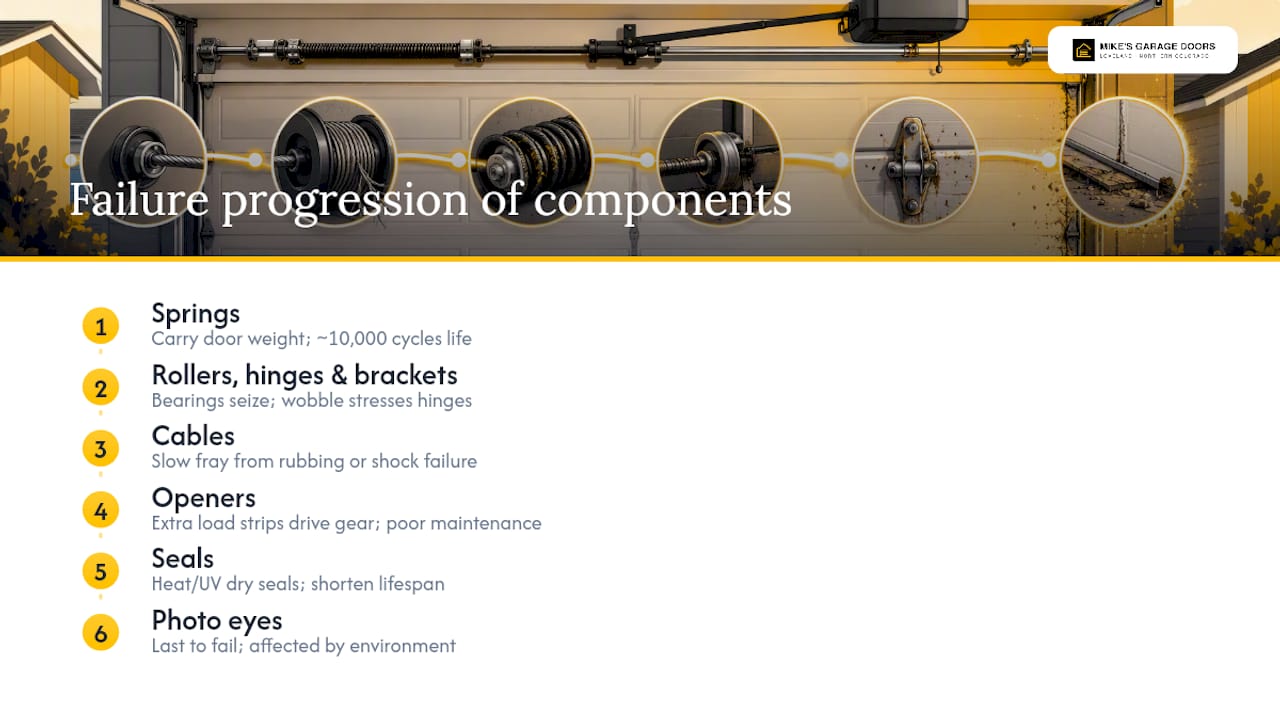
Springs carry almost the entire weight of your door. Standard torsion springs are rated for about 10,000 open-close cycles, roughly seven years at four uses a day, and every cycle adds microscopic fatigue cracks to the coil. Those cracks grow non-linearly, meaning a spring that looks fine on Monday can snap on Friday with almost no warning.
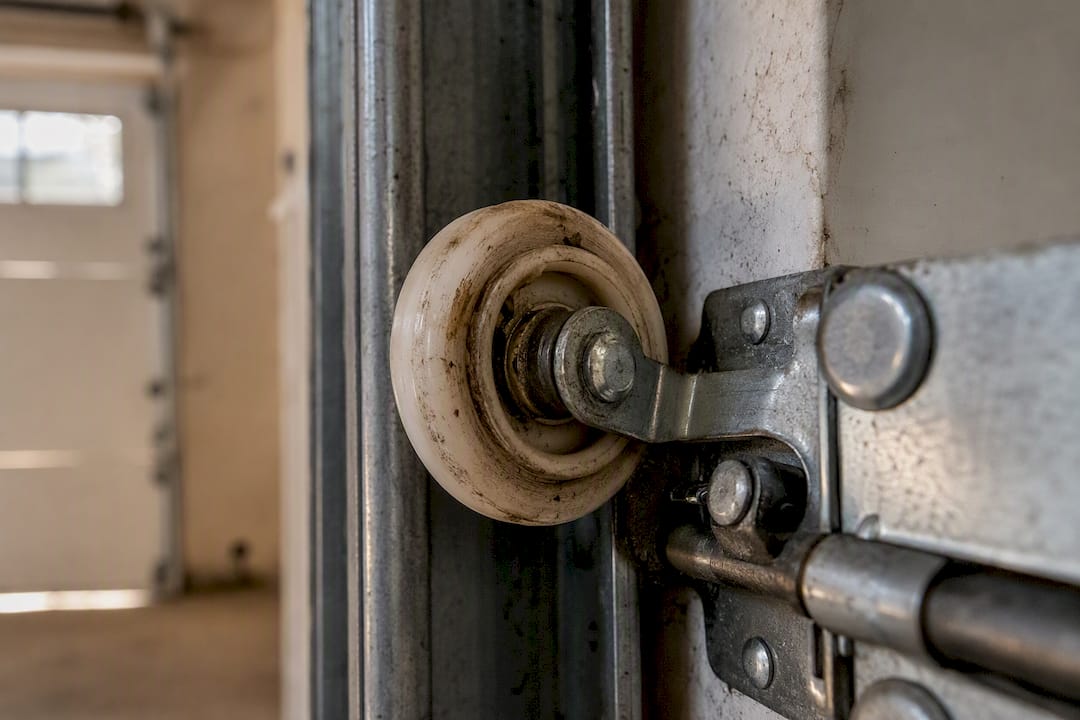
Rollers and hinges take the next hit. Nylon and steel rollers ride on bearings that dry out without regular lubrication, and once a bearing seizes, the roller starts wobbling instead of rolling smoothly through the track. That wobble stresses the hinges holding each panel together, and over time you'll see cracked rivets or bent hinge leaves, especially at the top and bottom panels where stress concentrates.
Cables usually fail one of two ways: slow fraying from rubbing against a misaligned drum, or sudden shock failure the instant a spring breaks and dumps all that tension onto the cable in a fraction of a second. Frayed cables give you warning. Shock failures don't.
Openers absorb the consequences of everything upstream. A door that's out of balance or dragging against a bent track forces the opener's motor and gears to work harder on every cycle, and that extra load strips the nylon drive gear far faster than normal use would. Poor maintenance and lack of lubrication account for a large share of these premature failures.
Weather compounds all of it. Cold contracts steel and thickens old lubricant, heat and UV dry out seals and weaken plastic components, and humidity feeds corrosion on any unprotected metal part. None of these are the primary cause of failure, but they all shorten the timeline.
Monthly Checks That Catch Wear Before It Becomes a Repair Bill
You don't need tools or training to catch most warning signs early. These checks take about ten minutes a month and tell you exactly when it's time to call a professional.
- Balance test. Disconnect the opener, lift the door halfway by hand, and let go. A balanced door stays put. If it drifts up or crashes down, the spring tension is off and you should stop and call a pro.
- Auto-reverse test. Place a block of wood on the ground under the door and close it. The door should reverse immediately on contact. If it doesn't, the safety sensors need attention right away.
- Photo-eye check. Look at the two small sensors near the bottom of the tracks. They should be aligned and free of dust, cobwebs, or a knocked-out angle.
- Listen. A squeak usually means dry hinges or rollers. Grinding suggests a bearing or track problem. A loud bang or pop can mean a cable has slipped or a spring coil has separated.
- Look. Check spring coils for visible gaps, inspect cables for frayed strands, and run a hand along weatherstripping for cracking or stiffness.
Pro Tip: Take a photo of your spring coils and cables every few months. Side-by-side comparisons make it much easier to spot gradual gapping or fraying that's easy to miss in the moment.
Building a Maintenance Routine That Actually Prevents Wear
Lubrication is the cheapest insurance you'll ever buy for a garage door. Use a silicone-based spray or white lithium grease on every moving metal part, and skip WD-40 entirely. It strips existing grease, evaporates fast, and leaves parts more exposed to grit than before you sprayed it. Petroleum-based greases have the same problem: they attract dust and debris that grinds down bearings over time.
Apply lubricant at these points:
- Roller stems and bearings
- Hinge pivots on every panel
- Spring coils, using a light coat only
- Bearing plates at each end of the torsion bar
Keep the inside of your tracks clean and dry; for more details on caring for overhead components, see these maintenance tips for gates. Never lubricate them. Grease inside a track makes rollers slide instead of roll, which accelerates wear rather than preventing it.
On cadence: do your quick visual and sound checks monthly, lubricate moving parts every three to six months depending on how often you use the door and how harsh your climate is, and book an annual professional inspection no matter how well the door seems to be running.
If your door cycles more than the typical four times a day, whether it's a busy family household or a commercial bay door, a high-cycle spring rated for 25,000 to 50,000 cycles usually pays for itself by cutting your replacement frequency by two to five times over. Standard replacement costs run into a modest repair bill; high-cycle springs cost more upfront but save you from repeat visits.
While you're at it, tighten any loose bolts or brackets, check weatherstripping for gaps, and clear leaves or debris from the track before they jam a roller.
Pro Tip: Set a phone reminder tied to the change of seasons rather than a fixed date. Spring maintenance right before summer heat and again before winter cold catches the two conditions that stress components the most.
When a Professional Needs to Take Over
Never attempt to wind, adjust, or replace a torsion spring yourself. These springs hold enough stored tension to cause serious injury or worse if they release uncontrolled, and this isn't a job for a determined DIYer with a wrench.
Call a professional immediately if you notice:
- A visible gap or separation in the spring coil
- The door suddenly feels much heavier to lift by hand
- Frayed strands on either lifting cable
- The door has jumped off its track
- The auto-reverse safety test fails
A proper professional inspection checks spring tension and cycle wear, cable condition, track alignment, opener force settings, and hardware tightness in a single visit, catching the small issues before they cascade into the next component. Eddie, who covers garage door maintenance for Mikes Garage Doors Loveland, Colorado, notes that catching a worn roller during an annual visit is a lot cheaper than replacing the cable it eventually frays.
How Usage Patterns Wear Down Your Door Faster Than Age Does
Cycle count matters more than calendar age. A door opened and closed 15 times a day burns through its 10,000-cycle spring rating in under two years, while a door used four times daily takes roughly seven years to hit the same mark. Property managers running commercial bays, households with multiple drivers, and homes with a gym in the garage often underestimate how fast those cycles add up.
Improper use compounds the math. Hitting the remote before the door fully opens, holding the wall button down against resistance, or repeatedly reversing mid-cycle all add extra stress load beyond a normal cycle. Kids treating the garage door button like a toy is a common, avoidable source of wasted cycles.
Frequent use without matching maintenance is where most premature failures start. If you're cycling the door more than average, shift your lubrication schedule from every six months to every three, and consider a high-cycle spring upgrade instead of waiting for two or three standard replacements to add up.
Why Door Material and Weight Determine How Fast Parts Wear Out
Heavier doors put more strain on every component in the system. Solid wood and thick insulated steel doors offer better durability and energy efficiency, but they demand correctly sized springs and heavier-duty rollers and hinges to match that weight.
A door installed with springs sized for a lighter panel wears out fast because the opener and hardware are constantly overworking to compensate. This is a common problem after a homeowner upgrades to a heavier insulated door without upgrading the spring system.
Material quality affects wear independently of weight. Cheap stamped steel panels dent and warp more easily, throwing off door alignment even when springs and rollers are in good shape. Higher-grade steel, properly reinforced wood, and quality composite panels resist warping and hold their shape through temperature swings, which keeps the whole system running smoother for longer.
How Track and Hardware Misalignment Accelerates Wear
A door that's even slightly out of alignment forces every component to compensate. Misaligned tracks make rollers ride at an angle instead of straight through the channel, and that sideways pressure wears out roller bearings and wheel edges far faster than straight-line travel would.
Loose brackets and hinges make the problem worse. Once a hinge shifts even a small amount, the panel above and below it no longer sits flush, and the door binds slightly on every cycle. That binding forces the opener to pull harder, which strains the drive gear and motor.
Track misalignment often traces back to a bent section from an impact, like a car bumper clipping the bottom track, or gradual loosening of the mounting brackets over years of vibration. Checking that brackets are snug against the frame and that both tracks run perfectly parallel catches this early, before rollers start grinding instead of gliding.
How Rust and Corrosion Break Down Metal Parts Over Time
Corrosion attacks the metal components your door depends on most: springs, cables, hinges, and track hardware. Rust doesn't just look bad. It weakens metal at a structural level, and a corroded spring coil or cable strand can fail without the gradual warning signs you'd normally catch during a visual check.
Humidity and exposure to moisture, whether from a leaky roof, a garage that floods slightly during storms, or coastal salt air, speed up the process significantly. Cold weather compounds the issue further, since low temperatures make aged, corroded steel more brittle and more likely to snap on a frosty morning rather than a warm afternoon.
Wiping down exposed hardware, keeping the garage dry, and addressing any rust spots with a wire brush and rust-inhibiting spray before they spread protects your investment. Once corrosion sets into a spring coil, replacement is the only safe option. There's no fixing rust in a component under that much tension.
The Real Cost of Slamming, Forcing, or Rushing Your Door
How you operate your door day to day matters as much as how well you maintain it. Slamming a door shut sends a shock impact through the panels, hinges, and bottom bracket that ordinary operation never produces, and repeated slamming loosens fasteners and cracks hinge rivets over time.
Forcing a door that's stuck or binding is worse. If a door meets resistance from a misaligned track or a failing roller and you push the opener anyway, you're asking the motor to overpower a mechanical problem instead of fixing it. That's exactly how a strained opener turns into a stripped gear or a snapped cable.
Manually forcing a door that won't budge, rather than checking for an obstruction or a spring problem first, is one of the fastest ways to turn a $150 roller replacement into a full spring-and-cable repair. Treat resistance as information, not an obstacle to push through.
What Homeowners Get Wrong About Preventing Door Wear
Most maintenance advice treats every component as equally urgent, and that's backwards. The technician-observed failure order matters because it tells you where to spend your attention first: springs, then rollers, then cables, then the opener. Skip straight to buying a fancy opener upgrade while ignoring a spring nearing its cycle limit, and you've solved the wrong problem.
The bigger gap in conventional advice is treating balance checks as optional. An out-of-balance door doesn't just strain the spring. It quietly overworks every part downstream, and by the time you notice the opener struggling, you're often looking at a multi-part repair instead of a single spring swap. If you only do one thing after reading this, make it the monthly balance test. It's the cheapest early-warning system you have, and it catches the problem at the point where a fix is still simple.
Sources
- High-cycle torsion springs — Garage Door Guide
- Which garage door part fails first — Garage Door Science
- How to properly lubricate garage door components — Clopay
- How often does my garage door need to be serviced? — Wayne Dalton
FAQ
What is the most common cause of garage door wear?
Spring fatigue is the most common cause. Standard torsion springs are rated for about 10,000 cycles, and once they weaken, rollers, cables, and the opener all take on extra stress.
How often should I lubricate my garage door?
Lubricate moving parts like rollers, hinges, and spring coils regularly, with frequency adjusted according to usage and local climate.
Can I replace a garage door spring myself?
No. Torsion springs hold significant stored tension and can cause serious injury during removal or installation, so this job should always go to a trained professional.
What does it mean if my garage door is unbalanced?
An unbalanced door means the spring tension no longer matches the door's weight, and it accelerates wear across the opener, cables, and rollers until it's corrected.
How do I know if my garage door needs a professional inspection?
Watch for a visible gap in the spring coil, a door that suddenly feels heavier to lift, frayed cables, or a failed auto-reverse test, all of which call for immediate professional attention.