
Metal fatigue is the main reason garage door springs break. Every torsion or extension spring is engineered for a set number of open and close cycles, usually around 10,000 cycles before the metal wears out from repeated stress. Rust, incorrect spring sizing, and extreme temperature swings all speed up that timeline, sometimes cutting years off a spring's life without you noticing until it snaps.
The good news: none of this happens overnight, and most of it is preventable. Here's what actually shortens spring life:
- Rust and corrosion eat into the coil surface and create weak points where cracks start.
- Wrong spring size or improper winding puts uneven stress on the metal from day one.
- Extreme heat and cold make steel expand and contract, which speeds up fatigue.
We'll walk through how springs work, rank the causes by how often we see them on service calls, and give you a maintenance plan that can add real years to a spring's working life.
Key Takeaways
Garage door springs break primarily from metal fatigue tied to cycle count, a process that rust, incorrect sizing, and extreme temperatures all speed up significantly.
| Point | Details |
|---|---|
| Primary cause | Metal fatigue from repeated cycling, typically rated around 10,000 cycles for torsion springs. |
| Top accelerants | Rust and corrosion, improper installation or sizing, and extreme temperature swings all shorten spring life. |
| Early warning signs | Visible coil gaps, uneven door travel, a heavy-feeling door, and unusual opener strain signal a weakening spring. |
| Safety first | Never use the opener or attempt to adjust a spring after failure; a broken spring can damage the motor and cause injury. |
| Call a professional | Mikes garage doors Loveland colorado offers same-day spring replacement with upfront estimates and warranty-backed repairs. |
Table of Contents
- How Garage Door Springs Work and Why Cycles Matter
- What Are the Top Causes of Garage Door Spring Failure?
- What Are the Warning Signs of a Failing Spring?
- Why Do Springs Fail Before Every Other Garage Door Part?
- How Do You Prevent Garage Door Spring Failure?
- What Should You Do the Moment a Spring Breaks?
- When Should You Replace Garage Door Springs?
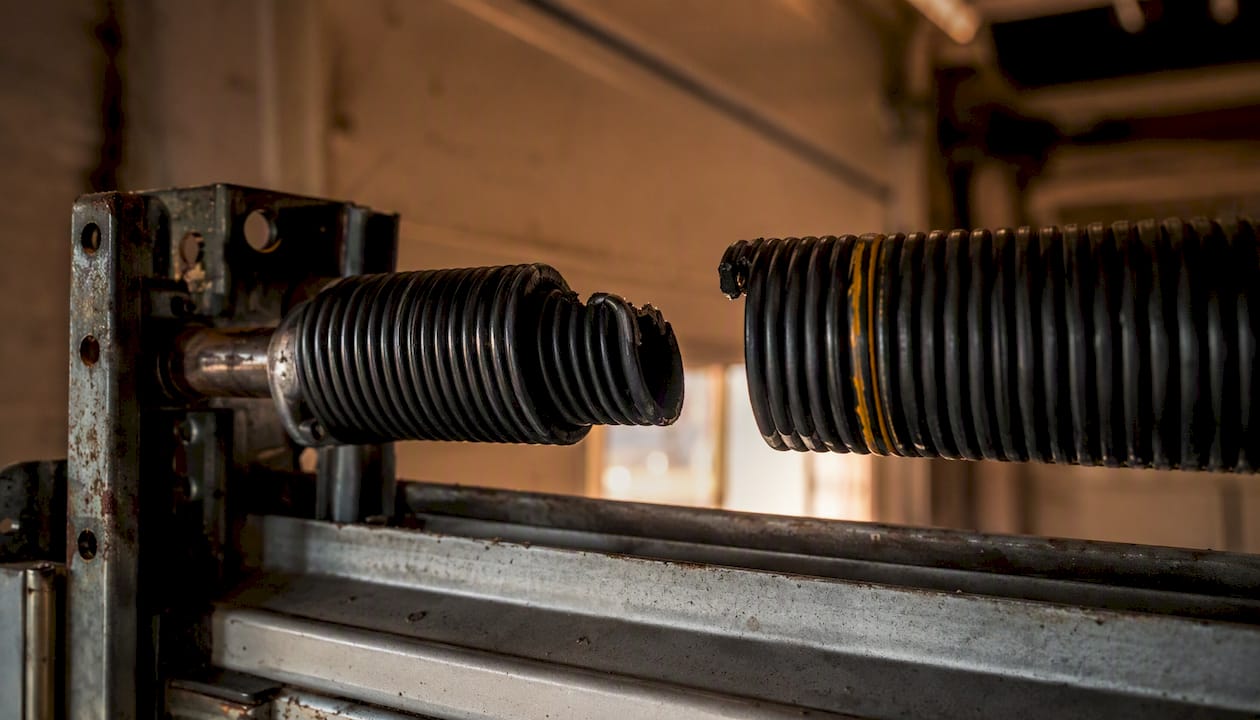
- What Springs Actually Look Like After Years on the Job
- When Should You Call a Professional for Spring Work?
- Sources
- FAQ
How Garage Door Springs Work and Why Cycles Matter
Your garage door runs on stored energy, not muscle. Torsion springs mount horizontally above the door on a metal shaft and twist to store energy, releasing it in a controlled turn that lifts the door evenly. Extension springs stretch along the horizontal tracks on either side of the door, storing energy by pulling apart rather than twisting. Picture a torsion spring as a tightly wound clock spring and an extension spring as a stretched rubber band. Both do the same job of counterbalancing the door's weight, just with different mechanics.
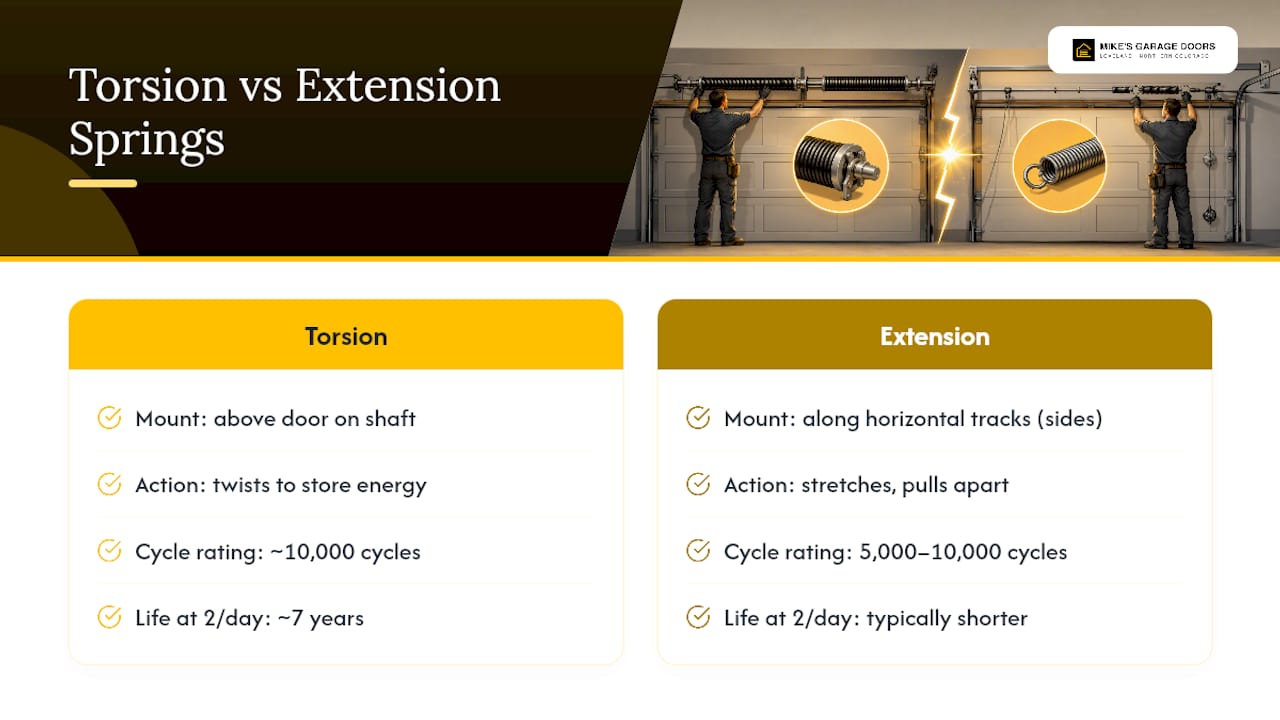
A "cycle" means one full open-and-close movement of the door. That single number, cycle count, is the best predictor of when a spring will fail, more useful than calendar age. A standard residential torsion spring is rated for roughly 10,000 cycles, which works out to about seven years if you open your garage door twice a day. Run the door six or eight times daily because it doubles as your main entrance, and that same spring might only last two or three years.
Extension springs tend to wear out faster. They're typically rated for 5,000 to 10,000 cycles, and technicians generally consider them riskier if they fail, since a broken extension spring can send a coil flying if it isn't fitted with a safety cable. For a closer look at where each type sits on your door and how the mechanics differ, our guide to garage door spring types breaks it down further.
Quick stat: A door used four times a day burns through a 10,000-cycle spring in roughly three and a half years, half the life you'd get from typical two-cycle-a-day use.
What Are the Top Causes of Garage Door Spring Failure?
Springs rarely fail for just one reason. Usually it's a primary driver, cycle fatigue, combined with one or two accelerants that push a spring past its breaking point sooner than expected. Here's how we rank the causes we see most often, from most to least common.
- Normal wear and metal fatigue. Every open and close cycle flexes the steel a tiny bit. Over thousands of cycles, microscopic cracks form at stress points, usually where coils touch each other or where the spring connects to its end fittings. Eventually one crack grows large enough that the spring snaps, often without warning.
- Corrosion and rust. Moisture, whether from humidity, snowmelt, or a leaky garage roof, eats into the coil surface. Rust doesn't just weaken metal evenly. It creates pits that concentrate stress in one spot, and fatigue cracks tend to start at those pits far sooner than on clean steel.
- Improper installation or incorrect sizing. A spring rated for a lighter door, or wound with the wrong number of turns, works harder than it should on every single cycle. That mismatch shows up as premature failure, often within the first year or two.
- Lack of lubrication. Dry coils rub against each other every time the spring moves, creating friction and heat that accelerates wear at contact points.
- Door imbalance. If your door is out of balance, one spring compensates for the other, wearing unevenly and failing early.
- Extreme temperature swings. Steel contracts in cold weather and expands in heat, and repeated swings between the two add mechanical stress on top of normal cycling.
- Manufacturing defects. Rare, but a flaw in the steel or a poor weld at the end fitting can cause failure well before the expected cycle count.
- Physical damage. A door slammed shut, a car backing into a closed door, or a DIY adjustment gone wrong can nick or bend a spring in ways that create instant weak points.
Pro Tip: Run your hand carefully along a torsion spring's coils (door closed, opener disconnected) and look for shiny, worn patches where coils rub together. That's early coil-contact wear, and it's a sign the spring is aging faster than its cycle count alone would suggest. If you use your garage door more than four times a day, ask about high-cycle springs when it's time to replace, they're built with thicker wire and more coils specifically for heavy use.
What Are the Warning Signs of a Failing Spring?
Springs rarely fail silently. Most give off warning signs for weeks or months before they actually break, if you know what to watch for.
- A loud bang from the garage, often described as sounding like a gunshot, usually means a spring has already snapped.
- A visible gap in the coils of a torsion spring, where the metal has separated, is a clear sign of failure.
- The door feels unusually heavy when you lift it manually or the opener strains more than normal.
- The door travels unevenly, one side rising faster than the other, or it jerks and slams instead of moving smoothly.
- Cables look frayed or loose near the bottom brackets.
- The opener motor runs longer or louder than usual, straining to lift a door it's not designed to carry alone.
Safety warning: A broken spring means the opener has to lift the full weight of the door, often 130 to over 400 pounds, on its own. That mismatch can burn out the motor, strip the gears, or damage the drive system, turning a spring repair into a spring-plus-opener repair.
Treat a sudden loud snap or a door that's stuck half-open as urgent. Don't try to force the door up or down. Our breakdown of warning signs your spring is about to snap covers what each symptom typically means and how much time you have before it becomes a full failure.
Why Do Springs Fail Before Every Other Garage Door Part?
Service records back up what technicians see every week: springs top the list of garage door failures by a wide margin, ahead of rollers, cables, opener components, hinges, and photo eyes. Once you understand the mechanics, that ranking makes sense. Springs are the only component under constant, high-magnitude stress every single time the door moves, which puts them ahead of the failure curve compared to parts that only bear load intermittently.
Fatigue failure follows a predictable pattern. A microscopic crack starts at a stress concentrator, usually a spot where coils touch each other or where the wire bends into an end fitting. Each cycle grows that crack a tiny bit. Corrosion and thermal cycling accelerate the process, meaning a rusted spring in a garage with big day-to-night temperature swings can fail at a fraction of its rated cycle count.
A documented failure analysis of a fractured extension spring found rust bands and multiple crack initiation sites on the spring's hook, cracks that started independently, then grew and merged until the metal gave way in a sudden, fast fracture rather than a slow tear. The case illustrates exactly why corroded springs fail with little warning: the damage builds invisibly for months before the final break happens in an instant.
Once a spring fails, the damage doesn't stay isolated. The opener takes on load it was never built for, cables can snap under sudden slack-then-tension shifts, and rollers wear faster as the door travels unevenly through the tracks. That's why one broken spring often turns into a multi-part repair if it sits too long.
Pro Tip: A balance test is the single highest-leverage maintenance check you can do. Disconnect the opener, lift the door halfway by hand, and let go. A balanced door stays put. If it drifts up or falls down, the springs are compensating unevenly, and that's often the first measurable sign of trouble, well before you hear a bang.
How Do You Prevent Garage Door Spring Failure?
Springs will eventually wear out no matter what you do. Fatigue is built into the physics. But a consistent maintenance routine can push a spring closer to its full rated cycle life instead of losing years to rust, friction, and imbalance.
Monthly:
- Visual inspection of coils for rust, gaps, or shiny wear spots.
- Check cables for fraying near the bottom brackets.
Seasonally:
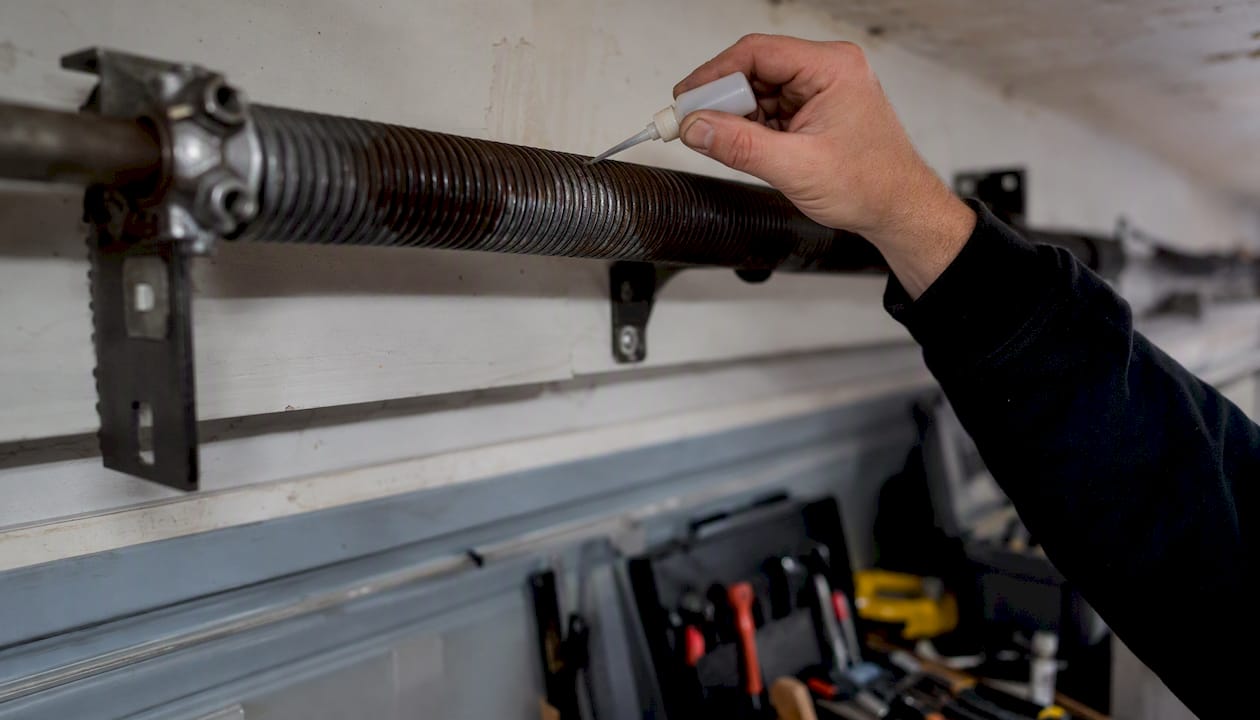
- Lubricate springs, hinges, and rollers.
- Tighten any loose hardware, brackets, and bolts that vibrate loose over time.
Annually:
- Schedule a professional balance test and full-system inspection.
- Check tracks and rollers for wear that could be putting extra strain on the springs.
- Wipe down visible coils and apply lubricant.
- Run the balance test described above.
- Inspect all mounting hardware for looseness.
- Check for track misalignment that could be causing uneven door travel.
- Call a technician if the door fails the balance test or shows any warning signs.
If you use your garage door heavily, several times a day as a main entry point, ask about high-cycle springs. They use thicker wire and more coils than standard springs, which can extend service life well beyond the standard 10,000-cycle baseline. In humid or coastal climates, corrosion-resistant coatings are worth the small upcharge, since rust pitting is one of the fastest ways to shorten spring life. If you're in a region with harsh winters, our Colorado winter prep guide covers steps that protect springs and hardware from cold-weather stress specifically.
Pro Tip: Use a lithium-based garage door lubricant, not WD-40 or motor oil, which attract dust and grime that actually increase friction over time. Apply it directly to the coils and let it work into the metal, then wipe off any excess so it doesn't drip onto the floor or door panels.
For the basic checks you can safely do yourself, our DIY garage door service guide walks through exactly what's safe to handle solo and what to leave to a technician.
What Should You Do the Moment a Spring Breaks?
The first thirty seconds after a spring breaks matter. Here's what to do, and what not to do.
Don't:
- Don't use the garage door opener. Running it with a broken spring can burn out the motor since it's not built to lift the door's full weight alone.
- Don't attempt to wind or unwind the spring yourself. A torsion spring under tension stores enormous energy, and mishandling it has caused serious injuries.
- Don't stand or walk under the door if it's stuck partway open.
Do:
- Clear the area around the door and keep kids and pets away from the door path.
- If it's safe to reach, disconnect the opener from the door using the manual release cord, but only if the door is fully down or securely propped.
- Call a qualified technician for spring replacement rather than attempting the repair yourself.
- If you absolutely must move the door manually before help arrives, do it only with at least two adults supporting the weight evenly, and only if the door isn't already stuck or jammed.
A broken spring is inconvenient, but treating it carefully now prevents a much bigger repair bill later. For a deeper look at why this particular repair calls for a professional, see our piece on why spring replacement is urgent.
When Should You Replace Garage Door Springs?
Replace a spring as soon as it shows a visible gap, fails a balance test, or has already snapped. There's rarely a case for patching or repairing a broken spring. Once one fails, replacement is the only real option.
Most technicians recommend replacing both springs at the same time, even if only one broke. Matched wear means the surviving spring is usually close to the end of its own cycle life, and pairing an old spring with a new one creates imbalance that strains the opener, cables, and rollers all over again.
Several factors drive the cost of a replacement job:
- Spring type: torsion springs typically cost more per spring than extension springs, but last longer.
- Single vs. pair: replacing both at once costs more upfront but avoids a second service call months later.
- High-cycle upgrade: thicker-wire, higher-cycle springs cost more than standard-rated springs but reduce how often you'll need this repair again.
- Labor and travel: rates vary by region and by whether the job is same-day or scheduled.
- Parts and warranty: longer warranties on parts and labor typically add a bit to the upfront price but save money if something fails early.
Pro Tip: Ask for a written, itemized estimate before any work starts, one that separates parts, labor, and any add-ons, like high-cycle upgrades. A transparent quote over the phone, before a technician even shows up, is a strong sign you're dealing with a company that won't surprise you with hidden fees once the job is underway.
What Springs Actually Look Like After Years on the Job
Eddie here. After years of pulling apart garage door systems across Loveland and the surrounding area, a few patterns show up again and again. Winter brings a noticeable spike in spring failures, cold steel is more brittle, and the sudden temperature swings between a heated house and a freezing garage put extra stress on metal that's already fatigued. We also see accelerated wear in households that use the garage door as their main entrance. If you're pulling in and out four, five, six times a day instead of the typical two, you're compressing years of wear into a much shorter window.
What sets a good repair experience apart isn't complicated. It's showing up when we say we will, telling you the real cost before we touch anything, and standing behind the work. That's the standard we hold ourselves to at Mikes garage doors Loveland colorado, where 90% of repairs get completed the same day, estimates are given upfront and in full over the phone, and every job is backed by a solid warranty. Veterans get a 10% discount on top of that, because taking care of the people who've served the community matters to us.
Pro Tip: When a technician inspects your springs, ask them to walk you through the balance test results and show you exactly what they're seeing on the coils. A tech who's willing to explain what "worn" or "fatigued" actually looks like on your specific springs is giving you real information, not just a verdict.
When Should You Call a Professional for Spring Work?
Any repair involving a tensioned spring, torsion or extension, belongs in the hands of a trained technician. The stored energy in a wound torsion spring is significant enough that even experienced DIYers get hurt attempting this repair without the right tools. That's not a reason to panic. It's a reason to make one phone call instead of a trip to the hardware store.
When you're booking a spring repair, a few questions separate a reliable company from a risky gamble. Ask whether they offer same-day service, since a broken spring means your garage is essentially unsecured until it's fixed. Ask what warranty comes with the parts and labor. Ask whether they recommend replacing one spring or both, and why. And if your household runs the door heavily, ask whether a high-cycle spring upgrade makes sense for your usage pattern.
At Mikes garage doors Loveland colorado, we walk through all of that with you before we ever pick up a tool, transparent estimates over the phone, same-day repairs on 90% of jobs, and warranties that back the work we do. If a spring has already broken or you're seeing any of the warning signs covered above, visit our garage door services page to see what's included in a spring repair or schedule a technician to come take a look. Catching a weakening spring before it snaps is always the cheaper, safer route.
Sources
- Which garage door part fails first, and why it's almost always the same one · Garage Door Science
- Guide to Garage Door Spring Types & Lifespan - Raynor
- Why Garage Door Springs Break Explained
- Why Do Garage Door Springs Break? - ConsumerAffairs (cost & replacement guidance)
FAQ
Is it common for a garage door spring to break?
Yes. Springs are the most frequently replaced garage door part by a wide margin, since they're rated for a set number of cycles and eventually wear out from fatigue regardless of how well the door is maintained.
What's the average cost to replace a garage door spring?
Cost varies based on spring type, whether you replace one or both, and whether you choose a high-cycle upgrade; ask for a written estimate that breaks down parts, labor, and warranty coverage. Mikes garage doors Loveland colorado provides transparent phone estimates before any work begins.
What's the average lifespan of garage door springs?
Standard torsion springs are typically rated for around 10,000 cycles, roughly seven years at two cycles a day, while extension springs often last 5,000 to 10,000 cycles. Heavier daily use shortens both estimates.
Can I still use my garage door if the spring is broken?
No. Running the opener with a broken spring forces the motor to lift the door's full weight, which can burn out the motor and cause additional damage; keep the door closed and call a technician.