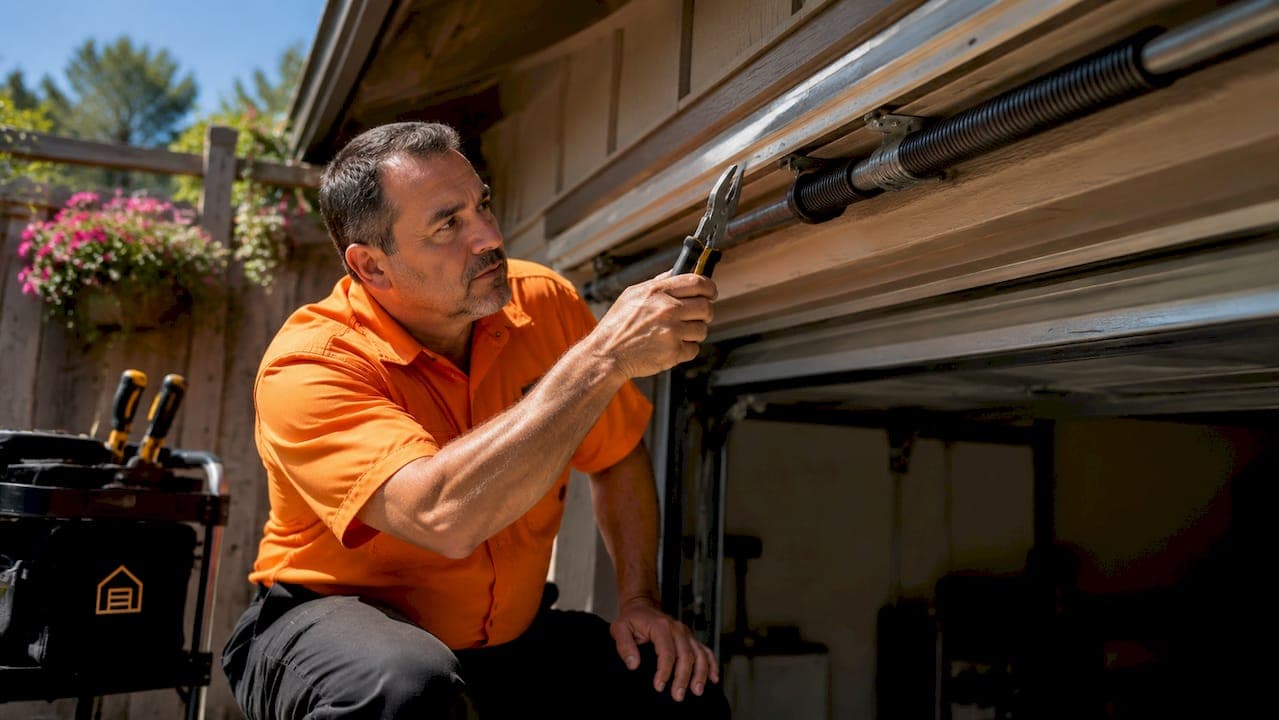
Garage spring replacement is urgent because a broken spring turns your 150–400 pound door into dead weight that your opener cannot safely lift. Over 2,000 injuries occur annually from garage door crush risks, and most of those emergencies trace back to spring failure. Randy Oliver, president of Hollywood-Crawford Door Co., confirms that broken torsion springs account for the majority of emergency service calls. When a spring snaps, the risk is immediate. Waiting is not a safe option.
Why garage spring replacement is urgent: the physics behind the danger
Garage door springs do not just assist the door. They carry the entire load. The opener motor is a secondary mechanism. It is the springs that counterbalance the door's weight and make lifting feasible at all.
When a spring breaks, that counterbalance disappears. Your opener must handle dead load it was never designed to carry. The motor strains, gears grind, and the door becomes unpredictable. A door that loses tension mid-travel can slam down without warning.
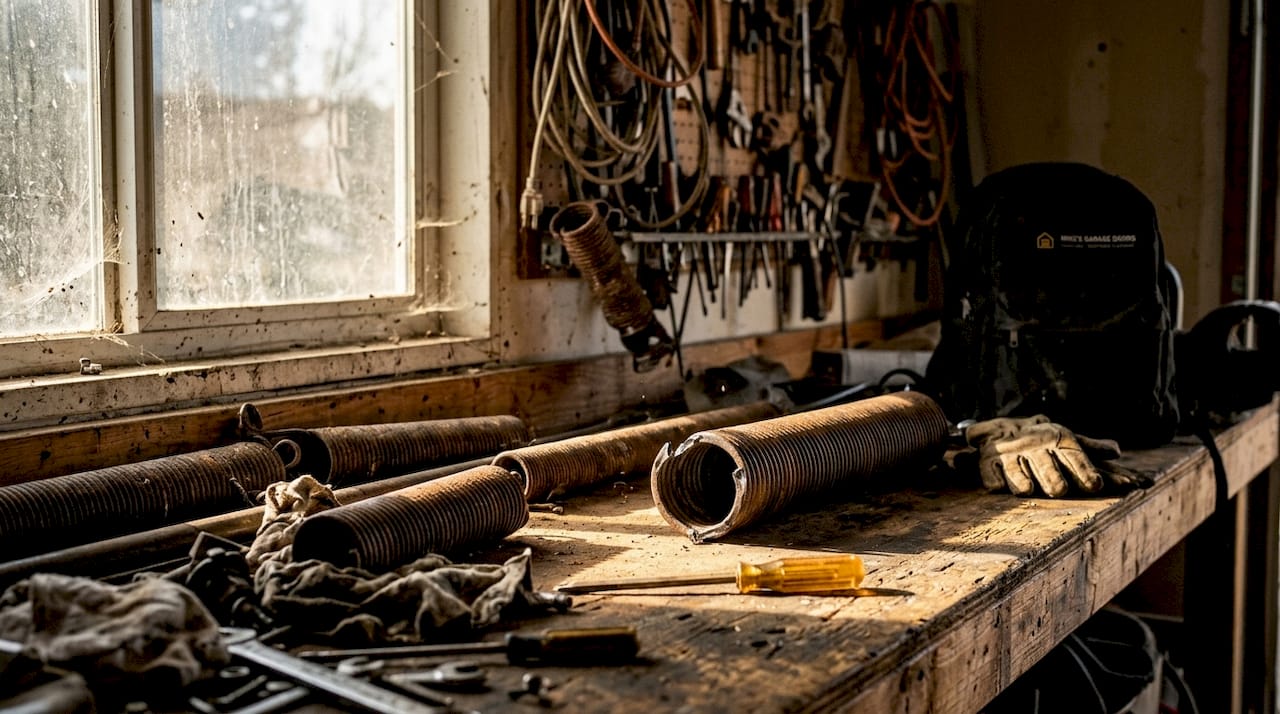
The crush risk is real and serious. A 200-pound door dropping on a person, a pet, or a vehicle causes severe harm. The danger is not theoretical. It is a mechanical certainty when springs fail and the door is still used.
Here is what breaks down when a spring fails:
- Door balance is lost. The door tilts or drops unevenly, stressing cables and rollers.
- Opener motor burns out. Forcing the opener to lift full door weight damages gears and motor, turning a spring repair into a much costlier opener replacement.
- Cables snap under strain. Unbalanced tension transfers to the lift cables, which can fray or break.
- Door slams without warning. A door held only by a damaged cable can drop suddenly, creating a crush hazard.
Any tensioned component at risk of moving on its own is an emergency. Treat a broken spring the same way you would treat a gas leak. Stop using the system and call a professional immediately.
Delaying repair does not just extend the risk. It increases overall repair costs disproportionately as secondary components fail from the added strain.
What are the signs your garage door spring needs replacement?
Most springs do not snap without warning. They give signals. Catching those signals early is the difference between a scheduled repair and an emergency call at midnight.
Watch for these warning signs:
- A loud bang from the garage. A snapping torsion spring sounds like a gunshot. If you hear it, the spring is already gone.
- The door feels heavy or moves unevenly. Springs carry the load. When they weaken, you feel it immediately when lifting manually.
- Visible gaps or rust on the spring coils. A gap in the coil means the spring has separated. Rust weakens metal and accelerates failure.
- The door reverses or stops mid-travel. Modern openers detect resistance. A struggling spring triggers the safety reversal.
- The opener runs but the door barely moves. The motor is working. The spring is not.
Pro Tip: Test your spring health by disconnecting the opener and lifting the door manually to waist height. A balanced door stays put. A door that drops or shoots up has a spring problem that needs professional attention.
Spring lifespan is measured in cycles, not years. Residential springs last about 10,000 cycles. That translates to roughly 7–10 years for a household using the door twice a day. Homeowners who use the garage as their primary entrance cycle through that lifespan much faster. You may hit the danger zone in four or five years without any obvious warning symptoms.
Cold temperatures make metal brittle and contract, which is why many spring failures happen in winter, often without prior warning. In Northern Colorado, where Loveland winters are genuinely cold, this risk is not abstract.
If one spring breaks, replace both. Industry consensus is clear: if one spring has reached failure, the other is close behind. Replacing both at once saves money and prevents a second emergency call within months.
Why is DIY garage spring repair so dangerous?
Garage springs store a tremendous amount of mechanical energy under tension. That energy does not disappear when the spring breaks. It stays coiled, waiting to release. Touching a spring without the right tools and training is genuinely dangerous.
Springs can recoil violently, causing lacerations, broken bones, and facial trauma. A spring that releases suddenly becomes a projectile. Injuries from DIY attempts are not minor. They send people to emergency rooms.
Safe spring replacement requires:
- Specialized winding bars. Standard tools slip. Winding bars are designed specifically for the torque involved in torsion spring tension release.
- Proper anchoring of the door. The door must be secured so it cannot move during the repair.
- Correct spring sizing. Springs are rated by wire diameter, inside diameter, and length. An incorrectly sized spring creates new failure risks immediately.
- Training in tension release technique. Spring tension release is the most dangerous step in the repair. Professionals use specific winding bar techniques to control the release safely.
- Knowledge of cable and drum alignment. Replacing a spring without resetting cables and drums correctly causes the door to bind or drop.
The DIY garage spring repair guide from Mikes garage doors Loveland covers what homeowners can safely maintain themselves. Spring replacement is not on that list. The risk-to-reward ratio does not work in your favor.
What should you do immediately when a spring breaks?
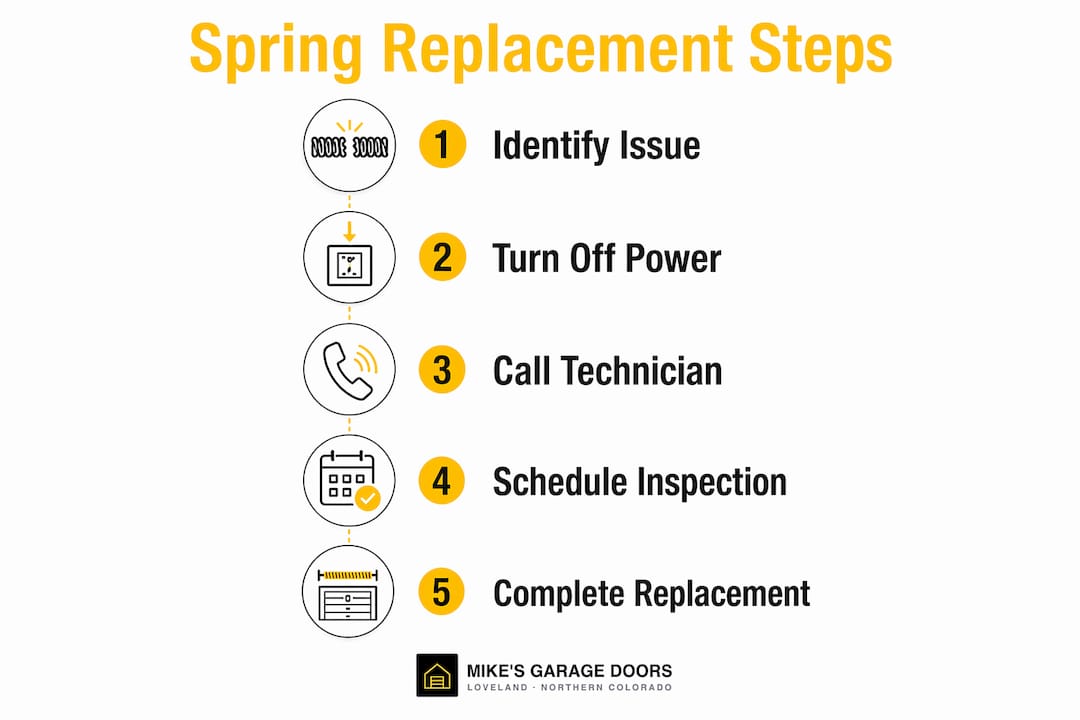
Speed matters, but panic does not help. Follow these steps in order.
- Stop using the opener. Every cycle you run with a broken spring risks burning out the motor. Opener replacement costs far more than spring replacement.
- Do not force the door open manually. A door without spring counterbalance is extremely heavy. Forcing it risks injury and cable damage.
- Secure your home another way. If the garage door is your primary entry point, use a side door or front door while the repair is pending. A door stuck open is a security risk.
- Call for emergency garage door repair. Do not wait until morning if the door is stuck open or partially open. Mikes garage doors Loveland completes 90% of repairs the same day, including spring replacements.
- Get a phone estimate before anyone arrives. Reputable services give you an upfront cost over the phone. You should not be surprised by the bill when the technician leaves.
Pro Tip: Take a photo of your existing spring before calling. The coil color, length, and wire thickness help a technician confirm the correct replacement spring before arriving, which speeds up the repair.
Replacing springs proactively before breakage prevents emergencies entirely. If your springs are older than seven years or you use the garage as your main entrance, schedule an inspection now. The cost of a planned replacement is always lower than an emergency call with secondary damage.
Key Takeaways
Garage spring replacement is urgent because a failed spring removes the counterbalance that makes a heavy door safe to operate, creating immediate crush risk and costly secondary damage.
| Point | Details |
|---|---|
| Springs carry the full load | The opener motor cannot safely lift a 150–400 pound door without spring counterbalance. |
| Delay multiplies costs | Operating a door with a broken spring burns out the opener motor, turning one repair into two. |
| Springs fail by cycles, not years | At 10,000 cycles, heavy users hit the danger zone in 4–5 years, not the expected 7–10. |
| Replace both springs at once | If one spring breaks, the other is near failure. Replacing both prevents a second emergency. |
| DIY repair causes serious injury | Spring tension release requires specialized winding bars and training. Leave it to professionals. |
What I've learned after years of spring calls
The homeowners who call us in a panic at 7 a.m. on a monday almost always say the same thing: "I heard a bang last night but figured it could wait." It never waits. A broken spring is not like a squeaky hinge you can ignore for a few weeks. The moment that spring goes, your door becomes a liability.
What surprises most people is how little they thought about the springs before failure. The door worked fine for years. Then one cold morning in january, it just stopped. That is exactly how springs behave. They do not slow down gradually. They cycle along quietly until they hit their limit, and then they snap.
The cost calculation is straightforward. A spring replacement handled promptly costs a fraction of what you pay when the opener motor burns out alongside it. I have seen homeowners try to save a few hundred dollars by waiting, only to spend three times that amount replacing the opener too. Proactive maintenance is not just safer. It is cheaper.
The other thing I want homeowners to understand: if your springs are more than seven years old and you use your garage door every day, you are likely close to that 10,000-cycle limit. You do not need to wait for a bang. Schedule an inspection. Catching a worn spring before it breaks is the best outcome for everyone.
— Eddie
Garage spring repair in Loveland, CO
When a spring breaks, you need someone who shows up fast and gives you a straight answer on cost before the work starts.

Mikes garage doors Loveland handles spring replacement and repair across Northern Colorado, with 90% of jobs completed the same day. You get an upfront estimate over the phone, no surprises on the bill, and technicians who carry the right springs on the truck. Veterans receive a 10% discount on all services. If your door is stuck or you suspect a failing spring, schedule your repair today and get it handled before it becomes an emergency.
FAQ
How do I know if my garage door spring is broken?
A loud bang from the garage, a door that feels extremely heavy, or a door that barely moves when the opener runs are the clearest signs. Visually inspect the spring for a gap in the coils, which confirms it has snapped.
Is it safe to use my garage door with a broken spring?
No. Operating the door with a broken spring risks burning out the opener motor and creates a crush hazard if the door drops unexpectedly. Stop using the opener immediately and call a professional.
How long do garage door springs last?
Residential springs are rated for about 10,000 cycles. For most households, that is 7–10 years, but heavy daily use shortens that lifespan significantly.
Why should I replace both springs if only one broke?
If one spring breaks, the other has the same wear history and is likely close to failure. Replacing both at once costs less than two separate service calls and prevents a second emergency.
Can I replace a garage door spring myself?
Garage spring replacement is not a safe DIY project. Springs store extreme mechanical energy, and improper handling causes lacerations, broken bones, and worse. Hire a trained technician with the proper winding bars and tools.
Recommended
- Garage Door Spring Tension Adjustment: 2026 Guide
- 5 Warning Signs Your Garage Door Spring Is About to Snap | Mike's Garage Door Repair Loveland
- Garage Door Services in Loveland, CO — Spring, Opener, Commercial & Custom
- Garage Door Repair vs. Replacement: When It's Time to Stop Patching | Mike's Garage Door Repair Loveland