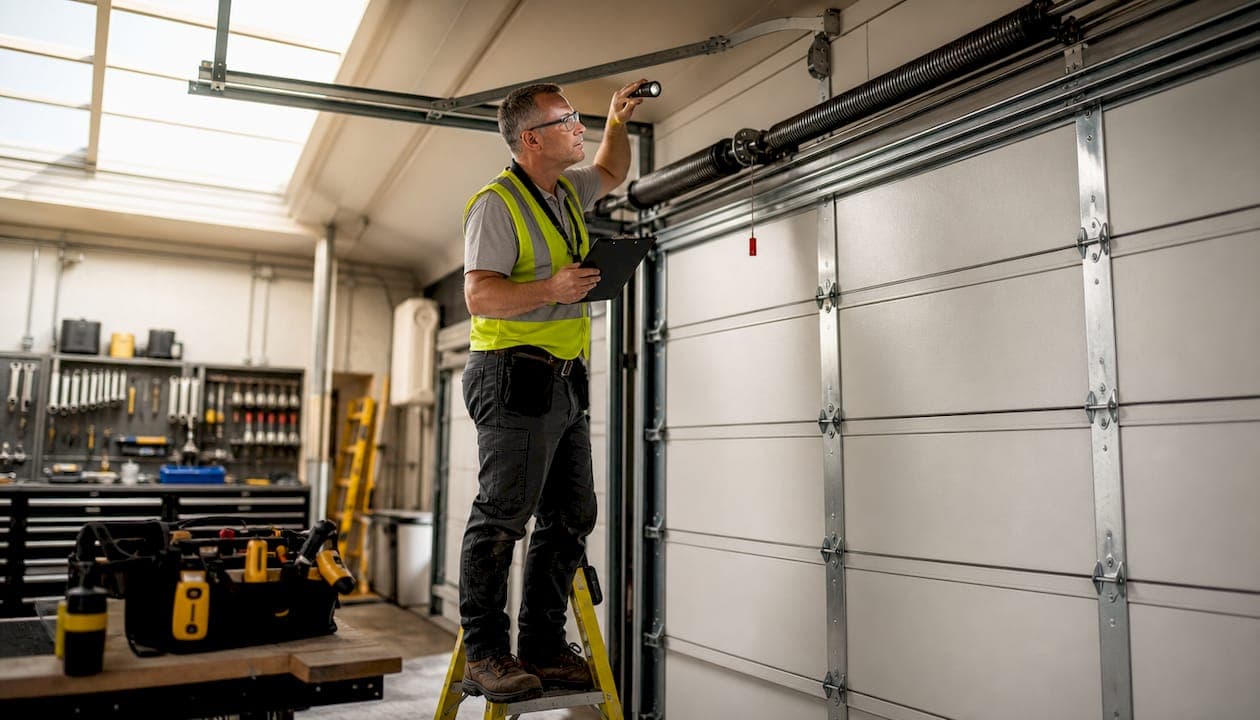
Scheduled commercial garage door maintenance is the practice of organizing regular, cycle-based inspections and services to keep doors operational and prevent costly downtime. A single jammed bay door can cost between $500 and $2,000 per hour in lost labor and shipping. That number alone makes preventive maintenance one of the clearest investments a property manager can make. This guide walks you through how to schedule commercial garage door maintenance based on your door's actual usage, what a professional visit covers, and how to choose the right service plan to protect your operations.
How to schedule commercial garage door maintenance by usage level
Maintenance frequency depends on how hard your doors work, not on a fixed calendar date. The industry standard, reinforced by 2026 commercial door service guidance, is a cycle-based approach. A "cycle" is one full open-and-close movement. Count your cycles per day, then match that number to a service interval.
Low-traffic doors operating under 10 cycles per day need service twice per year. Moderate-traffic doors running 10–30 cycles per day benefit from quarterly service. High-traffic doors at 30–50 cycles per day need service every other month. Severe-use doors exceeding 50 cycles per day require monthly attention.

| Usage level | Cycles per day | Recommended service interval |
|---|---|---|
| Light | Under 10 | Twice per year |
| Moderate | 10–30 | Quarterly |
| Heavy | 30–50 | Every 2 months |
| Severe | 50+ | Monthly |
Environmental factors shift these intervals too. A loading dock in Northern Colorado faces freeze-thaw cycles that stress springs and cables faster than a climate-controlled warehouse. Salt air near industrial facilities corrodes hardware at a faster rate. Adjust your schedule tighter when conditions are harsh.
Pro Tip: Most commercial door openers store a running cycle count on the control board. Check that number quarterly and compare it against your expected interval. If the count is climbing faster than your schedule assumes, move your next service date up.
What does a professional maintenance visit actually include?
A professional maintenance visit covers far more than a squirt of lubricant. The scope of a proper commercial door service visit includes mechanical, electrical, and safety system checks that most facility staff are not equipped to perform.
Here is what a certified technician addresses during a full visit:
- Balance test: The door is disconnected from the opener and lifted manually to the halfway point. A properly balanced door holds position. A door that drops or shoots up has a spring tension problem.
- Torsion spring inspection: Springs are checked for wear, corrosion, and correct tension. Standard torsion springs are rated for roughly 10,000 cycles. High-traffic sites should upgrade to 50,000 or 100,000 cycle springs to cut replacement frequency.
- Hardware torque check: Bolts, brackets, and roller stems are tightened to spec. Loose hardware causes misalignment and accelerates wear on tracks and panels.
- Lubrication: Springs, hinges, rollers, and tracks receive the correct lubricant. Grease and oil are not interchangeable here. The wrong product attracts debris and gums up moving parts.
- Safety sensor calibration: Photo-eye sensors are aligned and tested. Auto-reverse edge sensors are verified against ANSI/UL 325 force limits.
- Fire-rated door drop test: Where NFPA 80 applies, fire door drop tests confirm the door closes fully and latches under fusible link or electronic release.
- Cycle count documentation: The technician logs the current cycle count and any parts replaced. This record matters for insurance claims and warranty validation.
Pro Tip: Never let facility staff adjust torsion springs or cables. A wound torsion spring stores enough energy to cause a serious injury in under a second. That work belongs to a certified technician every time.
The documentation piece is easy to overlook but carries real weight. Proper maintenance records support insurance claims and keep warranties valid. A facility without service logs has a harder time recovering costs after a door failure causes property damage.
How do you choose a maintenance plan and contractor?
The right maintenance plan removes the guesswork from garage door upkeep and replaces it with predictable costs and faster response times. Preventive maintenance contracts reduce emergency service calls by roughly 70% and cut operational downtime by more than 80% within the first contract year. Those are not small numbers for a facility running multiple bays.
Cost is the most common objection to signing a service contract. A standard commercial tune-up runs $100–$120 per door, with multi-door discounts available from most contractors. Compare that to emergency call pricing. Parts and labor on an ad hoc emergency call can run 1.5 to 2 times the standard rate. One emergency visit can cost more than a full year's contract.
Response time is the other factor that separates contract holders from everyone else. Service contracts typically guarantee priority dispatch with a 2-hour response during business hours. Non-contract emergency calls average 4–8 hours. For a distribution center or manufacturing facility, that gap is the difference between a manageable delay and a full production stoppage.
Before signing with any contractor, ask these four questions:
- Are your technicians certified and insured for commercial door work?
- What is your guaranteed response time for contract holders?
- Do your contracts include locked-in parts pricing?
- Do you provide written documentation after every visit?
A contractor who cannot answer all four clearly is not the right fit for a commercial facility.
How to implement a recurring garage door inspection schedule
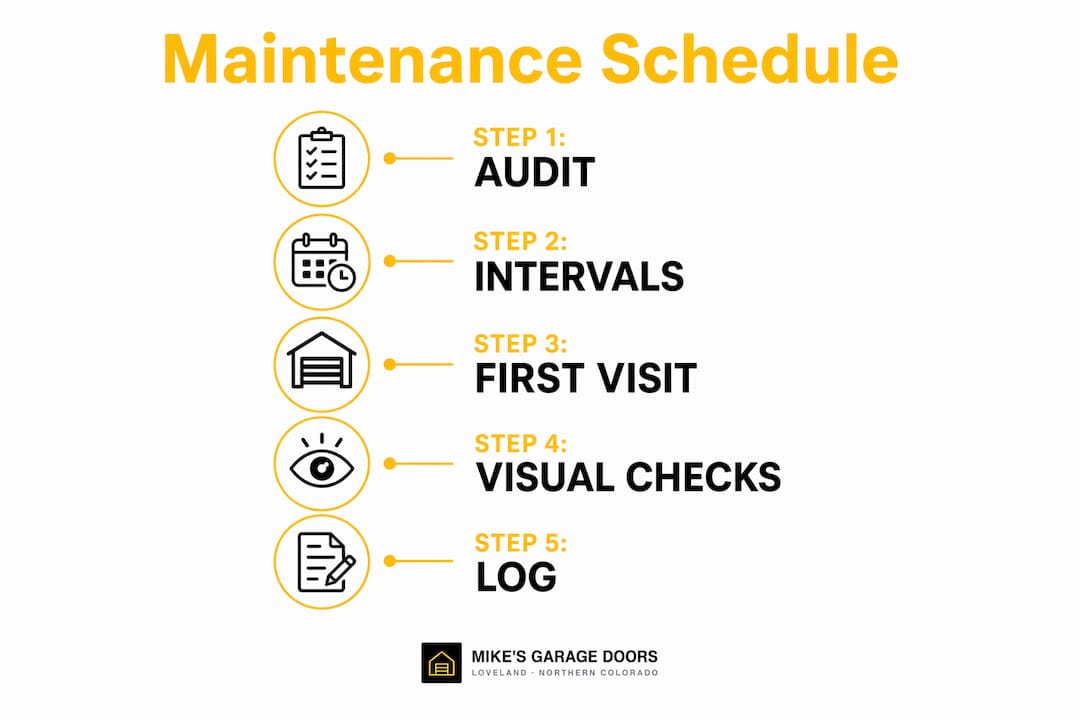
Setting up a recurring maintenance routine takes one afternoon of planning and pays off for years. The process is straightforward when you break it into stages.
Step 1: Audit your doors
Walk every bay and count the doors. Note the door type (sectional, rolling steel, fire-rated), the approximate age, and any known issues. This audit becomes the foundation of your service contract and helps the technician prioritize during the first visit.
Step 2: Establish service intervals
Use the cycle-based table from the usage level section above. Assign each door a service interval and enter those dates into your facility management calendar. Block the time at least two weeks in advance so you can coordinate around shift schedules.
Step 3: Schedule the first professional visit
Contact a qualified contractor and book the initial inspection. The first visit establishes a baseline: cycle counts, spring condition, hardware torque readings, and sensor calibration status. Everything after that is measured against this baseline.
Step 4: Assign monthly visual checks to facility staff
Facility staff should perform monthly visual inspections between professional visits. These checks take about five minutes per door and catch problems early.
Monthly staff checklist:
- Listen for grinding, popping, or scraping sounds during operation
- Check for visible cable fraying or spring corrosion
- Confirm photo-eye sensors are clean and aligned
- Test the auto-reverse by placing a 2x4 flat on the floor under the door
- Look for bent tracks, loose bolts, or cracked panels
Step 5: Keep a service log
Record every professional visit and every monthly staff check in a single log, whether digital or paper. Note the date, technician name, work performed, and any parts replaced. This log is your proof of compliance for insurance, warranty claims, and OSHA inspections.
Common scheduling mistakes to avoid: skipping service after a slow season (doors still cycle even when traffic drops), waiting for a visible problem before calling (most failures give warning signs weeks in advance), and letting staff handle anything beyond visual checks. The signs of a door needing repair are often subtle. A trained eye catches them before they become a $2,000 emergency.
Key Takeaways
A cycle-based commercial garage door maintenance schedule is the most reliable way to prevent downtime, control costs, and stay compliant with safety standards like NFPA 80.
| Point | Details |
|---|---|
| Match service intervals to usage | Doors running 50+ cycles per day need monthly service; light-use doors need twice per year. |
| Professional visits cover more than lubrication | Balance tests, torque checks, sensor calibration, and fire door drop tests are all part of a proper visit. |
| Contracts cut costs and response times | Service contracts reduce emergency calls by 70% and guarantee 2-hour priority dispatch. |
| Monthly staff checks fill the gaps | Visual inspections between professional visits catch early warning signs before they become failures. |
| Documentation protects your business | Maintenance logs support insurance claims, warranty validity, and regulatory compliance. |
What I've learned after years of commercial door calls
The property managers who call us in a panic almost always have one thing in common: they were waiting for something to break. I get it. When operations are running, maintenance feels like an interruption. But a torsion spring that snaps during a peak delivery window is not just a repair bill. It is a blocked bay, a delayed shipment, and a conversation with your operations director you would rather not have.
The cycle-based approach changed how I think about scheduling. A door at a busy distribution center does not age in months. It ages in cycles. A door running 60 cycles a day hits 10,000 cycles in under six months. That is the rated lifespan of a standard torsion spring. If you are still scheduling that door for twice-yearly service, you are already behind.
The upgrade that surprises most facility managers is the high-cycle spring swap. Moving from a standard 10,000-cycle spring to a 50,000 or 100,000-cycle spring at a busy loading dock is not glamorous, but it cuts downtime and reduces the frequency of emergency calls in a way that shows up clearly in the maintenance budget within the first year.
One more thing: do not send your maintenance staff after the springs or cables. I have seen what happens when someone tries to adjust a wound torsion spring without the right tools and training. The liability alone should be enough reason to keep that work with certified technicians. Monthly visual checks are exactly right for in-house staff. Everything else belongs to a pro.
— Eddie
Mikes garage doors Loveland: commercial maintenance built for your schedule
Commercial property managers across Northern Colorado trust Mikes garage doors Loveland for dependable, transparent garage door upkeep. The team handles everything from initial audits to recurring service contracts, with 90% of visits completed the same day you call.
Mikes garage doors Loveland provides upfront phone estimates with no surprise charges, so you know exactly what a commercial maintenance visit costs before the technician arrives. Certified technicians handle balance tests, spring inspections, sensor calibration, and fire door compliance checks. Veterans receive a 10% discount on all services. Whether you manage one bay or a full loading dock, the team builds a service plan around your hours and your budget. Reach out to schedule your first inspection and get a baseline on every door in your facility.
FAQ
How often should commercial garage doors be serviced?
Maintenance frequency ranges from twice per year for low-traffic doors to monthly for doors running more than 50 cycles per day. Match your service interval to actual cycle count, not a fixed calendar.
What does a commercial garage door maintenance visit cost?
A standard commercial tune-up runs $100–$120 per door, with multi-door discounts available. Emergency repairs without a service contract can cost 1.5 to 2 times that rate due to parts and labor premiums.
Can my facility staff perform garage door maintenance?
Staff should handle monthly visual inspections, including listening for unusual sounds, checking sensor alignment, and testing auto-reverse function. All high-tension spring and cable adjustments require a certified technician to avoid injury and liability.
What is NFPA 80 and does it apply to my doors?
NFPA 80 is the National Fire Protection Association standard governing fire-rated door assemblies. If your facility has fire-rated garage doors, annual drop tests and documentation are required to maintain code compliance.
Why do service contracts reduce downtime so significantly?
Preventive contracts catch failing components before they cause a full door failure. Contract holders also receive priority dispatch with typical 2-hour response times, compared to 4–8 hours for non-contract emergency calls.