Most residential sectional garage doors need about 10 to 12 inches of clear space between the top of the door opening and the ceiling or the lowest obstruction. If you have less, low-headroom track can work with as little as 4½ to 9½ inches, depending on the spring system. Below that, the header usually has to change. This guide shows you how to measure, which hardware fits which number, and when to call us before you buy a door.
TL;DR
- Standard extension-spring hardware needs about 10 inches of headroom, and standard torsion hardware needs about 12 inches, based on Clopay's installation chart.
- Low-headroom track kits run from about 4½ inches (extension springs) up to 9½ inches (front-mount torsion, per the same chart), so a tight space is rarely a dead end.
- Measure from the top of the opening to the lowest obstruction (pipe, beam, light, duct), not to the ceiling. Check at several points across the width.
- Headroom is only one of four measurements. Sideroom, backroom and opener space matter just as much.
- Not sure what you have? We give honest estimates over the phone, and most repairs are done the same day.
Table of Contents
- What headroom actually means
- How to measure your headroom
- Minimum headroom by hardware type
- Add the opener to the math
- The other clearances: sideroom and backroom
- When your garage does not have enough headroom
- Commercial doors need more room
- What we see in Loveland garages
- Perspective: why we measure before we quote
- Get it checked by people who do this daily
- FAQ
- Sources
What headroom actually means
Headroom is the clear vertical space above the closed door, measured up to the ceiling or the lowest thing in the way. The door's track curve, its springs and (later) the opener all fight for that space. That is why Clopay's buying guide points out that the lowest obstruction, not the nominal ceiling height, controls what you can install.
Think of it this way: a sectional door does not fly straight up. It rolls up a vertical track, curves through a bend, and then travels flat along the ceiling. The bend needs room. The tighter the bend, the less room it needs, but the harder the door works through it.
One more point from the manufacturers: ArmRLite defines headroom as the distance from the top of the opening to the lowest obstruction on the inside of the header wall, and says that number decides your track type and setup. It is the first measurement any installer takes.

How to measure your headroom
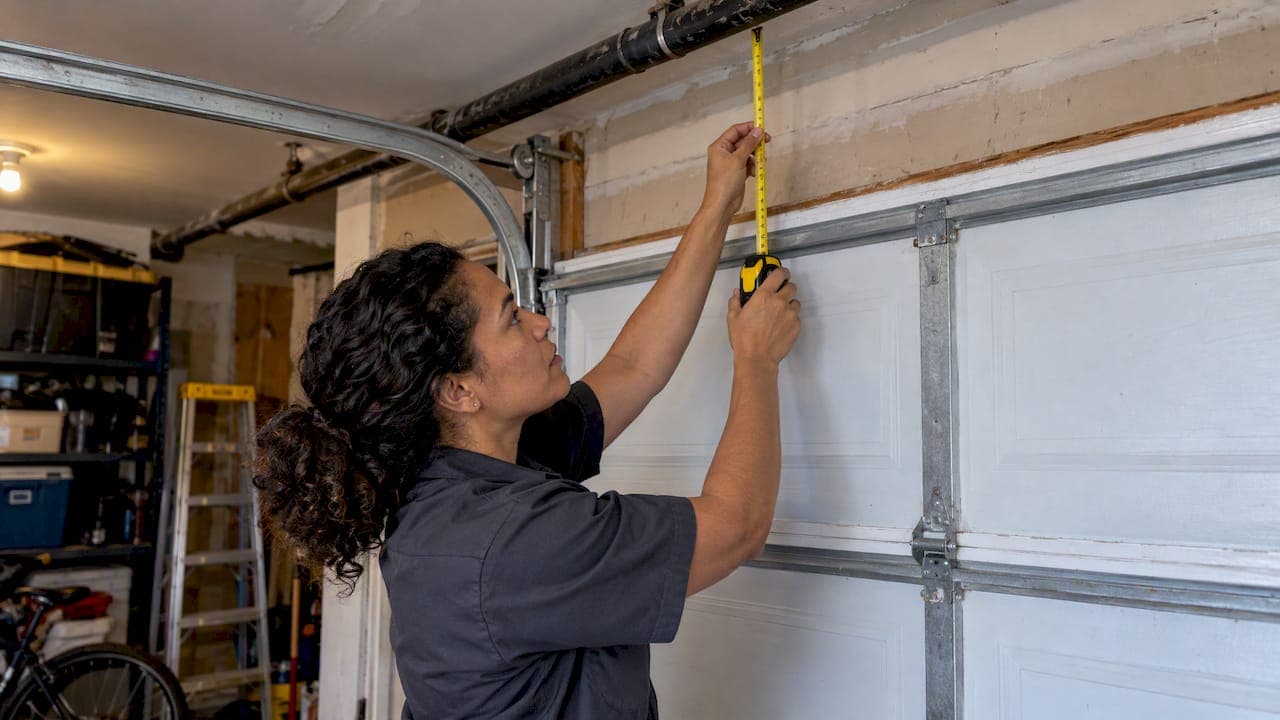
You need a tape measure, a ladder and about ten minutes. Close the door first.
- Stand inside the garage and find the top edge of the door opening.
- Measure straight up from that edge to the ceiling.
- Look for anything lower than the ceiling above the door: a joist, a beam, a water pipe, a light fixture, a duct, an existing opener rail.
- Repeat at the left, center and right of the opening. Clopay recommends checking several points across the width, because ceilings and framing are rarely perfectly level.
- Write down the smallest number. That is your usable headroom.
Do not measure from the floor, and do not use the garage's ceiling height printed on a floor plan. In Northern Colorado we see plenty of garages where a furnace vent, a sprinkler line or a utility pipe runs right across the top of the door. The ceiling might read 18 inches above the opening, but that pipe leaves you 7.
If you are measuring for a new door, Timberlane's measuring guide walks through the other numbers too: opening width between the inside edges of the trim, height from the top trim to the floor, sideroom from each trim to the side wall, and backroom from the opening to the rear obstruction.
Minimum headroom by hardware type
The number you need depends on the spring system and the track radius. The figures below come from manufacturer installation charts. Your door's manual is the final word, since models differ.
| Setup | Typical headroom needed | Source |
|---|---|---|
| Standard extension springs, 12-inch radius track | 10 inches | Clopay |
| Standard torsion springs (including EZ-SET) | 12 inches | Clopay |
| 15-inch radius track (extension / torsion) | 12 / 14 inches | Clopay |
| Low-headroom track for extension springs | 4½ inches | Clopay |
| Quick-turn bracket | 8 inches | Clopay |
| Front-mount low-headroom torsion | 9½ inches | Clopay |
| Rear-mount low-headroom torsion | 4½ inches | Clopay |
Other manufacturers publish slightly different numbers for their own hardware. LaForce's residential chart lists 10.5 inches for standard extension springs, 5 inches for low-headroom extension, 12 inches for standard torsion, 5 inches for rear-mount low-headroom torsion and 6.5 inches for the front-mount version. Amarr states that standard applications generally need 12 to 18 inches, while low-headroom track can fit a door with an opener in as little as 9½ inches.
So why the spread? Because "low headroom" is not one product. Each brand sizes its own track, brackets and spring placement. A garage with 6 inches might take one maker's low-headroom kit and not another's. That is a big reason to measure first and pick the door second.
A simple rule of thumb
- 12 inches or more: you can use standard torsion hardware, the most common setup on modern doors.
- About 5 to 12 inches: plan on a low-headroom system. Garaga's U.S. FAQ recommends a dual-track low-headroom system in the 4¾ to 12 inch range.
- Under about 4¾ inches: per the same FAQ, installation is not possible without raising the header. At that point, look at vertical-lift or other specialty track, or change the framing.
Add the opener to the math
An opener takes space too. Clopay's guide calls for roughly 3 additional inches of center headroom for an opener, plus extra backroom. Garaga says an electric operator adds 2 inches to standard-lift headroom requirements, and that its low-headroom system does not need that extra 2.
The practical takeaway: if your measured headroom exactly matches the door's minimum, you may fit the door but not a standard opener. Tell whoever is quoting the job that you plan to run an opener. If you are weighing an upgrade, our opener repair and installation service covers both fitting and troubleshooting, and we will check the clearance on site before anything is ordered.
The other clearances: sideroom and backroom
Headroom gets the searches, but a door can fail the fit test on any of four numbers. The Clopay chart gives these typical residential minimums:
- Sideroom: 3¾ inches on each side for vertical tracks, and 4½ inches on each side above the opening where torsion hardware attaches.
- Backroom: the door height plus 18 inches. LaForce lists door height plus 24 inches for its low-headroom configurations.
- Rough opening: it should match the door size, with the framing square and solid.
Backroom is where low-headroom kits bite. You trade vertical space for horizontal run. A 7-foot door under a low-headroom system needs a deeper garage than the same door on standard track. Measure from the opening straight back to the rear wall or any hanging storage, a ceiling-mounted rack or a parked-in work bench included.
Sideroom is the usual surprise in older homes. If a garage was framed tight to the door jamb, there may be no space for the track flag brackets. Fixing that means adding framing, which is a different kind of job.
When your garage does not have enough headroom
You have options before you give up on a sectional door.
Use low-headroom track
This is the most common answer. Rear-mount versions push the torsion spring shaft behind the door, which saves the most vertical room. Front-mount versions need a bit more. Extension-spring conversion kits are the cheapest route, but extension springs are a different safety profile than torsion, so read about the types of garage door springs before choosing.

We wrote a deeper walkthrough on this: low headroom garage doors and what a 4½ inch spec really tells you about whether the door fits.
Switch the track path
Amarr lists vertical-lift, follow-the-roof-pitch and high-lift tracks as alternatives for high ceilings, sloped ceilings, or installs where the door cannot retract horizontally in the usual way. A vertical-lift track runs the door straight up and stores it above the opening. That calls for lots of headroom, not little.
If your garage has a tall ceiling, a high-lift setup can raise the door's travel path so it clears a loft or a car lift. We cover that in high lift conversion, including how much space you need before hiring anyone.
Relocate the obstruction
Sometimes the fix is cheaper than special hardware. A pipe or duct can often be rerouted, and a light fixture can move. That is a call for a plumber, HVAC contractor or electrician, but the savings on the door side can pay for it. Never cut or notch a structural member to gain room. That is a job for a builder or engineer.
Raise the header
When the space is under the practical minimum, the header may need raising. It is a carpentry job, and in a load-bearing wall it is one that needs the right professional involved.
Commercial doors need more room
If you manage a shop, warehouse or multi-bay property, expect bigger numbers. Clopay's commercial chart lists 14½ inches of headroom for 12-inch-radius track and 16 inches for 15-inch-radius track, with siderooms of 4½ and 5½ inches. Low-headroom rear- and front-torsion configurations run from 6½ to 13 inches depending on the track.
Commercial doors are heavier and cycle more, so a tight fit that a homeowner can live with becomes a maintenance problem on a property with dozens of daily openings. We handle commercial garage door service across Loveland and Northern Colorado with the goal of keeping your downtime short.
What we see in Loveland garages
Three patterns come up again and again:
- Finished garages. Drywall ceilings and added insulation can eat an inch or two of headroom compared to the original rough framing.
- Mechanical runs. Water lines, gas lines, ducts and electrical conduit sit above the door more often than people expect.
- Door swaps. A homeowner buys a new door online, then finds the old door used low-headroom track and the new one is a standard model. The door arrives and does not fit.
If the old door's track is bent or the door hangs crooked, misalignment may be the real problem rather than clearance. Our guide to two track alignment checks shows what you can safely look at from the floor.
Perspective: why we measure before we quote
We would rather lose a quote than install a door that rubs the ceiling. Headroom problems are cheap to catch before the door is ordered and costly to fix after. Our family has seen the same story many times: the box arrives, the track will not clear the pipe, and the homeowner is out a restocking fee, or worse, a door that cycles badly and wears the springs early.
That is why we give you a straight answer on the phone. Tell us the headroom, sideroom and backroom numbers, the spring type you have, and whether you want an opener. In most cases we can tell you right then whether a standard door fits, whether you need low-headroom hardware, and roughly what the job involves. No surprise add-ons at the door.
A few things we hold to:
- Measure to the lowest obstruction, always.
- Never force a door into a space it was not built for. The spring will tell you, and loudly.
- Leave torsion spring work to a trained technician. That spring is under serious tension, and a failed one can injure you badly.
- If a cheaper fix exists, we say so.
— Eddie
Get it checked by people who do this daily
If you are replacing a door, adding an opener or fixing one that scrapes the ceiling, we can look at your space and tell you what fits. Our team handles springs, openers, tune-ups, custom doors and parts, and 24-hour emergency repair, and 90% of repairs get finished the same day. Veterans get 10% off. See everything we do on our services page, or call and describe your garage. For help choosing a safe setup, read why professional installation matters.
FAQ
What is the minimum headroom for a garage door?
It depends on the hardware. Standard extension springs need about 10 inches and standard torsion springs about 12, according to Clopay. Low-headroom kits can drop that to roughly 4½ inches in some configurations. Always check your specific door's installation manual.
Can I install a garage door with only 6 inches of headroom?
Often yes, with a low-headroom system. LaForce lists rear-mount torsion at 5 inches and front-mount at 6.5, so a rear-mount kit might fit while a front-mount would not. Check your backroom too, since low-headroom setups need more depth.
Does an opener need extra headroom?
Usually a little. Clopay's guide cites about 3 extra inches of center headroom for an opener, and Garaga puts it at 2 inches for standard lift. Some low-headroom systems avoid that extra requirement, so ask which opener your door pairs with.
How do I measure headroom if my ceiling is finished?
Measure from the top of the door opening straight up to the finished ceiling surface, or to the lowest pipe, beam or fixture, whichever comes first. Check left, center and right, and use the smallest number. Drywall and added insulation count, since the track cannot pass through them.
Do commercial doors need more headroom than residential ones?
Typically yes. Clopay's commercial chart shows 14½ to 16 inches for standard-radius track, versus 10 to 12 inches for common residential hardware. Low-headroom commercial options exist, but they have their own limits.
Sources
- Clopay installation instructions
- Clopay garage door track options
- Clopay commercial installation and maintenance
- Garaga headroom FAQ
- Amarr residential and commercial FAQ
- LaForce installation manual
- ArmRLite FAQ
- Timberlane measuring guide