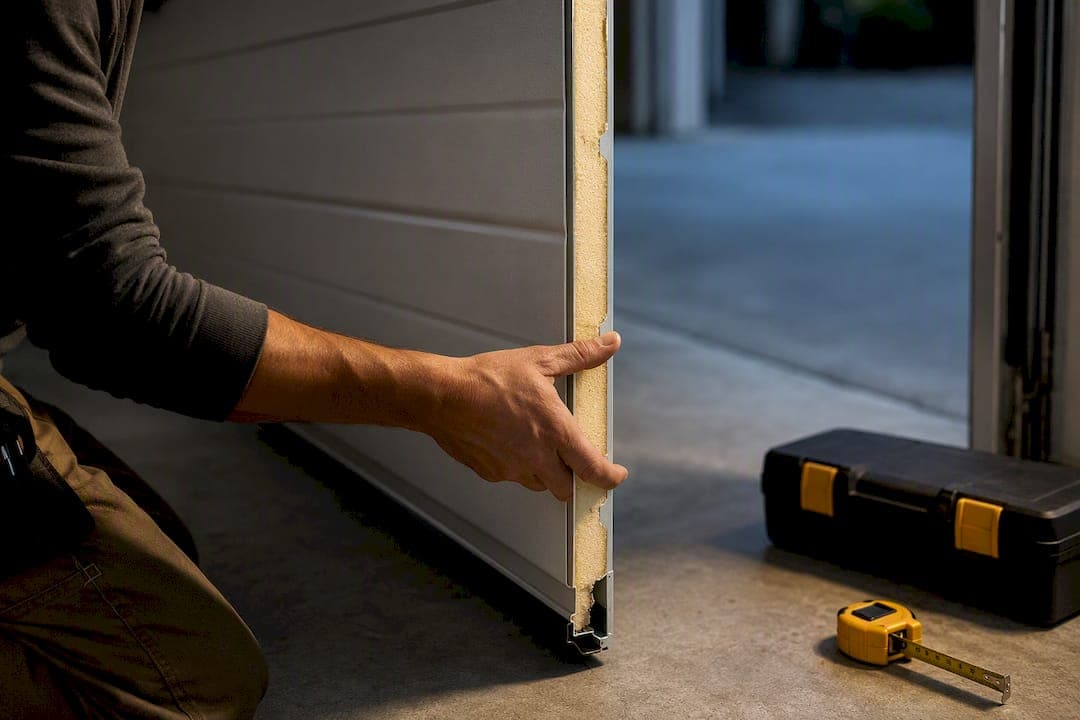
An insulated garage door is worth the money if your garage sits attached to the house, gets heated or cooled, or doubles as a workshop. For those setups, choose a polyurethane-injected door and target somewhere in the R‑12 to R‑18 range. Installed pricing typically lands between $750 and $3,700 or more depending on size, so get itemized quotes from at least two installers and have them check your perimeter seals before you sign anything.
TL;DR:
- Polyurethane-injected garage doors with R‑12 to R‑18 insulation offer the best performance for attached or heated garages, with higher durability and noise reduction.
- The actual installed R-value of a door can be much lower than the panel's lab-tested number due to seams, hinges, and steel framing, so verifying the U-factor is essential.
- Installation costs range from $750 to over $3,700 depending on size and features, with a focus on seal quality and spring load to maintain insulation effectiveness.
- Gaps along the bottom seal or seams significantly diminish insulation benefits, making seal inspections and proper weatherstripping crucial for real-world energy savings.
- For unconditioned, detached garages, insulation mainly boosts durability and noise reduction rather than significantly lowering energy bills.
Table of Contents
- Insulated Garage Door Benefits: Energy, Comfort, and Noise
- Polyurethane vs Polystyrene: What the R-Value Numbers Really Mean
- What Does an Insulated Garage Door Cost Installed?
- How to Choose the Right Insulated Garage Door
- Installation and Maintenance: Keeping the Insulation Working
- What a Technician Actually Checks on an Insulated Door
- Ready to Upgrade? Here's What a Professional Install Includes
- Sources
- FAQ
Insulated Garage Door Benefits: Energy, Comfort, and Noise
The payoff from an insulated garage door depends entirely on how you use the space behind it. An attached garage with a bedroom or living room on the other side of that wall benefits noticeably. A detached garage that sits empty most of the year experiences less impact from insulation.
Here's where homeowners actually see results:
- Temperature swings shrink in attached garages, which matters most in Colorado's freeze-thaw winters and 90-degree summers.
- Noise drops noticeably with denser foam and bonded panel construction, since thicker foam and tighter bonding raise the door's sound transmission class along with its R-value.
- Panels resist dents and warping better than thin single-skin steel, so the door holds its shape longer under wind load or an accidental bump.
- Opening and closing gets quieter, since the extra mass and foam core dampen vibration in the track.
If your garage is detached, unheated, and used only for storage, an insulated door still helps a little. It just won't transform your energy bill the way it will for a converted workshop or a garage backed right up against your kitchen.
Polyurethane vs Polystyrene: What the R-Value Numbers Really Mean
Two insulation types dominate the market, and they perform differently enough to matter. Polystyrene panels are rigid foam boards slotted into the door's steel skin. They're cheaper to manufacture and lighter, but they leave small air gaps at the seams that reduce real-world performance. Polyurethane is liquid foam injected between the steel layers, where it expands and bonds to both skins. That bond is what pushes polyurethane doors up to R‑12 to R‑18 or higher, while comparable polystyrene doors often top out lower for the same thickness.
Panel thickness runs from about 1⅜ inches to 2 inches on most residential doors, and thicker generally means a higher R-value, though the insulation type matters more than thickness alone.
Here's the part manufacturers gloss over: the R-value printed on a spec sheet describes the panel, not the installed door. Once you factor in steel stiles, hinge joints, and the seams between sections, real-world performance drops. That's why the ANSI/DASMA 105 standard exists. It tests the whole assembly and reports a U-factor, which is a far more honest number than a panel R-value pulled from a lab sample.
- Ask if the quoted R-value is a panel number or a tested assembly U-factor.
- Check the bottom seal and hinge lines for gaps you can see daylight through.
- Run your hand along the seams on a cold day. A cold stripe means a thermal weak point.
Pro Tip: Walk out to your garage right after sunrise with the door closed. If you can see slivers of daylight along the bottom seal, that gap is undoing a good chunk of whatever R-value you paid for.
What Does an Insulated Garage Door Cost Installed?
Budgeting for an insulated garage door means looking past the sticker price on the door itself. Installation, hardware, and any opener upgrade all add up.
Those figures come from itemized cost breakdowns and national installed cost surveys. Windows, custom colors, and premium hardware push the number toward the top of each range. Bigger doors and thicker insulation cost more, obviously, but so does removing and hauling away your old door if it's heavy steel or wood.
Here's the rule of thumb worth remembering: if your garage is attached and conditioned, the insulation upgrade tends to pay for itself in comfort even before you factor in energy savings. If it's detached and unheated, treat the insulation as a durability and noise upgrade rather than an energy investment. DIY insulation kits run $50 to $200, but they rarely match the R-value or longevity of a factory-insulated door.
How to Choose the Right Insulated Garage Door
Start with how you actually use the space, not with the highest R-value number on the shelf. That single decision drives everything else.
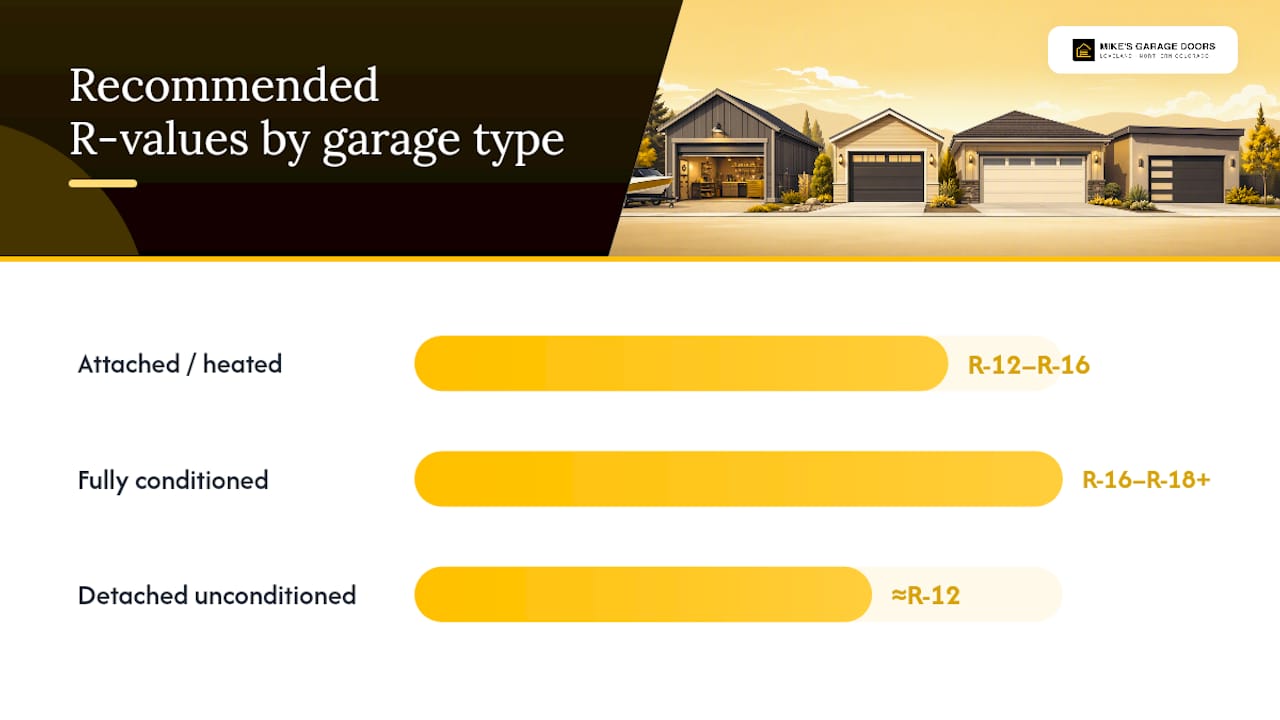
- Match the R-value to your garage's job. Attached or heated garages generally do well with R‑12 to R‑16; fully conditioned spaces benefit from R‑16 to R‑18 or higher, while detached, unconditioned garages see diminishing returns above roughly R‑12.
- Ask whether the quoted R-value is tested or theoretical. A tested assembly U-factor under DASMA guidelines tells you more than a panel-only number.
- Check the warranty and spring cycle rating. Insulated doors weigh more, and a low-cycle spring on a heavier door fails sooner than it should.
- Confirm seal replacement is included. A new door with an old, worn threshold seal loses much of its advantage on day one.
Red flags worth walking away from: a verbal R-value claim with nothing in writing, an estimate that isn't itemized, springs rated for a fraction of the cycles your new door needs, and any installer who doesn't mention weatherstripping at all.
Pro Tip: If two quotes list the same R-value but one costs hundreds less, ask what insulation type each uses. A polystyrene door and a polyurethane door can share a headline number while performing very differently in your actual garage.
Installation and Maintenance: Keeping the Insulation Working
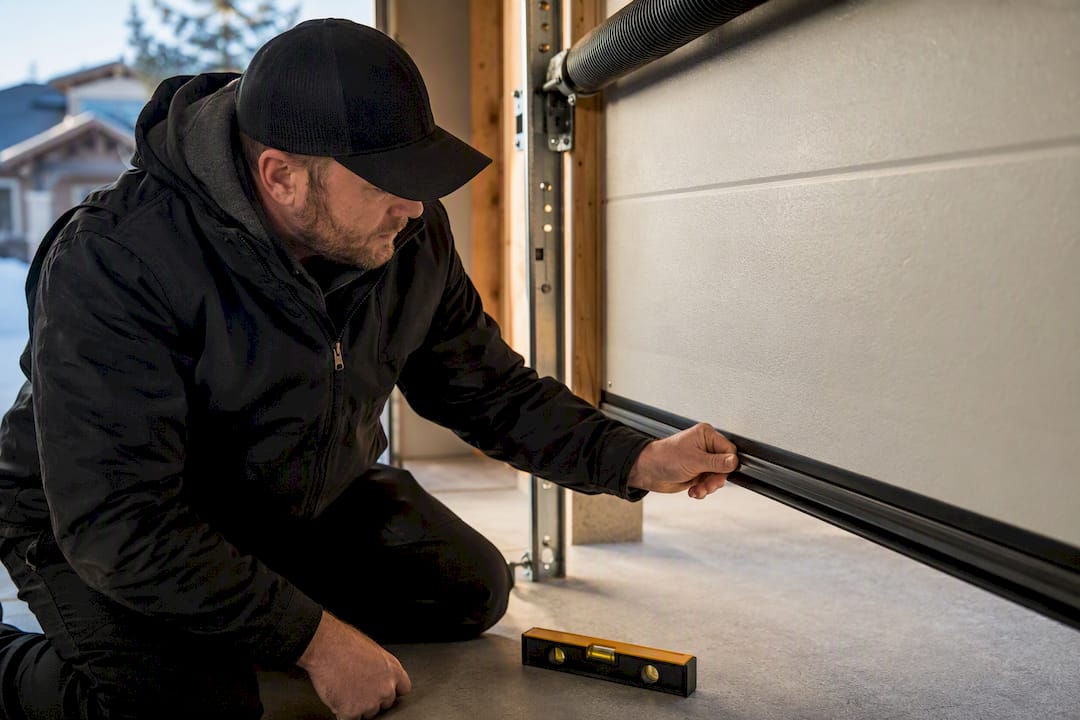
A great door with a bad install performs like a mediocre one. The bottom U-seal and perimeter weatherstripping do more real-world work than most people expect, since gaps there let conditioned air leak out no matter how good the panel insulation is. A worn or uneven threshold usually calls for a threshold kit paired with a fresh U-seal, a fix that typically runs $50 to $120 and restores much of the lost thermal resistance.
Weight matters too. Insulated doors are heavier than standard steel, so the springs and opener need to be sized for that added load, not just carried over from the old door.
- Check seal compression twice a year, especially before winter.
- Feel for cold spots along hinge lines and joints on a chilly morning.
- Call a professional for spring or cable work. DIY seal kits are fine; springs under tension are not.
What a Technician Actually Checks on an Insulated Door
Working on garage doors across Northern Colorado all year, many technicians see the same insulation killers over and over: seals that dried out and cracked, springs rated for a lighter door struggling under insulated panels, and tracks knocked out of alignment just enough to let cold air whistle through the gap. On a quote visit, technicians check seal compression, verify the spring cycle rating matches the door's actual weight, and confirm the opener has enough horsepower for insulated panels. Many of these fixes can finish the same day, and estimates are provided upfront before work begins.
Ready to Upgrade? Here's What a Professional Install Includes
If you've decided an insulated door makes sense for your garage, the next step is getting a quote that actually itemizes what you're paying for instead of one flat number. Some local providers handle insulated door replacement, installation, opener matching, and spring upgrades for homes and businesses across Northern Colorado, with estimates that include seal inspections and spring cycle recommendations.

A site visit means one of our technicians measures your opening, checks your current seals and threshold, and tells you plainly whether your springs and opener can handle a heavier insulated panel or need an upgrade too. We back installs with solid warranties, and veterans get 10% off. Homeowners can also compare real-world energy-efficient door examples before deciding on a spec. When you're ready, take a look at our garage door services in Loveland and schedule a free estimate. There's no pressure, no guesswork on price, just a straight answer about what your garage actually needs.
Sources
FAQ
Is It Worth Getting an Insulated Garage Door?
Yes, if your garage is attached to living space, heated, or used as a workshop. For a detached, unheated storage garage, the durability and noise benefits still apply, but the energy payoff is much smaller.
What Is the Average Cost of an Insulated Garage Door?
Installed costs typically run $750 to $1,900 for a single-car door and $1,500 to $3,700 or more for a double-car door, depending on size, insulation type, and hardware.
Which Garage Door Is Best for Insulation?
Polyurethane-injected doors outperform polystyrene panels because the foam bonds directly to both steel skins, commonly reaching R‑12 to R‑18 compared to lower ranges for polystyrene at similar thickness.
Do Insulated Garage Doors Keep the Garage Cool?
They help moderate temperature swings, especially in attached garages, but a high R-value panel with worn seals or gapped joints loses much of that benefit. Confirming a tested assembly U-factor and tight weatherstripping matters as much as the insulation type itself.