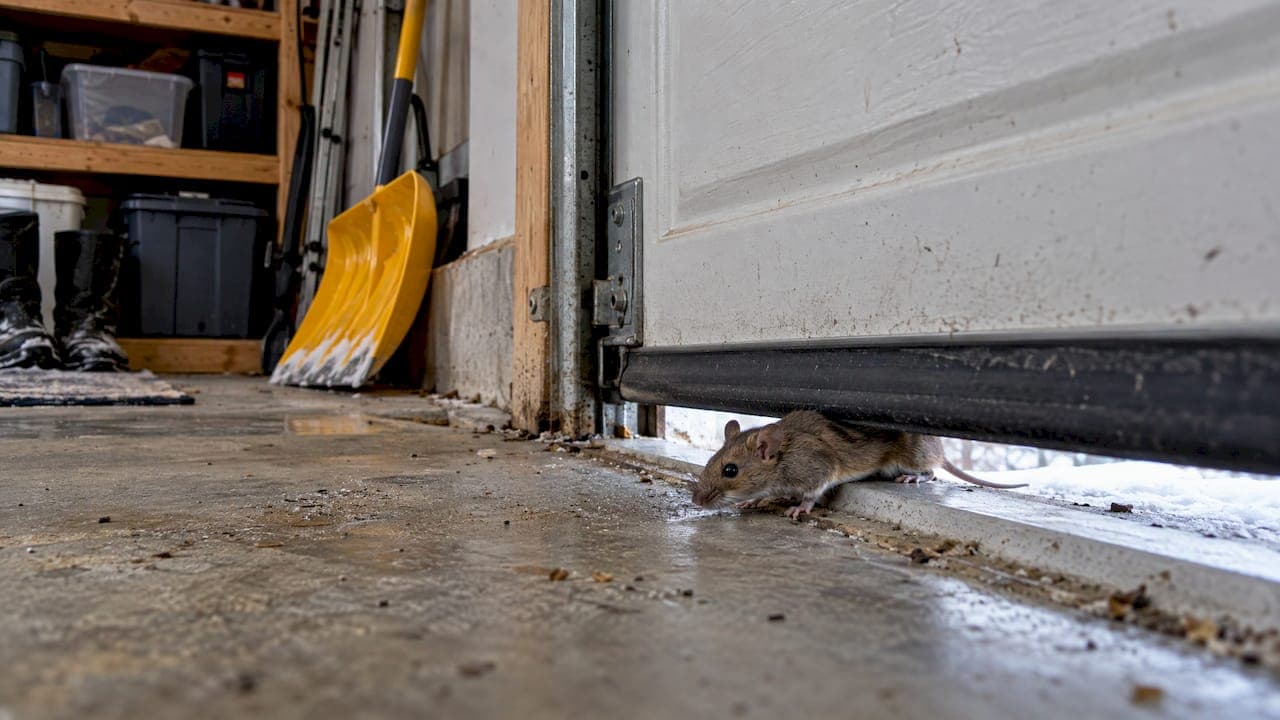
To keep mice out of your garage, seal every gap they can squeeze through, starting with the bottom and sides of the garage door. Then take away food and clutter, and trap any mice already inside. Exclusion is the most successful and permanent form of house mouse control, according to the UC Statewide IPM Program. The garage door is the biggest moving opening in your home, so it's the best place to start.
We repair garage doors across Loveland and Northern Colorado, and we see worn-out bottom seals every week. This guide walks through the whole job: where mice get in, how to rodent-proof the door, what to do about the rest of the garage, and how to clean up safely.
TL;DR
- Mice can enter through openings as small as 1/4 inch, and they head indoors in autumn as nights get colder.
- Fit a bottom sweep and side and top weatherstripping. Bristle-style sweeps hold up better than rubber or plastic, which rodents can chew.
- Plug small holes with stainless-steel mesh. Expanding foam on its own is not enough.
- Store food in sealed containers, clear clutter, and use snap traps for a few mice.
- Never sweep or vacuum droppings. Wet them with disinfectant first, then wipe.
Table of Contents
- Why mice move into garages
- Find where they are getting in
- Rodent-proof the garage door
- Close the other openings
- Make the garage less inviting
- Trapping mice that are already inside
- Clean up droppings safely
- Our perspective
- Get the door checked before the cold sets in
- A simple seasonal checklist
- FAQ
- Sources
Why mice move into garages
A garage gives a mouse what it wants: shelter, quiet and something to eat. House mice do well anywhere food and shelter are plentiful, and they commonly move in during autumn when nighttime temperatures drop, per the UC IPM house mouse guide. In Northern Colorado, that means the first hard freezes are when you should be sealing up, not after you hear scratching in January.
The things that attract them are mundane:
- Bagged pet food, bird seed or grass seed on the floor
- Cardboard boxes stacked against walls
- Open trash or recycling bins
- Stored seasonal gear, like holiday decorations and camping equipment
- A car or tool bench that nobody has moved in months
A mouse doesn't need a hole you'd notice. A quarter-inch gap is about the width of a pencil. A door that looks closed from the driveway can still leave that much room at a corner.
Find where they are getting in
Before you buy anything, walk the garage with a flashlight. Do it in the evening with the lights off, then check for any line of daylight at the door edges. Light you can see is a path a mouse can use.
Check these spots in order:
- The bottom of the garage door. Close the door and look along the full width. Pay attention to the two corners and any dip in the concrete.
- The sides and top. The vinyl or rubber stop strips along the jambs dry out, crack and pull away over time.
- Where the door meets the floor. Slab settling and cracks create gaps that a seal can't fix on its own.
- Utility penetrations. Look at where gas lines, electrical conduit, water pipes and dryer vents pass through the wall.
- The door into the house. Mice that get into the garage often keep going. Inspect shared walls, utility pipes and the interior door, since those are the routes into living space, as noted in the UC IPM guidance above.
- Dark corners and shelving. Droppings, gnawed boxes and shredded insulation show where they're nesting and traveling.
If the gap under the door is uneven, the cause may be the door, not the seal. We cover that in our guide to the gap under your garage door, and our post on finding the cause of seal gaps shows how to pinpoint the exact spot.
Rodent-proof the garage door
This is where most garages leak. A tight door seal blocks mice, and it also cuts drafts, snow melt and dust.
Bottom seal or sweep
The bottom is the main entry point. Pest Control Technology reports that door sweeps or thresholds go on the bottom, with weatherstripping around the sides and top, and that bristle sweeps are preferred over rubber or plastic, which rodents can chew through. The Texas A&M rodent resource guide makes the same point about sweeps and side weatherstripping closing the gaps mice use.
What that means for your door:
- Measure the width of your door and the gap you need to fill before you shop.
- Pick a sweep or kit sized for your door style and gap. A seal that's too short leaves a hole at each corner, and mice find it.
- Look at brush-style products such as a 24-inch garage flex sweep when you compare lengths and styles.
- Replace the whole strip if it's brittle, flattened or torn. Patching a short section leaves the weak point in place.
Side and top weatherstripping
The vertical stops on both sides and the top strip are easy to overlook. Close the door, then press on the stop strip with your hand. If it's loose, split or doesn't touch the door panel, replace it. Make sure the door sits snug against it all the way up.

When a seal alone won't do it
Sometimes the door itself doesn't sit level. A bent bottom panel, a worn track or uneven spring tension leaves a wedge-shaped gap that a new seal just squashes unevenly. Our post on testing balance before buying a top seal walks through how to tell. If the door is out of balance, don't adjust the springs yourself. They hold enough tension to injure someone badly, and that's a job for a trained technician.
Close the other openings
The door isn't the only way in. Once it's sealed, mice will test everything else.
| Opening | Best fix |
|---|---|
| Small holes around pipes and wires | Pack with stainless-steel mesh |
| Gaps in the wall or sill | Mesh first, then sealant over it |
| Cracks where the wall meets the slab | Mesh and a masonry-grade sealant |
| Vent openings | Cover with hardware cloth, secured at the edges |
| Gap under the house entry door | Add a bristle-style sweep |
Texas A&M's guidance recommends stainless-steel mesh for small openings and says expanding foam used alone is generally ineffective. Foam is fine as a backing over the mesh to hold it in place, but a mouse can chew through foam by itself.
Push the mesh in tightly. If you can pull it out with your fingers, so can a mouse.
Make the garage less inviting
Sealing keeps new mice out. Housekeeping gives any that slipped in no reason to stay. The UC IPM program recommends reducing food and shelter through good housekeeping, cleaning up debris and keeping food and garbage containers sealed.
A practical garage reset:
- Move pet food, bird seed and fertilizer into metal or heavy plastic bins with tight lids, or out of the garage entirely.
- Keep trash cans lidded and rinse recycling before you store it.
- Swap cardboard for plastic totes. Cardboard is nesting material.
- Pull stored items off the walls by a few inches so you can see the baseboard and spot droppings early.
- Raise what you can onto shelves rather than leaving it on the floor.
- Clean up debris along the walls and under the workbench.
This takes an afternoon, and it makes every other step work better.
Trapping mice that are already inside
If you find droppings or hear activity after you've sealed up, you have to deal with the mice inside, or they'll keep looking for a way through to the house.
UC IPM says trapping is preferred in homes, garages and other structures where only a few house mice are present. For a small problem, use snap traps.
The CDC gives specific advice on placement: set snap traps on the floor against a wall, baited end next to the wall to form a "T", in spots where you've seen rodents or signs of activity. The same CDC brochure advises against glue traps or live traps around the home because they can scare rodents into urinating, which raises the chance of getting sick.
Some practical tips:
- Set several traps along the walls where you've found droppings, not one in the middle of the floor.
- Check them daily and wear gloves when you handle them.
- Keep traps away from kids and pets.
- Keep trapping until no new droppings appear, then keep your seals in good shape.
If you use rodenticide baits, follow the product label. One EPA-registered bait label says to place bait out of reach of children, pets and non-target wildlife, or in tamper-resistant bait stations. If you see droppings in many parts of the garage, or the activity continues after a week or two of trapping, call a licensed pest professional.
Clean up droppings safely
Mouse waste can carry disease, so the cleanup method matters. The CDC's steps for cleaning up after rodents:
- Put on rubber or plastic gloves.
- Spray the droppings and nesting material with disinfectant, or a fresh bleach solution of 1.5 cups of bleach in 1 gallon of water (1 part bleach to 9 parts water), until very wet.
- Let it soak for 5 minutes.
- Wipe it up with paper towels and throw them away.
- Disinfect the surface again, then wash your gloved hands, then your bare hands.
Never sweep or vacuum rodent droppings. Doing so puts particles in the air that you can breathe in. If you have a heavy infestation, or you're not sure how to clean a large area, talk to a pest control professional or your local health department before you start.
Our perspective
We fix garage doors for a living, and we see the same pattern every fall. A homeowner finds droppings, buys traps, sets them for weeks, and never looks at the bottom seal. The door is still letting mice in.
Our view is simple: the door is part of your home's envelope, and it should be treated like one. A flattened, cracked bottom seal or a loose side strip is an open invitation. A door that sits crooked in its tracks can leave a gap no seal will cover.
That's why we look at the whole door during a visit: seals, panels, tracks, springs and opener. A tune-up gives you a trained set of eyes on every part of the door, and it's a good time to catch a worn seal before the cold weather arrives. We give honest, upfront estimates over the phone, so you know what to expect before we show up, and 90% of our repairs are finished the same day.
If the door is the problem, fix the door. If it's the rest of the garage, you now have the checklist.
Eddie
Get the door checked before the cold sets in
If your door has a visible gap, a crumbling seal or a bent bottom panel, we can look at it. Our team handles tune-ups, spring repair, opener work and more for homes and businesses in Loveland and across Northern Colorado, and we offer 24-hour emergency repair if something fails. Call us for an upfront estimate over the phone. Veterans get a 10% discount.

Our work is backed by written warranties on parts and labor. A door that closes square and tight is the foundation of any rodent-proofing job.
A simple seasonal checklist
To keep this from becoming a yearly scramble, run through this list each fall, before nighttime temperatures drop:
- Close the door and check for daylight along the bottom, sides and top.
- Press on the side stops and bottom seal. Replace anything stiff, torn or flat.
- Check the interior house door and its threshold.
- Re-inspect mesh around pipes and wires.
- Move food and bird seed into sealed containers.
- Set a few snap traps against the walls as an early warning.
- Look for droppings along the baseboards once a month through winter.
Spend twenty minutes on that each October and you'll catch most problems before they become a nesting colony.
FAQ
What is the best way to stop mice from getting under a garage door?
Install a bottom sweep or threshold, plus weatherstripping on the sides and top. Choose a bristle-style sweep, since rubber and plastic can be chewed through. Size it to your door and gap so there are no short spots at the corners.
Can mice squeeze through tiny gaps?
Yes. House mice can get through openings as small as 1/4 inch, according to UC IPM. That's why corners, pipe penetrations and worn seals matter more than any single large hole.
Do peppermint oil or mothballs keep mice out of a garage?
We don't rely on them. Sealing the gaps and removing food and shelter are the methods backed by extension and pest-management sources, and they last. Strong smells don't close an opening, so treat them at most as a supplement to exclusion.
Is it safe to clean up mouse droppings myself?
For a small amount, yes, if you follow the right steps. Wear gloves, soak the droppings with disinfectant or a 1:9 bleach solution for 5 minutes, and wipe with paper towels, as the CDC describes. Never sweep or vacuum them. For a large infestation, call a pest professional.
Should I call a garage door company or a pest control company?
Both can matter. If the problem is a worn seal, a gap under the door or a door that doesn't sit level, call us. If you have a large or ongoing infestation, bring in a licensed pest control professional as well.
Sources
- House Mouse, UC Statewide IPM Program
- Pest-Proofing Exterior Doors to Keep Rodents Out, Pest Control Technology
- Section 3: Integrated Pest Management/Exclusion, Texas A&M Rodent Academy Resource Guide
- You Can Prevent Hantavirus, CDC
- How to Clean Up After Rodents, CDC
- EPA Pesticide Product Label, Tomcat Bait Chunx
- 24-Inch Garage Flex Sweep Broom, Polar Tool & Supply