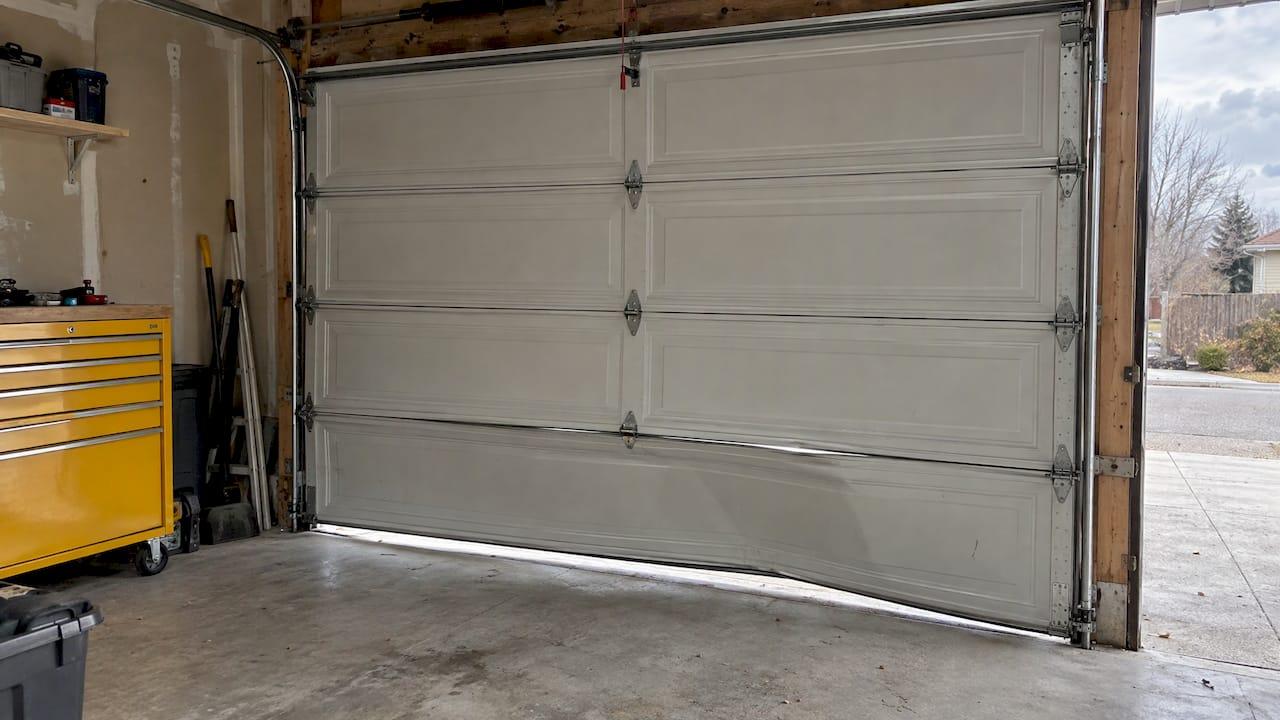
If wind has bent your garage door, knocked it off its track or left it rattling and stuck, stop using it, leave it closed if it will close, and call a trained technician. Do not try to lift, re-seat or fix it yourself. A garage door is a heavy panel held in balance by springs under extreme tension, and wind damage often hides problems you cannot see from the floor. At Mike's Garage Door Repair, 90% of repairs are completed the same day, and we give you an upfront estimate over the phone before anyone drives out.
TL;DR
- Close the door and leave it closed. Do not run the opener on a door that is off track, bent or hanging crooked.
- Never adjust springs, cables or brackets yourself. Industry guidance says only trained door systems technicians should do that work.
- Take photos of every dent, gap and bent part before anything moves, then check your homeowners or commercial property policy.
- Do not brace the door with lumber or angle iron. The extra weight can make tracks fail.
- Call a local repair company early. Small wind damage turns into big damage when the door keeps getting used.
Table of Contents
- Why Loveland doors take a beating from wind
- What to do in the first hour
- Can you keep using a door that rattles, is off track or will not close?
- How wind damage is checked
- Repair or replace?
- Permits and codes in Loveland
- Documenting damage for insurance
- What affects cost and timing
- Perspective
- Get it fixed the same day
- Preventing the next wind call
- FAQ
- Sources
Why Loveland doors take a beating from wind
Northern Colorado wind is not a once-a-year event. Gusts come off the foothills and across open ground, and a garage door is the largest moving part on the front of most homes. It is a big flat surface made of thin sections, held in place by a track, rollers and hinges. When wind pushes on it, the load goes straight into the track fasteners and the framing around the opening.
The City of Loveland's Building Division lists a 130 mph three-second gust design wind speed and Exposure C among its design criteria. Exposure C means open terrain with scattered obstructions, which describes a lot of the ground around town. That number is what buildings are designed for, so it tells you how seriously the city takes wind. It also means a standard builder-grade door installed years ago may not have been built to the same standard as one chosen for that load today.
Most of the time the damage is smaller than a failed door. It is a section that flexed, a track that shifted, a roller that popped out or a bracket that loosened. These are exactly the problems that get worse if you keep operating the door.
What to do in the first hour
Safety first, repair second. Work through this in order.
- Keep people and cars clear. A door that has been pushed in or out can fall without warning. Keep kids and pets away from the opening, and do not park under or against it.
- Close the door if it still closes normally and leave it closed. The Door & Access Systems Manufacturers' Association (DASMA) advises keeping the door closed and secured during a high-wind event and says it does not recommend operating doors in high wind, because the extra force needed to open or close them can injure someone or damage the door.
- Do not force it. If the door sticks, binds, shudders or tilts, stop. Pulling the release cord and wrestling a damaged door by hand is how people get hurt.
- Leave the springs and cables alone. The springs hold enough stored energy to cause serious injury. DASMA's technician guide says occupants should never remove, adjust or repair doors, springs or components, and that only trained door systems technicians should do the work.
- Photograph everything. Take wide shots and close-ups of dents, cracks, gaps at the sides and top, bent track and any hardware on the floor. Add the date. You will want this for insurance.
- Call for an estimate. Describe what you see and what you hear. A phone estimate is only as good as the description, so the more detail you give, the closer it will be.
If the door is open and will not close, or the opening is exposed overnight, that is an emergency situation. Our 24-hour emergency repair exists for exactly that.
Can you keep using a door that rattles, is off track or will not close?
The short answer is no, not until a technician has looked at it.
A door that rattles in the wind is often telling you something is loose: track fasteners, hinges, rollers or the brackets that tie the track to the framing. Rattling is a symptom, not a nuisance. Loose parts move more every gust.
A door that is off track has lost the guide that keeps it square in the opening. Running the opener against that can bend the track further, crack sections and strip the opener's drive. A small roller reset can become a bent track or a damaged section. Our guide to five steps for a bent garage door track explains what is going on and why waiting makes it cost more.
A door that will not close may have damaged sections, a shifted track, a cable that came off its drum or a bent jamb. Any of these can leave the opening unsecured, which matters for your car, your tools and the door from the garage into your house.
A door that was manually locked for wind needs a specific step. DASMA says that where a manual locking device is provided on a higher wind-resistant door, the door should be locked for a high-wind event, and the operator disconnected while it is locked. It also warns that using an automatic operator on a manually locked door can damage both the door and the operator. Unlock it before normal operation.
One more warning on a tempting fix. After a windy night, some owners prop a vehicle against the door or screw lumber or angle iron across it. DASMA says a door can be blown into the garage or pulled out of the opening, so backing a vehicle against it is not recommended, and adding your own reinforcement can overload tracks and components that were not rated for it. The springs are set to balance the door's original weight. Add weight and the system is out of balance. Real wind resistance comes from a door and track system that was built and rated for the load.

How wind damage is checked
A trained technician does not just look at the part that is obviously broken. DASMA's technician guide for checking a garage door after a wind event lists what to inspect. Here is what that means in plain terms:
| What gets checked | What the technician is looking for |
|---|---|
| Door alignment to the track and framing | Is the door square, or has it racked or shifted? |
| Jambs, header and track fasteners | Loose, pulled-out or deformed fasteners and framing |
| Rollers, brackets and hinges | Bent, cracked or missing hardware |
| Spring-system cables | Frayed, slipped or off-drum cables |
| Door sections | Cracks, dents or buckling |
That list comes from DASMA's technician guide. The same guide tells inspectors to check the door for stress or fatigue and to judge whether it would hold up in another high-wind event.
This is why a quick look at the sagging corner is not enough. A door can seem to work and still have a fatigued section or loosened fasteners that fail in the next storm. It is also why an honest estimate starts with a good description and ends with an in-person inspection.
Repair or replace?
Most wind damage is repairable: a reset or replaced roller, a straightened or replaced track section, a new cable, a replaced panel or a reset opener. The decision turns on two things.
Is the damage local or structural? A single dented section can be replaced. Several buckled sections, a racked door or tracks pulled away from the framing point toward a new door.

Will the door survive the next event? DASMA tells technicians that if stress or fatigue has compromised the door's performance, the owner should be advised to send the assessment to their insurance company stating that replacing the garage door system is required. A registered design professional may also be needed in some cases, especially where the framing is involved. Framing questions belong with a building contractor or design professional.
If you are replacing, think about wind rating. DASMA explains that required wind load varies by door size, building importance and exposure, and that doors are tested to a standard (ANSI/DASMA 108). A rated door carries a label stating its design loads, and it is installed to a manufacturer's drawing that specifies the reinforcement, hinges, rollers, track brackets and fasteners. DASMA's inspection guidelines for wind-load doors call for checking that what is installed matches that drawing. We wrote a separate piece on reading the label and installation drawing on wind-rated doors if you are choosing a new door.
Permits and codes in Loveland
Whether you need a permit depends on the work. Loveland's Title 15 covers construction, alteration, repair and maintenance of structures in the city, and sets deadlines for picking up permits and starting work: a permit must be procured within 90 days after you are told the application has been processed, and it becomes invalid if work does not start within 180 days of issuance. The city also adopted code amendments based on the 2024 International Codes, effective July 1, 2026.
For a typical swap of an existing door in an existing opening, the rules are usually light, but anything that changes the opening or the framing is different. If you are not sure, ask the Building Division before work starts. If you live outside city limits, Larimer County's rules apply instead, and the same advice holds: ask before you build. Commercial property managers should check this early, because framing and code questions can add time that a plain repair does not.
Documenting damage for insurance
Wind damage can be a covered loss under some homeowners and commercial property policies, but coverage depends on your policy, your deductible and the cause. Only your insurer can tell you what yours covers. Here is how to make the claim easy to evaluate:
- Photos and video of the door, tracks, framing and surrounding damage, taken before any repair or cleanup.
- The date and the weather that you believe caused it.
- Keep the broken parts until the adjuster has seen them or approved their disposal.
- A written assessment from the technician. DASMA's own guidance has technicians advise owners to pass their assessment to the insurer when replacement is needed.
- Temporary protection. Keep the opening secure and keep receipts. Most policies expect you to prevent further damage.
If the opening cannot be closed, get it secured the same day and tell your insurer. For businesses, downtime is the bigger cost, so tell the dispatcher at the first call that the door is part of daily operations.
What affects cost and timing
Cost depends on what failed. A reset roller is a very different job from a replaced section or a bent track, and a full replacement is a different category altogether. Opener damage, spring or cable problems and after-hours work all change the total. Our Loveland garage door repair cost guide walks through the factors.
Timing is where local matters. After a big wind day, everyone calls at once. Calling early, with photos in hand, helps the dispatcher decide what parts to bring.
Perspective
We repair wind damage in Northern Colorado, and the pattern is simple: the door that gets used after the storm is the one that costs the most. People want to get the car out, so they pull the release and force the door up, or they hit the opener one more time. That is how a track you could have straightened turns into a track you have to replace.
Our advice is to stop, close up what you can, take pictures and call us. We give honest, upfront estimates over the phone so there are no surprises when we show up, and 90% of our repairs are finished the same day. We are a family-owned local company, and our repairs come with written warranties on parts and labor.
Wind also teaches the right lesson about the door itself. A door that was built, rated and installed to a drawing is the one that holds. A door held together with bracing and hope is not. If your door needs more than a repair, we install custom doors and can help you pick one that suits your building.
Eddie
Get it fixed the same day
Whether it is a roller that popped out, a bent track, a broken spring or an opener that quit, Mike's Garage Door Repair handles garage door repair, spring replacement, opener repair and installation, custom doors and parts, and commercial service across Loveland and Northern Colorado. We offer 24-hour emergency repair, and veterans receive a 10% discount. Call for an upfront phone estimate, or see everything we do on our garage door services page.

For commercial properties, we work to keep downtime low. Tell us how the door is used, and we will plan the repair around your operation.
Preventing the next wind call
You cannot stop Colorado wind, but you can reduce what it finds to work on.
- Schedule a tune-up. Loose hardware, worn rollers and misaligned tracks are the weak points wind exploits. Our tune-ups look at these before a storm does.
- Do the two track checks. Our guide on two track alignment checks shows what to look for from the floor without touching a spring.
- Close the door before a forecast wind event. DASMA recommends having the door closed and wind-resistant to local requirements before the event.
- Do not add DIY bracing. Extra weight can overload tracks.
- Ask about a wind-rated door if yours is older or you are replacing it.
FAQ
Can I open my garage door after a windstorm?
If it moved normally and shows no damage, a gentle test is reasonable once the wind has passed. If it rattles, sticks, sits crooked or has a visible gap, do not operate it. DASMA does not recommend operating doors during high winds because of the injury and damage risk.
How do I stop my garage door from rattling in the wind?
Rattling usually means loose hardware, worn rollers or a track that has shifted. Those need a technician, because tightening the wrong bolt on a track or bracket tied to the spring system is dangerous. A tune-up can address the cause rather than the noise.
Will insurance pay for a wind-damaged garage door?
It can, depending on your policy and deductible. Photograph the damage before repairs, keep damaged parts and get a written assessment from the technician. Your insurer decides coverage, so contact them early.
Is a wind-damaged garage door an emergency?
It is if the door will not close, is hanging from the track or leaves your home or business open. Secure the area and call for emergency repair. If the door is closed and stable, it is still best repaired soon, as damage grows with each use.
Sources
- DASMA: Trained Door Systems Technician, checking a garage door (TDS-175, 2019)
- DASMA: Trained Door Systems Technician (TDS-175, 2015)
- DASMA: Securing Garage Doors During High Wind Events (TDS-192)
- DASMA: Garage Doors and Hurricanes (TDS-152)
- DASMA: Explaining Codes and Wind Loads
- DASMA: General Code Inspection Guidelines for Wind Load (TDS-181)
- City of Loveland: Building Code Amendments
- City of Loveland: Title 15, Buildings and Construction