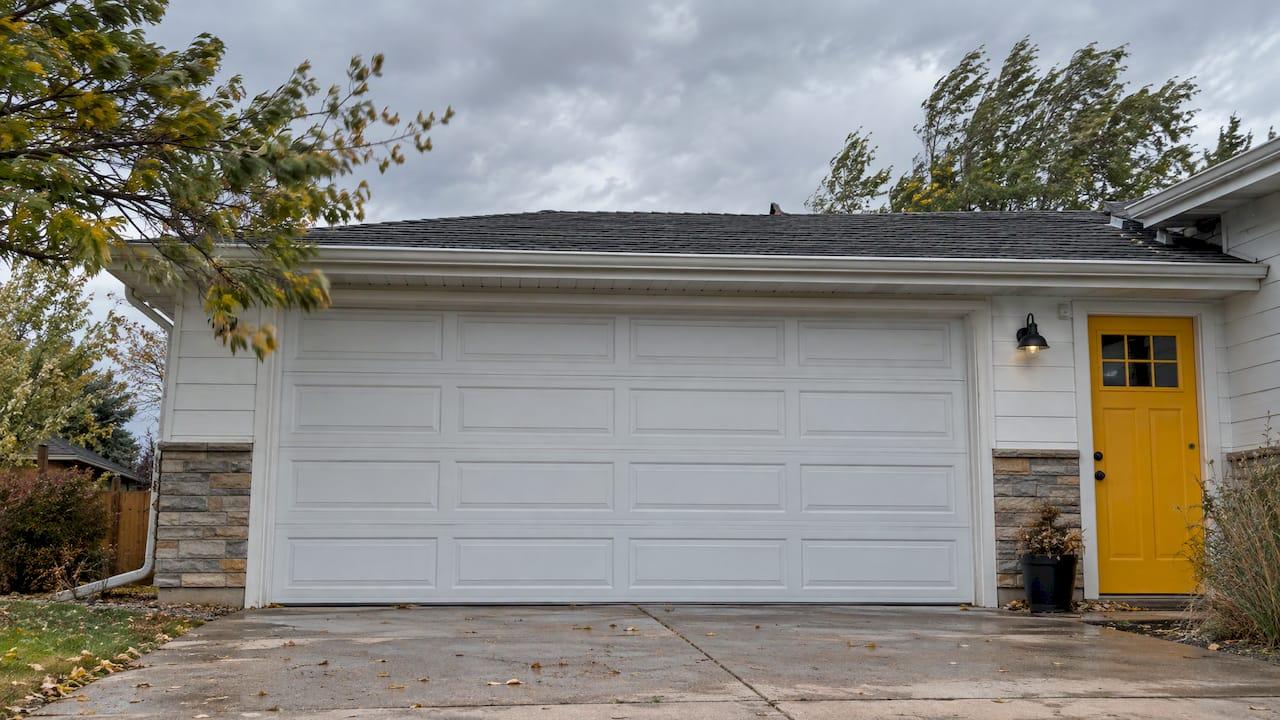
A garage door that rattles, whistles or booms when the wind picks up is usually telling you one of three things: the seals have gaps, the hardware has loosened, or the door is flexing more than it should. Most of those causes are easy to spot with a flashlight and ten minutes. A few, like springs and cables, are not yours to touch. Here in Loveland, where the wind comes off the foothills hard and often, it pays to know which is which.
TL;DR
- Wind noise comes from air getting past the door (seal gaps) or from parts that have room to move (loose hinges, worn rollers, loose track fasteners).
- Do a light test from the inside, then listen during a gusty day to pin down where the sound lives: bottom, sides, top or panels.
- Lubricate the right parts only. Do not oil the tracks, and keep lubricant off plastic parts.
- Never adjust springs, cables or the brackets they attach to. Those repairs belong to a trained technician.
- A door that visibly flexes, shifts in the track or sits crooked after a big storm should stay closed until someone checks it.
Table of Contents
- Why a garage door gets noisy in the wind
- Step 1: Pin down where the noise is coming from
- Step 2: Check the weather seal
- Step 3: Look for loose hardware
- Step 4: Lubricate the right parts, and only those
- What not to touch
- Can wind actually damage a garage door?
- Quick fixes that quiet a windy door
- Perspective: what we see on Loveland garages
- When to call a technician
- Get your door checked in Loveland
- FAQ
- Sources
Why a garage door gets noisy in the wind
Wind pushes on a garage door harder than most people expect. It is one of the largest flat openings in a house, and gusts load it like a sail. Industry engineering data from the Door & Access Systems Manufacturers' Association (DASMA) shows that a single-story 9' x 7' door designed for a 100 MPH wind speed sees about 9.6 psf of positive and negative pressure, rising to 18.8 psf positive and 21.3 psf negative at 156 MPH. You will not see those loads on a normal windy day, but even a fraction of that pressure pulses the panels in and out.
That pulsing is what you hear. In our experience, the sound tells you where to look:
- A whistle or hum usually means air is squeezing through a narrow gap, often along the bottom edge, the sides or the top.
- A rattle or chatter usually means something has slack: a loose hinge, a worn roller, a track fastener that has backed out.
- A boom or drumming sound usually means a large panel is flexing in and out, often on a lighter or older door.
- A clunk or bang as the door shifts means the door is moving in the track more than it should.
None of these is a mystery once you know where to listen.
Step 1: Pin down where the noise is coming from
Before you touch anything, spend a few minutes on diagnosis. It saves you from replacing parts that were never the problem.
- Close the door and stand inside the garage on a windy day. Listen at the bottom, each side and the top. Walk the full width.
- Put a flat hand lightly on a few panels. A panel that you can feel pulsing is flexing.
- Look for visible movement at the hinges and where the rollers meet the track.
- Note whether the noise changes with wind direction. A sound that only appears with a west wind points to a gap on that side.
The same listen-first habit works for other noisy systems in the house too. If you want a model for it, these ductwork banging sound clues show how much a noise can tell you before anyone picks up a tool.
Write down what you hear and where. If you end up calling us, that note speeds up the phone estimate considerably.
Step 2: Check the weather seal
Seal gaps are the most common source of whistling and also the easiest to check. The U.S. Department of Energy's Building America program describes a few simple ways to find leaks at an exterior opening: feel for drafts by hand, watch a tissue for movement, look for visible light at night, or hold a dollar bill in the doorway and see whether it slides out easily when the door closes.
For a garage door, put that into practice like this:
- Turn off the garage lights and let your eyes adjust for about 30 seconds.
- Look around the whole perimeter of the closed door for any line of daylight.
- Have someone stand outside with a leaf blower or just use a breezy day, and feel along the bottom seal for moving air.
- Try the dollar bill test in several spots across the bottom, not just one.
What you find tells you what to do:
| What you see | Likely cause | Typical next step |
|---|---|---|
| Light or air along the bottom only | Worn, hardened or flattened bottom seal | Replace the bottom seal |
| Light at one corner but not the other | Uneven floor, or the door is not level | Have the door and floor checked |
| Light along the sides | Side stop molding set too far from the door | Adjust or replace the side weatherstripping |
| Light across the top | Top seal worn, or a bowed header | Check balance first, then the top seal |
| Gap that comes and goes | Door out of balance or cables uneven | Call a technician |
We wrote separate guides for each of these. If the gap is at the floor, start with gap under your garage door: causes, fixes and when to call. If the problem is more general, garage door seal gaps: find the cause, fix the right spot walks through each location. And if the gap is at the top, read test balance before buying a top seal, because a door that is out of balance can leave a gap no new seal will close.
A note on the "free fix" you may have seen
Some homeowners get a quieter door just by adjusting the position of the side stops so the door sits snug against the weatherstripping instead of floating away from it. That is reasonable on a door that is in good shape. What it will not do is solve a gap that exists because the door is sagging, the opener is pushing the door unevenly, or the springs are losing tension. When the cause is mechanical, a seal only hides it.
Step 3: Look for loose hardware
Rattling is almost always hardware with room to move. A garage door has dozens of fasteners and moving points, and years of opening and closing shake them loose.

The DASMA technical data sheet for a trained door systems technician lists what a proper inspection covers. Visually check the track system for loose fasteners, twisting, bending or an opened-up track, and look for misaligned track components. The same sheet says rollers should sit in the track without tension, ball-bearing rollers should be checked for looseness or missing bearings, and roller stems should be able to rotate and slide in their brackets.
You can do the looking part of that safely from the floor with the door closed:
- Track bolts and brackets on the vertical sides: look for bolts that have backed out or brackets that show a shiny, worn spot where they have been rubbing.
- Hinges between panels: look for gaps, elongated holes or hinges that wiggle when you press on them.
- Rollers: a roller that wobbles in its hinge, or that you can see tilting, will chatter in the track.
- Panel-to-panel alignment: gaps or steps between panels can mean the door is racking.
Tightening a loose track bolt or hinge screw on the sides of the door is generally a basic task if the fastener is clearly loose and the door is closed. Stop there. Anything attached to the springs, the cables or the brackets at the bottom corners of the door is under serious tension. More on that below.
Rollers get their own explanation in what garage door rollers actually do for your door. If your rollers are worn, a replacement tends to quiet a door noticeably, and it takes up the slack that lets a door shake in the wind.
Step 4: Lubricate the right parts, and only those
A dry hinge or spring coil adds its own squeaks and groans to the wind noise, and it hides the sounds you are trying to diagnose. But lubricating the wrong parts makes things worse.
Here is what manufacturers say:
- Amarr advises regularly lubricating the door's moving parts but not lubricating plastic parts, such as plastic rollers and idler bearings.
- CRC Industries says not to lubricate the tracks, because that can cause rollers to slip. It also says to apply lubricant to roller bearings while avoiding the wheels, to spray the pivot point of each hinge, to apply a light spray on torsion or extension springs, and to lubricate the chain or screw drive if your opener has one.
Put together, a simple routine looks like this:
- Wipe the tracks clean with a damp rag. Leave them dry.
- Spray the hinge pivots.
- Lightly spray the springs from a safe distance with the door closed.
- Treat exposed roller bearings, not the wheel surface.
- Lubricate the opener's chain or screw drive if it has one.
- Wipe off any excess so it does not drip onto the floor or your car.
Do this twice a year and you will notice what remains: the noise that is really about wind and fit, not friction.
What not to touch
We say this often because it matters. Some parts of a garage door store enough energy to cause serious injury.
DASMA's residential checklist is blunt about it: keep people clear while the door moves, do not operate the door if a spring is broken, and do not try to remove, repair or adjust springs. Repairs and adjustments must be performed by a trained door systems technician.
That means:
- Do not loosen or tighten anything on the torsion spring assembly above the door.
- Do not touch the bottom brackets at the lower corners. They carry cable tension.
- Do not try to force a door that sits crooked or hangs unevenly.
- Do not run the door with a broken spring, even if the opener seems to lift it.
If the rattle seems to come from above the door, from the spring area, or from the cables, stop and call.
Can wind actually damage a garage door?
Yes. Strong gusts can bend panels, pull track fasteners loose, push rollers out of the track and stress the hardware. The warning signs we watch for after a big wind event are:
- Panels that are bowed in or out, or creased
- A door that no longer closes flush with the floor
- Track that looks bent, twisted or pulled away from the wall
- Rollers sitting partially out of the track
- A door that binds, jerks or runs noisily after the storm when it did not before
DASMA's guidance for technicians after a high-wind event is to assess stress or fatigue and decide whether the door system will withstand another high-wind event, and if performance is compromised, to send the assessment and recommendations to the insurer. That is a good rule for owners too: if the door looks or sounds different after a storm, leave it closed and get it looked at.
If you are thinking about replacing an older door, wind rating matters. Our guide to wind rated garage doors and how to read the label and installation drawing explains what to check before you buy.
Will insurance cover it?
Policies differ, and wear and tear is generally treated differently from sudden storm damage. If a wind event damaged your door, photograph it before anyone moves anything, and ask your insurance company how your policy treats the garage door and what your wind or hail deductible is. We can describe the damage and the repair needed in writing to go with your claim.
Quick fixes that quiet a windy door
Here is a practical order of attack, from cheapest to biggest:
- Lubricate the hinges, bearings and springs as above.
- Tighten loose track bolts and hinge screws on the sides of the door.
- Replace the bottom seal if it is hard, cracked or flattened.
- Reset or replace side weatherstripping so the door sits snug against it.
- Replace worn rollers so the door stops shifting in the track.
- Check balance and have a technician look at springs and cables if the door sits uneven or has gaps that come and go.
- Consider reinforcement or a new door if panels flex and boom in moderate wind.
Most homes need only steps 1 through 4. When you get to step 5 or 6, a pro saves time and risk.
Perspective: what we see on Loveland garages
We get calls after every windy stretch along the Front Range, and the pattern is consistent. Homeowners think the noise is the door being cheap or old. Most of the time it is a handful of small things stacking up: a bottom seal that has gone stiff, side stops that have drifted, a couple of loose bolts and rollers with too much play.
That is good news, because those are inexpensive fixes. The bad news is that the noisy door is also the one people avoid looking at, and a rattle can hide a problem that is getting worse. A worn roller or a loose track bolt does not fix itself, and the wind just finds it faster each time.
Our approach is simple. We listen to what you describe on the phone, give you an honest, upfront estimate before anyone shows up, and fix what is actually wrong. About 90% of our repairs are completed the same day. If the noise turns out to be springs, cables or an out-of-balance door, our technicians handle that safely, and our work is backed by written warranties on parts and labor.
If your door is telling you something, it is worth a call.
Eddie
When to call a technician
Call rather than DIY if any of these apply:
- The noise comes from the spring area or cables, or you see a gap in the spring coil
- The door is crooked, heavy, or does not stay open halfway
- Track is bent or pulling away from the wall
- Panels are creased, cracked or visibly bowed
- The door jerks, binds or reverses unpredictably
- You have tightened, lubricated and sealed, and the door still rattles
- A storm just hit and the door looks or sounds different
A phone description is often enough for us to tell you what is likely going on and what it will cost, before anyone visits.
Get your door checked in Loveland
We are a family-owned shop serving Loveland and Northern Colorado, and our technicians handle everything on this list: tune-ups to tighten and lubricate the whole system, spring repair, opener repair and installation, custom doors and parts, commercial doors and 24-hour emergency repair. Veterans receive a 10% discount.

If your door rattles, whistles or booms when the wind blows, see our garage door services and call for an upfront phone estimate. A tune-up is often the quickest way to quiet a door that has been shaking itself loose for years, and we will tell you plainly if something more is needed.
FAQ
Why does my garage door rattle in the wind?
Usually because something has slack. Loose hinges, worn rollers or track bolts that have backed out let the door shift with each gust. Panels on lighter doors can also flex. Check the hardware from the floor with the door closed, and call a technician if the noise seems to come from the springs or cables.
Can I fix a whistling garage door myself?
Often, yes. A whistle points to a gap, so look for daylight around the closed door and replace a worn bottom seal or reset the side weatherstripping. Leave springs, cables and the lower corner brackets to a trained technician, since they hold dangerous tension.
Should I lubricate the tracks to quiet the door?
No. Manufacturers advise against it because lubricant on the track can make rollers slip. Wipe the tracks clean with a damp rag instead. Lubricate hinge pivots, springs and exposed roller bearings, and keep lubricant off plastic parts.
Can wind damage a garage door?
Yes. Strong gusts can bend panels, loosen track fasteners and push rollers out of the track. If your door looks bowed, sits crooked or runs differently after a storm, keep it closed and have it inspected. Photograph any damage for your insurance company.
Will homeowners insurance pay for wind damage to a garage door?
It can when the damage comes from a covered storm event, but wear and tear is generally treated differently. Coverage and deductibles vary by policy, so ask your insurer before you schedule the repair, and keep photos and a written repair assessment.
Sources
- Add Weatherstrip to Windows and Doors, Building America
- Care & Maintenance, Amarr
- How to Lubricate a Garage Door, CRC Industries
- Trained Door Systems Technician: Checking a Garage Door, DASMA TDS-175
- Wind load pressures, DASMA TDS-155x
- Residential One-Piece Garage Door and Electric Operator checklist, DASMA TDS-198