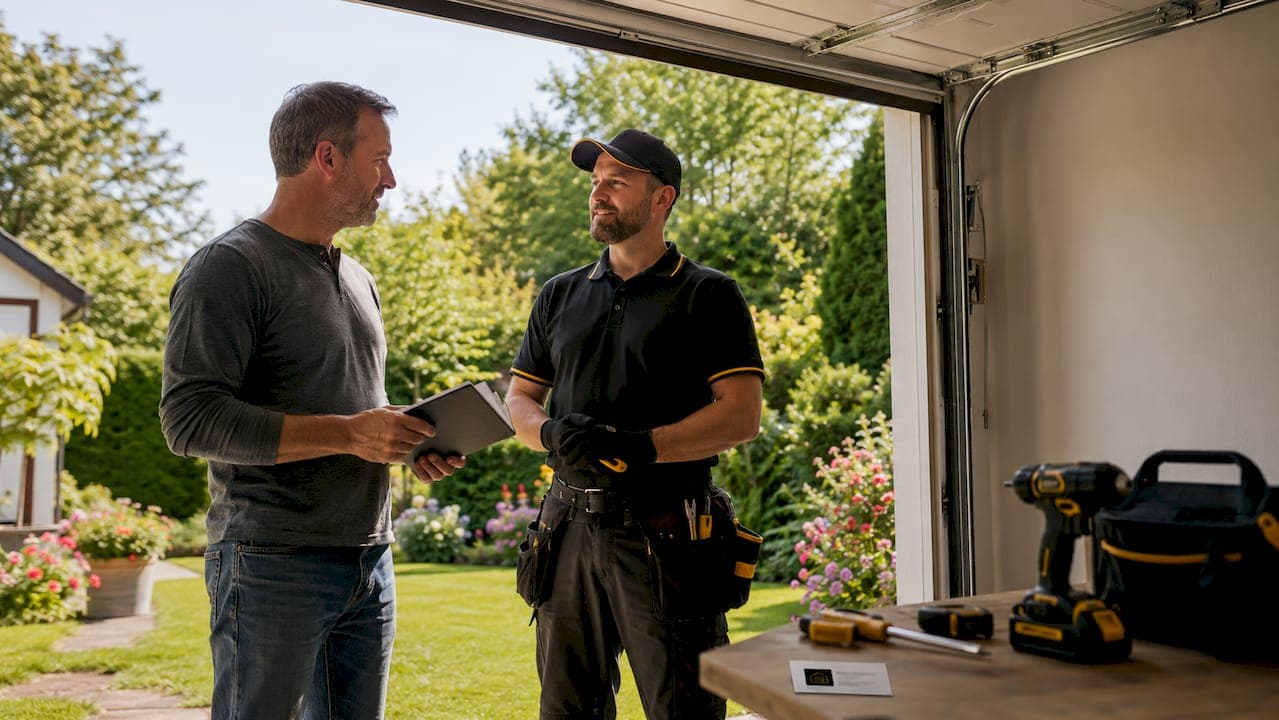
Asking the right questions to ask a repair technician is the single most effective way to separate a trustworthy garage door professional from one who will cost you more money and headaches down the road. Most homeowners call the first number they find and skip the vetting entirely. That is how you end up with a verbal quote that doubles by the time the job is done, or a spring that fails six months later because the technician skipped the balance test. This guide gives you the exact questions to ask, what good answers sound like, and which red flags to walk away from.
What credentials and legal documentation should you verify?
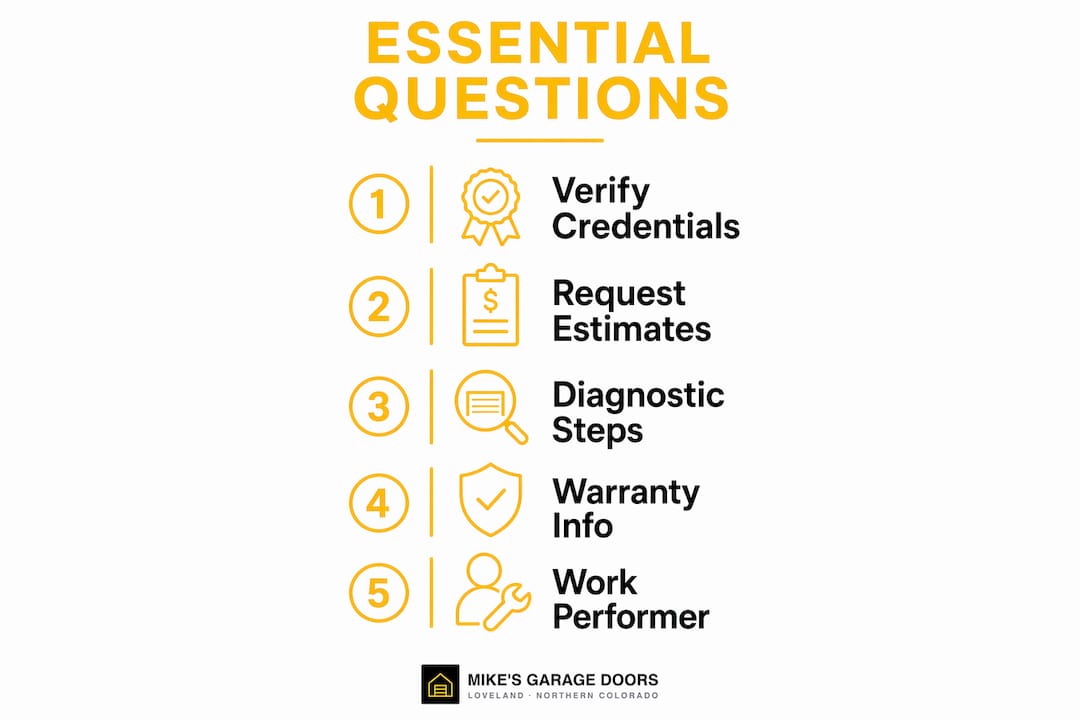
Credentials are the first filter. A legitimate garage door technician provides a contractor license number without hesitation. Confirm the license number immediately and verify it through your state's contractor licensing board. A technician who stalls, changes the subject, or claims they "don't need one for this type of work" is a red flag you cannot afford to ignore.
Beyond the license, ask these questions directly:
- Are you bonded and insured? Request proof, not just a yes. Bonding and insurance protect you if a technician damages your property or gets injured on your driveway. Without it, that liability lands on you.
- Do you have a physical shop location? A local address confirms the company is established in your area, not a fly-by-night operation that disappears after payment. Reputable companies have served their local areas for many years, which means they have experience with the full lifespan of the products they install.
- Can I see your business license? This is separate from a contractor license and confirms the company operates legally as a business entity.
If a technician gets evasive or defensive about any of these questions, treat that as your answer. A professional who has nothing to hide answers these questions in under 60 seconds.
Pro Tip: Search the technician's company name plus your city on the Better Business Bureau website before they arrive. A pattern of unresolved complaints tells you more than any credential.

How do you get a clear, written estimate before work starts?
Transparent pricing is the hallmark of a trustworthy repair provider. Written estimates should detail parts and labor separately, with clear explanations for each line item. A verbal quote is not a quote. It is a starting point that can shift the moment a technician opens your garage door.
Here is how to run the pricing conversation before any work begins:
- Ask for a written estimate before any tools come out. This is non-negotiable. The practice of getting repair costs in writing with parts listed upfront is sometimes called "quote hygiene." It prevents runaway costs from change orders and protects you from unsigned-check scenarios.
- Request a line-by-line breakdown. Parts cost X. Labor costs Y. Service call fee is Z. If a technician bundles everything into one number, ask them to separate it. You need to know what you are paying for.
- Ask what triggers additional charges. Some companies charge extra for after-hours calls, specific part brands, or disposal fees. Get those conditions in writing too.
- Compare estimates for common repairs. Spring replacement, opener repair, and cable work all have typical cost ranges in your market. If one estimate is dramatically lower than others, ask why. Cheap upfront often means inferior parts or a missing warranty.
- Ask if the estimate is binding. A good technician stands behind their written number. If they say the price could change after they "get a better look," ask them to define exactly what would trigger that change.
Pro Tip: Ask specifically whether the estimate includes the service call fee or if that is charged separately. Some companies waive it if you proceed with the repair. Others do not.
What diagnostic steps should a reliable technician perform?
A qualified technician diagnoses before they quote. The balance test is the clearest sign you are dealing with a professional. The technician disconnects the opener, manually lifts the door to waist height, and releases it. A balanced door stays put. A door that crashes down or flies up has a spring or cable problem that needs addressing before anything else.
A technician who skips the balance test after replacing springs is not finishing the job. They are setting you up for a premature failure and a second service call.
Beyond the balance test, a thorough technician inspects springs, cables, and photo-eye sensors for wear and alignment before giving you a final price. This triage approach catches root causes instead of just treating symptoms. Ask your technician directly: "What will you inspect before you give me a final quote?" A good answer names specific components. A bad answer is "I'll take a look and let you know."
A thorough spring replacement visit also includes measuring wire diameter, length, and wind direction to specify the correct parts, then inspecting rollers, bearings, and safety features before completing the balance and safety test. If your technician cannot describe this process, they are likely skipping steps.
One more detail worth asking about: what lubricant does the technician use? A technician who reaches for WD-40 is signaling a lack of expertise. Proper garage door lubricant is lithium or silicone-based. That single detail tells you a lot about how carefully they work.
Which product and warranty questions protect your investment?
Warranties are where many homeowners get burned. They assume a repair is covered, then discover the warranty expired in 90 days or only applies to the part, not the labor. Ask these questions before the technician starts work.
| Question to ask | What a good answer looks like |
|---|---|
| What brands do you service? | Names specific brands and confirms factory authorization |
| Are you an authorized dealer? | Authorized dealers have better parts access and trained technicians for those brands |
| What is the warranty on parts? | States a specific duration and covers premature failure |
| What is the warranty on labor? | Covers workmanship separately from parts, in writing |
| Do you offer high-cycle springs? | Explains that high-cycle springs cost more upfront but last twice as long |
Always ask for warranty terms in writing. A technician who offers a warranty verbally but refuses to put it on paper is offering you nothing. Written warranties protect your investment and give you recourse if the repair fails ahead of schedule.
Ask specifically about safety-critical components like torsion springs and cables. These carry the most mechanical stress and should carry the longest warranty coverage. If a technician offers only a 30-day warranty on a spring replacement, that is below industry standard.
Who will actually perform the work on your property?
This question catches homeowners off guard, but it matters enormously. Ask directly: "Will your own technicians do this job, or do you refer it out?" Using the company's own technicians ensures consistent workmanship and clear warranty responsibility. Subcontracted work creates a gray area where neither party fully owns the outcome.
For property managers overseeing multiple units, this question is even more critical. Subcontracting affects warranty clarity and scheduling consistency, which are both non-negotiable for maintenance reliability across a building. Here is what to document when you confirm who is doing the work:
- The technician's full name and employee ID or license number
- Whether they are a direct employee or a subcontractor
- Who holds the warranty: the company you called or the subcontractor
- How to reach that specific technician for follow-up questions
A reputable company answers this question without hesitation. They know who is going to your property and can tell you exactly who to call if something goes wrong after the job is done. If the answer is vague, ask again. Accountability starts with knowing who is on your driveway.
Key Takeaways
Asking targeted questions before a garage door repair begins is the most reliable way to verify technician credentials, lock in fair pricing, and protect your warranty coverage.
| Point | Details |
|---|---|
| Verify credentials first | Ask for a contractor license number and proof of bonding and insurance before any work begins. |
| Get everything in writing | Written estimates with itemized parts and labor prevent hidden fees and protect you from change orders. |
| Demand a proper diagnostic | A qualified technician performs a balance test and inspects springs, cables, and sensors before quoting. |
| Confirm warranty terms | Request written warranty coverage on both parts and labor, especially for safety-critical components. |
| Know who does the work | Confirm whether the company uses its own technicians or subcontractors to protect warranty accountability. |
What I have learned from watching homeowners skip these questions
The homeowners who get burned are not careless people. They are busy people who assumed a professional would just do the right thing. That assumption costs real money. I have seen torsion springs replaced without a balance test, leaving the opener to fight a door that was still out of alignment. I have seen verbal quotes triple by the time the invoice arrived because nobody asked for a line-by-line breakdown upfront.
The questions in this guide are not adversarial. A good technician welcomes them. When a homeowner asks me about our license, our warranty terms, and whether we use our own crew, I know they are serious and they will be a good long-term customer. The technicians who bristle at these questions are telling you something important about how they operate.
One thing most articles miss: ask the technician to explain the problem to you in plain language before they start. A reputable shop provides clear explanations of the problem, urgency, and repair options so you can decide on timing and necessity. If a technician cannot explain what is wrong in terms you understand, they either do not know or they do not want you to know. Neither is acceptable. You have every right to understand what is happening with your own property. Ask confidently. The right technician will respect you for it.
— Eddie
Mikes garage doors Loveland: where your questions get straight answers
Mikes garage doors Loveland was built on the idea that homeowners deserve honest answers before any work begins. Every estimate is written, itemized, and delivered upfront, so there are no surprises when the invoice arrives. Our technicians are our own employees, not subcontractors, which means the person who fixes your door is the same person accountable for the warranty.

We service broken springs, faulty openers, off-track doors, and everything in between, with 90% of repairs completed the same day you call. Veterans receive a 10% discount as our way of giving back to the Loveland community. When you are ready to work with a team that welcomes every question you have, explore our full garage door repair services in Loveland, CO, and request your written estimate today.
FAQ
What is the first question to ask a garage door technician?
Ask for their contractor license number and proof of insurance before any work begins. A legitimate technician provides both without hesitation.
Should I always get a written estimate for garage door repairs?
Yes. A written estimate with itemized parts and labor is the only way to prevent unexpected fees and protect yourself from change orders after work starts.
How do I know if a technician is doing a thorough diagnostic?
A thorough technician performs a balance test, inspects springs, cables, and photo-eye sensors, and explains the root cause before quoting. Skipping these steps is a red flag.
What warranty should I expect on a garage door spring replacement?
Written warranty terms on both parts and labor are standard for reputable companies. High-cycle springs carry longer coverage and reduce long-term maintenance costs compared to standard springs.
Does it matter if a garage door company uses subcontractors?
Yes, especially for property managers. Subcontracted work creates unclear warranty responsibility and inconsistent scheduling. Always confirm that the company's own technicians will perform the repair.