
Door duty cycle is the percentage of time a garage door or gate operator can run within a set period before it needs to rest and cool down. A common commercial threshold looks like this: light-duty operators handle a low number of cycles daily, while heavy-industrial units run 75 to 200-plus cycles daily. If your traffic pattern beats your operator's rating, check that rating today. UL 325 governs the safety side of these systems, and a LiftMaster commercial-grade opener will list its duty cycle right on the spec sheet. Match the number to your actual peak traffic, not your average.
Key Takeaways
Door duty cycle determines how much running time an operator can handle before overheating, and matching that rating to peak, bunched traffic prevents most premature failures.
| Point | Details |
|---|---|
| Definition | Duty cycle is run time divided by total period, expressed as a percentage or cycles per hour. |
| Bunched traffic matters most | Concentrated cycles overheat operators even when the daily average looks light. |
| Calculate before buying | Time one cycle, log peak cycles per hour, then compute required duty percent. |
| Watch the warranty language | Coverage often voids at either a time limit or a maximum cycle count, whichever comes first. |
| Match rating to real use | Choose industrial or continuous ratings for bunched, high-frequency sites, not just high daily totals. |
Table of Contents
- What Is Duty Cycle, Technically Speaking?
- How Duty Cycle Applies to Automatic and Commercial Doors
- What Are the Common Duty-Cycle Categories?
- How Do You Calculate the Duty Cycle for Your Door?
- What Happens if You Exceed the Rated Duty Cycle?
- Checklist for Choosing the Right Operator
- Sources
- FAQ
What Is Duty Cycle, Technically Speaking?
The formula is simple: D = run time ÷ total period × 100%. If a motor runs 15 minutes out of every 60, that's a 25% duty cycle. Manufacturers don't always express it the same way, though. Some list a straight percentage, others give cycles per hour, and some cap it at a number of consecutive cycles before the unit must rest.
Here's how the conversions work:
- Percent to minutes: A 25% duty cycle over a 60-minute period allows 15 minutes of run time per hour.
- Minutes to cycles per hour: If one full open-close cycle takes 30 seconds of motor run time, 15 minutes of allowed runtime supports about 30 cycles per hour.
Duty cycle callout: A 25% rating doesn't mean "run for 15 minutes, then quit for the day." It means 15 minutes of running per hour, every hour, indefinitely, without overheating.
Electrical engineers originally built this concept for signals and switches, where duty cycle is D = PW/T × 100%, a measure of how long a component dissipates heat. Door operators borrow that same math, but the practical concern is motor and gearbox heat, not signal timing.
How Duty Cycle Applies to Automatic and Commercial Doors
A motor doesn't care about your average traffic. It cares about how fast heat piles up between cycles. That's why bunched activity, like a school pick-up line or a warehouse shift change, stresses a motor far more than the same number of cycles spread evenly across the day. Ten cycles in ten minutes can push a light-duty motor into overheating even if that door only sees 40 cycles total that day. Bunched cycles cause thermal problems that a daily average completely hides.
The whole system affects your real-world duty capacity, not just the motor:
- Voltage drop from long wire runs or an undersized transformer forces the motor to work harder per cycle.
- Worn rollers, dragging tracks, or misaligned hardware add resistance that raises load and heat.
- Aggressive acceleration settings on the controller increase peak current draw.
- High ambient temperatures in a hot warehouse or unshaded loading dock eat into your thermal margin before the motor even starts working.
Pro Tip: Check the duty-cycle line on the manufacturer's datasheet before you ever look at horsepower. Warranty coverage is often tied directly to staying within that rated cycle count, so specifying by feel instead of by spec is how businesses end up paying for a second opener within a year.
If your current setup already shows signs of drag or misalignment, a DIY service check can tell you whether hardware wear is quietly raising your effective duty needs.
What Are the Common Duty-Cycle Categories?
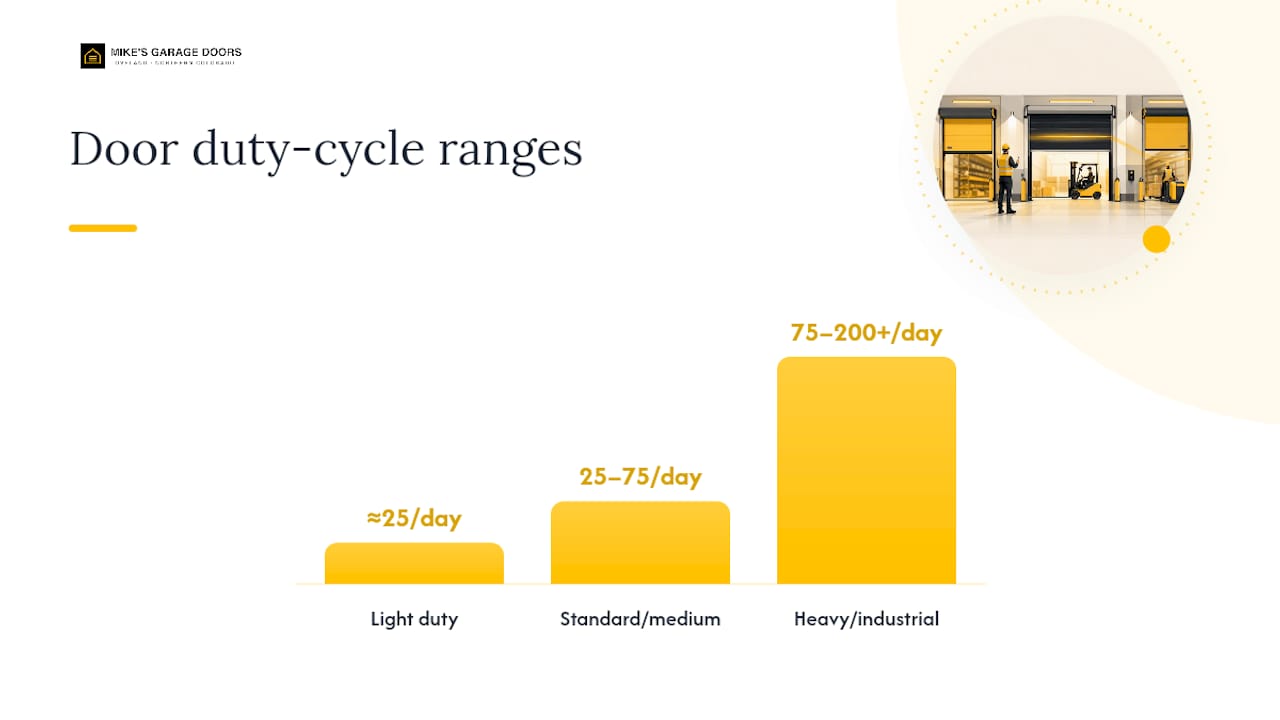
Industry guidance sorts operators into four rough tiers based on daily cycle count. These aren't rigid legal categories, but they're consistent enough across manufacturers to use as a self-classification tool.
| Category | Typical cycle range | Common use case |
|---|---|---|
| Light duty | Around 25 cycles/day | Single-family driveway gate, small residential garage |
| Standard/medium | 25 to 75 cycles/day | Small retail entrance, small office parking gate |
| Heavy/industrial | 75 to 200+ cycles/day | Warehouse dock door, high-traffic parking facility |
| Continuous duty | Sustained running with defined recovery limits | High-throughput yards, distribution centers |
- Light-duty and standard ratings cover the majority of homes and small commercial storefronts.
- Heavy and continuous ratings exist specifically for sites where cycles stack up in short bursts.
- A "continuous duty" label still comes with fine print. Manufacturers set ambient temperature limits and maximum consecutive running time even on continuous-rated units, so verify those numbers before assuming unlimited operation.
How Do You Calculate the Duty Cycle for Your Door?
You don't need a lab to get a workable estimate. Three steps and a stopwatch will get you close enough to spec correctly.
- Time one full cycle. Run the door open and closed, and note the actual motor run time in seconds, not the total time including any pause.
- Count peak cycles per hour. Watch your busiest hour, not your daily average. A loading dock with 40 cycles a day might see 15 of them in one 20-minute rush.
- Compute required duty: required duty (%) = cycles per hour × run time per cycle ÷ 3600 × 100.
Here are two worked examples:
Always confirm whether the manufacturer's number is a percentage, a cycles-per-hour figure, or a consecutive-cycle limit before comparing it to your math — mixing formats is the fastest way to misjudge a spec sheet.
What Happens if You Exceed the Rated Duty Cycle?
Pushing an operator past its rated duty cycle doesn't usually cause instant failure. It causes accumulating damage that shows up weeks or months later.
- Motor overheating from repeated thermal stress, even when daily cycle counts look modest on paper.
- Gearbox wear accelerated by sustained heat and load.
- Control-board failures triggered by voltage irregularities during high-frequency bursts.
- Shortened component life across the whole system, not just the motor.
Warranty terms are frequently written as "time period or maximum cycles, whichever comes first," and reaching either limit can void coverage entirely — regardless of how well the unit was maintained otherwise.
Before a full failure, most modern operators enter thermal-protect mode: the door stops mid-cycle, sits for a cooling period, then resumes normal operation. If you're seeing intermittent stalls with long recovery times, that's the system protecting its motor, not a random glitch. Treat it as an early warning that your duty rating doesn't match your traffic.
Checklist for Choosing the Right Operator
Get these five things confirmed before you sign off on any operator, residential or commercial:
- Time an actual full cycle at your site, not a manufacturer's lab estimate.
- Log your busiest hour for a full week to catch real bunched-traffic patterns.
- Confirm whether the manufacturer's duty rating is a percentage, cycles/hour, or a consecutive-cycle cap.
- Ask directly how many consecutive cycles the unit tolerates before it needs a recovery period.
- Get the warranty terms in writing, specifically what voids coverage.
Ask your installer or the manufacturer these questions directly: What's the defined ambient temperature range for the rated duty cycle? What's the warranty's actual scope if cycle limits are exceeded? For sites with bunched traffic like school zones or shift-change docks, lean toward an industrial or continuous rating even if your daily average looks light.
Pro Tip: Preventive maintenance isn't just about avoiding squeaky hinges. Worn rollers and misaligned tracks quietly raise the load per cycle, which raises your effective duty requirement without changing your traffic pattern at all. A well-maintained door needs less operator than a neglected one running the same schedule.
A Technician's Take on Duty Cycle in the Field
Match the rated duty to your busiest hour, not your daily average, and read the warranty's cycle language before you buy, because that's where the real cost surprises hide.
Sources
- Commercial door operators buyer's guide
- How to choose a gate operator: sizing, duty cycle and specs explained
- Automatic gate motor duty cycle: calculating capacity for peak traffic
- Duty cycles explained
If your current opener keeps stalling mid-cycle or you're not sure whether your traffic has outgrown its rating, Mikes garage doors Loveland colorado can inspect your setup, measure actual cycle demand, and spec a replacement that matches your real usage instead of a guess.
FAQ
What Does a 70% Duty Cycle Mean? A 70% duty cycle indicates that the motor can operate for 70% of a given time period and must rest during the remaining time to avoid overheating. The exact runtime and rest intervals depend on the manufacturer's specifications and the application context.
What Is Duty Cycle in Simple Terms?
Duty cycle is the share of time a motor can actually run compared to the time it needs to sit idle and cool, expressed as a percentage of a fixed period like one hour.