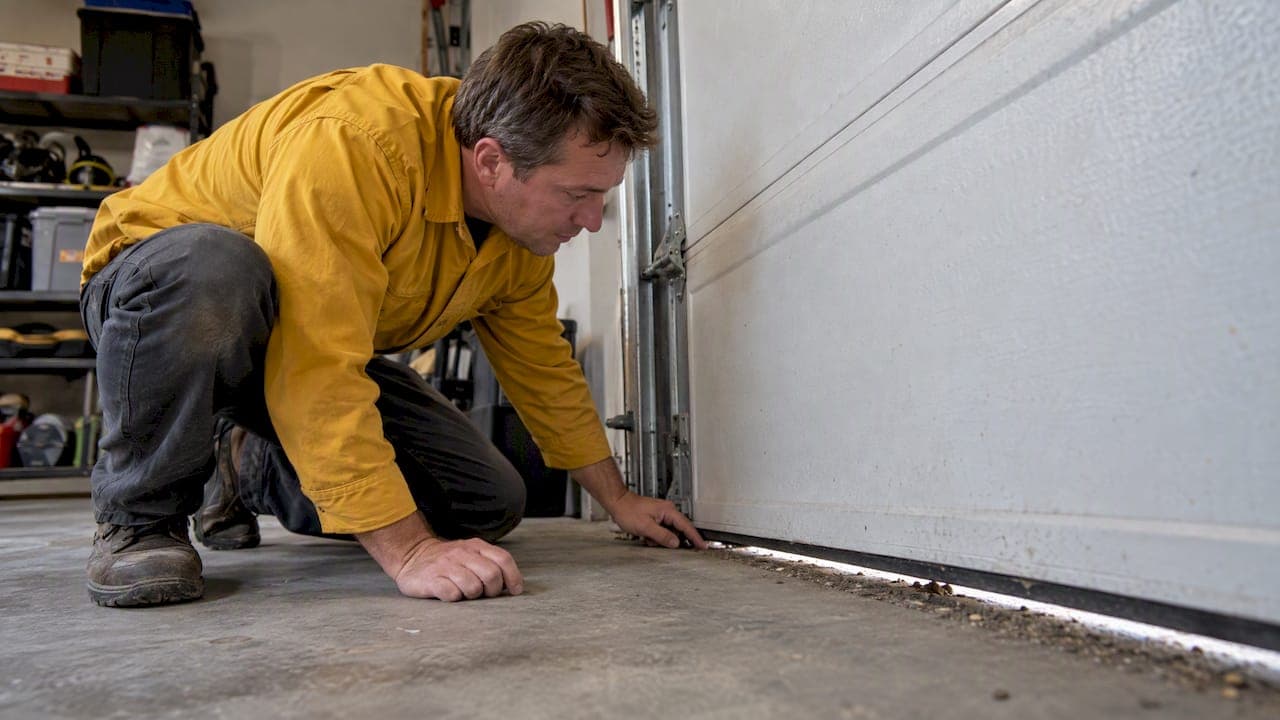
A gap under your garage door usually comes from one of three things: a worn bottom seal, a floor that dips or slopes, or a door that has stopped closing square because something mechanical is off. The first two are cheap, weekend-sized fixes. The third is not, and a new seal will not touch it. The trick is knowing which one you have before you spend a dime.
We repair garage doors in Loveland and across Northern Colorado, and we get this call all the time. Here is how we sort it out, step by step.
TL;DR
- Close the door and look at the gap along its full width. A gap that is even everywhere points to the seal. A gap that is bigger at one end points to the floor or a balance problem.
- Gaps under about half an inch are usually a seal job. Larger gaps on uneven concrete often need a flexible rubber seal, a threshold, or both.
- A door that sits crooked, runs noisy, or looks off-balance has a mechanical problem. Do not force it, and do not buy a seal to hide it.
- Broken springs, frayed cables and off-track doors are not DIY jobs. Call a pro.
- Cold, rain and pests all come through even small gaps, so it is worth fixing before winter.
Table of Contents
- Why a gap under the door matters
- Step one: figure out which kind of gap you have
- Cause one: a worn or wrong bottom seal
- Cause two: an uneven garage floor
- Cause three: the door is the problem, not the seal
- Safety: what not to do yourself
- What it costs
- Perspective: what we see on Loveland doors
- When to call us
- Before winter: a quick prevention routine
- FAQ
- Sources
Why a gap under the door matters
It is easy to shrug at a gap you can slide a finger into. The trouble is what comes through it. According to DURA-LIFT hardware, even gaps under an inch let in rain, drafts and pests, and that undercuts the garage's job as a buffer between the outdoors and the rest of your house.
In Loveland that buffer matters. We get snow, wind-driven grit, and big temperature swings. A garage door takes more weather exposure than most parts of a house, which is why the Building America Solution Center walks through insulating and weatherstripping it. If your garage is attached, the cold air you let in under the door ends up in the walls and floors above and beside it.
One honest note: a garage is not meant to be airtight. Small gaps at the corners are common and not always a problem. You are fixing a gap that lets in water, snow, mice or a steady draft, not chasing perfection.
Step one: figure out which kind of gap you have
Before you touch anything, do this ten-minute check. You need a flashlight and a tape measure.
- Close the door fully. Use the wall button, not the manual release.
- Go inside and turn off the lights in the garage. Have someone shine a flashlight along the bottom from outside, or do it yourself on a bright day. Light shows you exactly where the gap runs.
- Measure at three points: left corner, middle, right corner. Write the numbers down.
- Look at the seal itself. Is it cracked, flattened, brittle, torn, or missing in places?
- Look at the floor. Does the slab crown in the middle, slope toward the driveway, or drop off at one corner?
- Look at the door. Does one side sit higher than the other? Are the top panels square to the frame?
Here is how to read what you found.
| What you see | Most likely cause | Typical path |
|---|---|---|
| Even gap across the width, seal looks flat, cracked or torn | Worn bottom seal | Replace the seal |
| Gap grows toward one or both corners, seal looks fine | Uneven or crowned floor | Flexible seal, wider seal, or threshold |
| Gap bigger on one side, door looks tilted | Cable, spring or balance problem | Professional repair |
| Door looks bent, rollers visible out of the track | Off-track door | Stop using it, call a pro |
| Gap and the door is also noisy or slow | Mechanical strain | Inspection |
Cause one: a worn or wrong bottom seal
The rubber or vinyl strip on the bottom edge of the door is the bottom seal, also called weatherstripping or a bottom gasket. It is the first thing to fail. Sun, cold and years of squashing against concrete harden it until it cracks or stops springing back.
There is more than one kind, and they are not interchangeable. Angi's guide to bottom seal types covers the common profiles, such as T-style seals that slide into a retainer track. Your door's retainer decides what fits. Pull a small piece of the old seal out and bring it with you to the store, or take a clear photo of the end profile.
What a good replacement looks like
Material matters more than most people expect. Practitioners quoted by DURA-LIFT recommend 100% EPDM rubber seals, which they say hold their shape up to five times longer than standard vinyl. EPDM stays flexible in cold, which is relevant here, since stiff seals in a Colorado January do not conform to anything.
Replacing it yourself
If your gap is even and the door is otherwise working fine, this is a reasonable DIY job. We have a full walkthrough in How to Replace a Garage Door Weather Seal the Right Way. The short version:
- Close the door, then unplug the opener or disconnect power so it cannot move while you work.
- Slide the old seal out of its retainer from one end. Cut it free if it fights you.
- Clean the grooves. The Building America Solution Center suggests clearing debris with a stiff dust brush before you slide in new rubber.
- Cut the new seal a little longer than the door is wide, then feed it in from one end. A bit of soapy water on the rubber can help it slide.
- Trim the ends flush, reconnect power, and run the door once to check for rubbing.
If you are weighing parts against a pro visit, our post on DIY garage door weather stripping costs lays out both sides.
One caution from the research: one source warns against putting lubricant on door tracks because it collects grit and speeds up wear. Keep any lubricant to the seal grooves, in a light coat, and keep the tracks clean.
Cause two: an uneven garage floor
This is the one that fools people. You replace a perfectly decent seal, and the gap is still there, or worse. A thicker seal does not fix a crowned slab. As one homeowner described on the Garage Journal forum, a new seal made a roughly 2-inch corner gap larger, not smaller.
The reason is that rigid vinyl will not follow irregular concrete. Practitioners recommend flexible EPDM rubber for better compression, and for gaps over half an inch, pairing a bulb seal with a floor-mounted threshold.
Your options, from small to large
- Gap up to about half an inch: A fresh, flexible bottom seal often closes it. Choose a bulb or T-style EPDM seal that is generous enough to flatten into the dip.
- Gap over half an inch at the corners: A wider seal, or a bulb seal paired with a threshold. A threshold is a rubber ramp glued to the floor that the door lands on. GaraDry describes that approach for uneven floors.
- Gap large and the floor slopes out of the garage: A threshold also helps keep water out. In that case you want one that is tall enough to turn runoff away from the door.
- Severe slab problems: Grinding or patching the concrete is possible, but it is a bigger project and not one we would start with.
A word about thresholds: they can trip people, and they take a hit from snow shovels and plows. Think about how you use the garage before you glue anything down.
Cause three: the door is the problem, not the seal
Sometimes the gap is a symptom. A door that hangs unevenly will leave a gap on one side no matter what seal you put on it. That is the situation where we ask people to stop shopping and start looking at the hardware.
Industry guidance is clear that you should not conflate seal replacement with structural repair. A door that is off-balance, slow or noisy is likely under mechanical strain, not suffering simple seal wear. Catch it early and you avoid a snapped spring or cable, which costs far more to fix than a tune-up.
Signs the problem is mechanical:
- One side rises faster than the other when the door opens. Garage.com ties that to cable damage, uneven spring tension or track alignment.
- The door looks crooked in the closed position.
- You hear grinding, popping or squealing that was not there before.
- A gap shows up on one side only, with a seal that still looks fine.
- The door feels heavy when you lift it by hand with the opener disconnected.
We wrote two posts on this. Garage Door Gap? Test Balance Before Buying a Top Seal explains why balance comes first, and Test an Unbalanced Garage Door by Lifting 3 to 4 Feet walks you through a safe check. If the noise is the main complaint, try Noisy Garage Door Fix.
When it is off track
A door that looks like it has a gap at the bottom may really be off track or have snapped cables. CostInspector warns that forcing a misaligned or off-track door can do severe, costly damage to springs and panels. Loose track brackets are one cause: over years of vibration they drift, the track shifts, and a roller can slip out.

If you see this, do not run the opener and do not try to push the door back into place. Leave it, keep people and cars clear, and call for help.
Safety: what not to do yourself
Torsion springs and lift cables hold a lot of stored energy. A broken spring can sound like a gunshot, and it turns your 200-pound door into dead weight. Adjusting, unwinding or replacing springs and cables takes the right winding bars and the right training. Mistakes injure people.
A seal swap is a homeowner job. Spring, cable and track work is for a trained technician. If your gap comes with any sign of a mechanical issue, that is the point to hand it off.
What it costs
Seal work is cheap compared with mechanical repair. For context, HomeGuide puts typical garage door repair at $150 to $350, with simple fixes sometimes starting under $100 and minimum service fees possible. Bigger repairs, such as full track resets or major component failures, can reach $500 to $1,000 or more depending on parts and labor.
For an off-track door in particular, LatestCost reports technicians generally charge $125 to $450 to secure a door that has slipped off an otherwise straight, undamaged track. These are national figures. Prices around Larimer County vary by door and by job.

We do not post flat prices because every door is different. What we do is give you an upfront estimate over the phone, so you know the number before anyone shows up.
Perspective: what we see on Loveland doors
Most gap calls we get start with someone who already bought a seal. Sometimes it is the right fix. Often it is not, because the real issue was a balance problem or a slab that dips at one corner. So we always look at the whole door, not just the strip along the bottom.
Our rule is simple. If the gap is even and the seal is old, replace the seal and move on. If the gap is lopsided, check balance before you spend anything. A door that is out of balance wears out the opener and the springs faster, and a seal will not hide that.
We are a family-owned shop, and about 90% of our repairs get finished the same day. We would rather tell you over the phone that a $30 seal will do the job than sell you something you do not need. If it is a spring or a track, we will say that too, and back the work with a written warranty on parts and labor.
— Eddie
When to call us
Call if any of these are true:
- The gap is uneven and the door looks tilted.
- You hear a loud bang, or the door will not lift.
- A cable is frayed or hanging, or a roller is out of the track.
- You replaced the seal and the gap is still there.
- You run a business and cannot have a door stuck open overnight.
Our garage door services cover tune-ups, spring repair, opener repair and installation, commercial doors, custom doors and parts, and 24-hour emergency repair. A tune-up is often the smart middle step when a door is starting to show strain but has not failed. Veterans get an automatic 10% discount.
Not sure what you are looking at? Our post on 9 signs your garage door needs repair now is a good checklist. Or call us, describe the gap, and we will tell you whether it is a DIY job.
Before winter: a quick prevention routine
A few small habits keep gaps from sneaking up on you.
- Look at the seal each fall. Press it with a finger. If it is stiff or stays flattened, plan to replace it.
- Keep the bottom edge clean. Dirt and leaves under the seal stop it sealing and wear it out faster.
- Clear snow and ice away from the door before you close it, so the seal is not frozen to the floor and torn on opening.
- Watch for changes. A new noise, a slower door or a lopsided close is worth a call before it becomes a broken spring.
- Schedule a tune-up if it has been a while since anyone checked the hardware.
FAQ
How do I fix a gap under my garage door?
Start by measuring the gap at both corners and the middle. An even gap with a worn seal means replacing the seal. A gap that varies along the width usually means an uneven floor, which calls for a flexible EPDM seal or a threshold. If the door looks tilted or the gap is on one side only, have a technician check balance, cables and springs.
What is the strip at the bottom of a garage door called?
It is called the bottom seal, and you will also hear bottom gasket, door sweep or weatherstripping. It slides into a retainer track along the bottom edge of the door. Common profiles include T-style, J-type and bulb seals, so match the profile before you buy.
What is the best bottom seal for an uneven concrete floor?
A flexible EPDM rubber seal tends to do best, because it compresses into dips where rigid vinyl will not. For gaps larger than about half an inch, practitioners suggest pairing a bulb seal with a floor threshold. Measure your widest gap first so you pick the right size.
How much does it cost to fix a misaligned garage door?
Nationally, HomeGuide lists $150 to $350 as a typical repair range, and track resets or major parts can run higher. Cost depends on what is actually wrong. Call us with a description and we will give you an upfront estimate over the phone.
Can I just leave a small gap?
Sometimes, yes. Garages are not built to be airtight, and small corner gaps are common. But rain, drafts and pests can still get through gaps under an inch, so if you store anything valuable or have a room above the garage, it is worth sealing.
Sources
- Sealing the Bottom of an Uneven Garage Door, DURA-LIFT Door Hardware
- Insulate and Weatherstrip a Garage Door, Building America Solution Center
- Garage Door Off Track or Bent Track: Repair Cost, CostInspector
- Garage Door Repair Costs, Problems & Fixes, Garage.com
- How Much Does Garage Door Repair Cost? HomeGuide
- Cost to Put a Garage Door Back on Track, LatestCost
- 6 Garage Door Bottom Seal Types, Angi
- How To Seal An Uneven Garage Floor, GaraDry USA
- Garage door seal, large gaps, uneven floor, Garage Journal forum