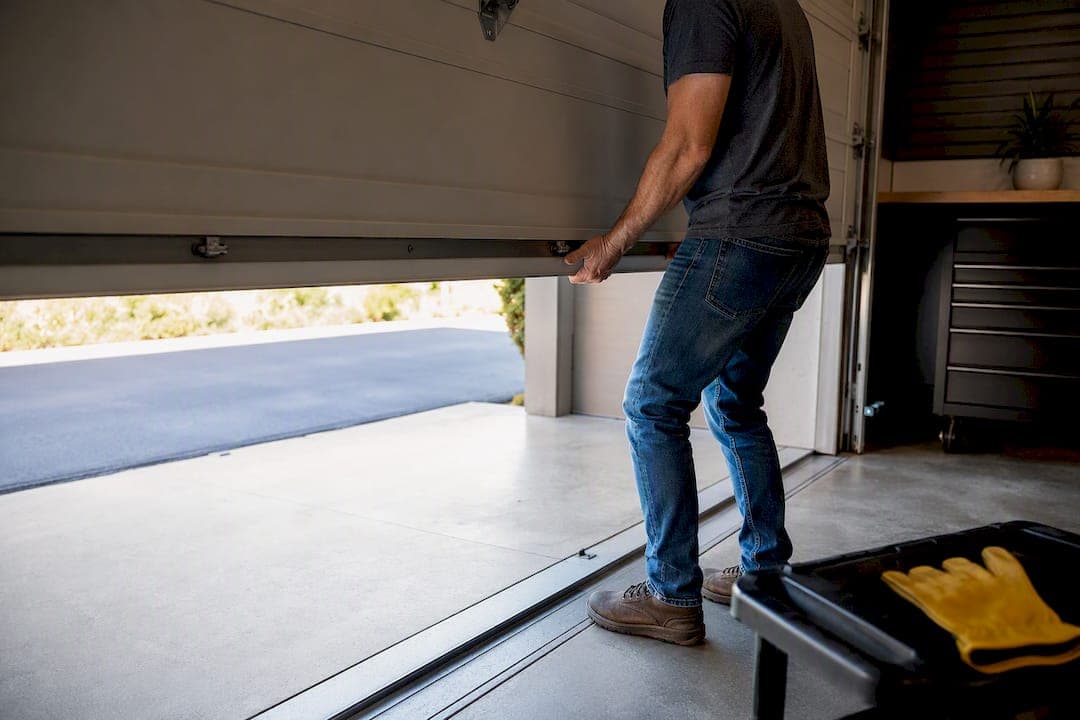
If your garage door slams down, shoots up, or hangs crooked when you test it, you're dealing with an unbalanced garage door, and it's almost always a spring or hardware problem. Stop running the opener until you know more. A quick, careful balance test can confirm the issue, but never touch the springs or cables yourself. When the test looks bad, call a technician before you use the door again.
TL;DR:
- An unbalanced garage door often results from worn or broken springs, misaligned cables, structural changes, or rust, which can cause it to hang crooked or travel at an angle.
- A proper balance test involves manually lifting the door to about four feet and releasing it; a balanced door should hold position or drift down slowly.
- Stop operating the garage door immediately if it slams shut or shoots open, as these signs indicate a serious imbalance requiring professional repair.
- Regular maintenance, including monthly manual tests and biannual visual inspections, can prevent imbalance from worsening and reduce repair costs.
- Only qualified technicians should adjust or replace springs and cables because of the extreme tension involved and the risk of serious injury.
Table of Contents
- What an Unbalanced Garage Door Looks and Sounds Like
- How to Safely Test Your Garage Door's Balance
- Common Reasons a Garage Door Goes Out of Balance
- When to Stop Using the Door and Call a Technician
- Simple Maintenance That Keeps Your Door Balanced
- How We Look at Garage Door Balance Problems
- Getting Your Garage Door Balanced the Right Way
- Sources
- FAQ
What an Unbalanced Garage Door Looks and Sounds Like
An unbalanced garage door rarely hides itself. You'll usually catch it with your eyes first: the door travels crooked, dipping lower on one side as it moves along the tracks. Sometimes it won't stay put where you leave it. Ask it to hold halfway open and it either creeps back down or lurches upward on its own.
Sound gives it away too. Listen for grinding, creaking, or a sharp metal-on-metal noise that wasn't there a month ago. A door that used to glide now groans through the whole cycle.
The reason this matters comes down to weight and tension. Residential steel doors commonly weigh 130 to 350 pounds, and insulated double-wide doors often land at the heavy end of that range. Springs exist purely to counterbalance that mass. When they weaken or break, your opener suddenly has to lift dead weight it was never built to handle. That mismatch strains gears, stretches cables, and turns a $20 part failure into a much bigger repair if you keep running it.
- Door hangs crooked or travels at an angle
- Won't hold its position when stopped partway
- Slams shut or shoots open faster than normal
- Grinding, creaking, or metallic scraping sounds during operation
Ignoring a slight imbalance rarely stays minor. It tends to accelerate wear across the whole system, turning what could have been a simple spring swap into a job involving cables, drums, and the opener too.
How to Safely Test Your Garage Door's Balance
Manufacturers like Genie and Chamberlain both publish the same basic procedure, and it's worth following it exactly rather than improvising. Never test with the door open, and never test with anyone standing underneath it.
- Close the door completely and clear the area of people, pets, and vehicles.
- Locate the emergency release cord (usually a red pull handle hanging from the opener carriage) and pull it to disconnect the opener from the door.
- Lift the door manually to about 3 or 4 feet off the ground.
- Let go and watch what happens.
A balanced door holds its position or drifts down slowly once you release it. That's the outcome you want. If it drifts noticeably faster than a slow settle, the spring tension is off but manageable for now. If it slams down or shoots upward on its own, stop immediately. That door is out of balance and needs professional service, not another DIY attempt.
Pro Tip: If the door only sticks slightly or drags on one side, check first for a track obstruction or a dry roller before assuming it's a spring issue. A quick wipe-down and a shot of silicone lubricant sometimes solves what looks like an imbalance.
Once you've reconnected the opener, don't try to loosen, tighten, or shim anything near the springs, cables, pulleys, or bottom brackets, and always follow electrical safety tips when working near power components. Those parts sit under extreme tension and can cause serious injury if they let go while you're working near them.
Common Reasons a Garage Door Goes Out of Balance
Most imbalance problems trace back to one of four culprits, and a technician will check all four during a visit.
- Worn or broken springs. Torsion and extension springs lose tension over thousands of open-close cycles, or they snap outright from age and metal fatigue.
- Cable and drum wear. Frayed, loose, or off-track lift cables, along with worn drums or pulleys, throw off how evenly the door rises.
- Structural changes. Bent tracks, damaged panels, or extra hardware (a heavier decorative panel, added insulation) can shift the door's actual weight away from what the springs were sized for.
- Moisture and rust. Water intrusion adds weight to wood panels and insulation, while rust on hardware increases friction and resistance throughout the system.
Any one of these throws off the careful math that balances a 200 pound door against a spring system designed for that exact weight. A spring adjustment issue that seems small at first often points to one of these underlying causes rather than a simple fix.
When to Stop Using the Door and Call a Technician
Some signs mean you shouldn't wait for a scheduled inspection. Call right away if you see a visibly broken spring or snapped cable, if the door slams or refuses to stay open at any position, or if you notice a connector, bracket, or pulley that's clearly failed. At that point, the door isn't just inconvenient. It's a hazard to whoever opens it next.
A technician's diagnosis typically walks through the same balance test you can do yourself, then goes further: inspecting spring condition, checking cable tension at the drums, and testing how the opener's coupling handles the load. If one spring has failed, most technicians will recommend replacing both at once so the tension stays even on each side.
- Visible broken spring, cable, or bracket
- Door slams down or shoots up during your own balance check
- Door won't hold any position when released manually
Spring and cable work isn't a homeowner project, and it's not about lacking confidence with tools. It's about the tension those parts hold and the specialized winding bars and clamps required to release that tension safely. Cost and scheduling usually hinge on whether you need one spring or a matched pair, the door's size and weight class, and whether the cables, drums, or opener took damage alongside the springs.
Pro Tip: Before you call, note whether the imbalance happened suddenly (likely a snapped spring) or crept in gradually (likely wear). That detail helps a technician bring the right parts on the first visit instead of a second trip.
Simple Maintenance That Keeps Your Door Balanced
Most imbalance problems don't appear overnight. They build slowly, which means routine attention catches them before they become emergencies.
- Run a quick manual balance test once a month, following the same close-disconnect-lift-release steps.
- Do a more thorough visual inspection twice a year, checking tracks, rollers, and hinges for rust, wear, or obstruction.
- Lubricate rollers and hinges with a silicone-based product during that seasonal check, since dry hardware adds resistance that mimics imbalance symptoms.
- Schedule spring replacement proactively once you notice consistent drift or age past the 7 to 10 year mark, rather than waiting for a snap.
Genie's own maintenance guidance backs this cadence, and it lines up with what Garage Door Science recommends too: catching a spring on its way out costs far less than replacing one after it fails mid-cycle.
How We Look at Garage Door Balance Problems
Most garage door guides tell you to run the balance test and stop there, as if that's the whole job. It isn't. The test tells you that something's wrong. It doesn't tell you why, and guessing wrong on that second part is how a $250 spring job turns into a $600 repair involving cables, drums, and opener gears.
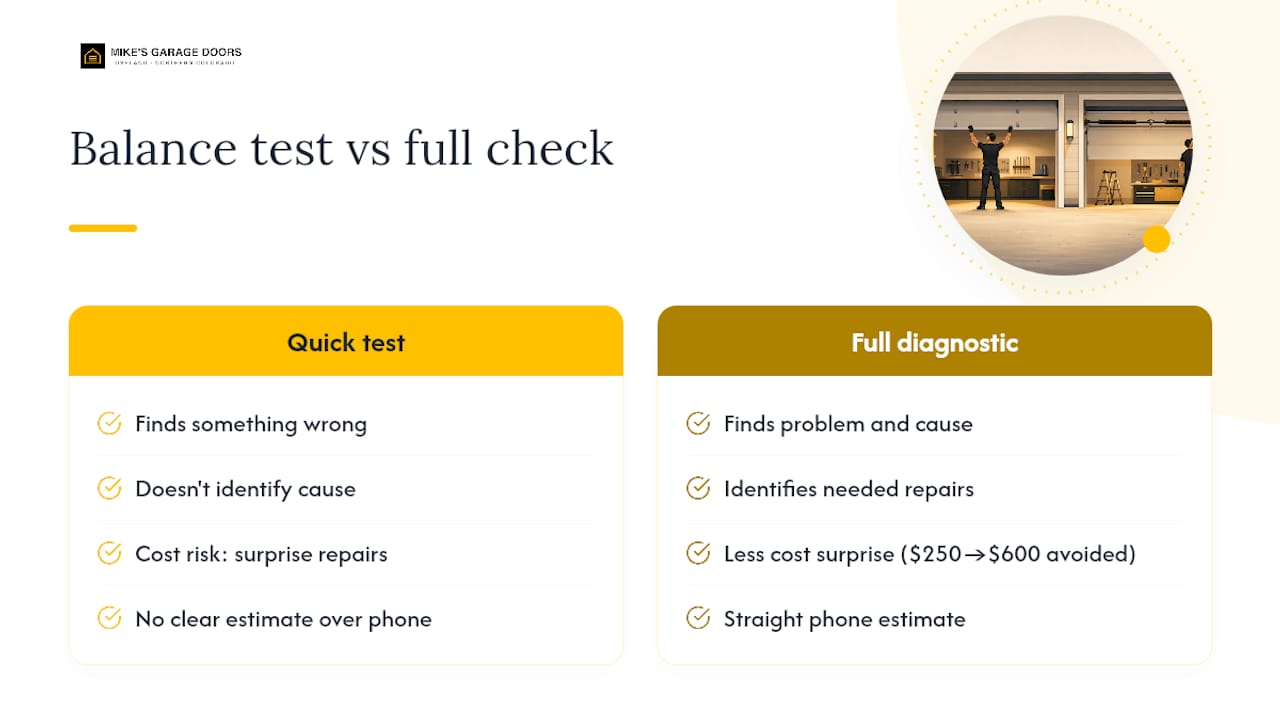
That's the gap we try to close on every call. You get a straight estimate over the phone, not a surprise invoice after the truck leaves. Veterans get 10% off, and every repair carries a warranty because we'd rather stand behind the work than hope you don't call back.
The honest take? An unbalanced door is rarely urgent enough to panic over, but it's never something to just live with either.
— Eddie
Getting Your Garage Door Balanced the Right Way
Mikes garage doors Loveland colorado handles the exact problems this guide covers: spring replacement, cable and roller repair, opener inspection, and the preventive maintenance that keeps a balance issue from becoming an emergency in the first place.

When you call, tell the dispatcher what you noticed: whether the door slammed, drifted, or hung crooked, what type of door and opener you have, and whether anything changed recently, like a new panel or a storm that dropped debris on the tracks. That handful of details lets a technician arrive with the right spring size and tools instead of guessing on-site. If your imbalance test came back with slamming, shooting, or a crooked crawl, visit the garage door services page to book a diagnostic and get it fixed before it strands your car inside or hurts someone underneath it.
Sources
- How to Check If Your Garage Door Is Balanced – The Genie Company
- How to test the balance of a garage door
- Garage door repair: what you can fix, what to leave alone, and how to tell the difference · Garage Door Science
FAQ
What should I do if my garage door is out of balance?
Stop using the opener, run the manual balance test with the door disconnected, and if it slams or shoots up, call a technician instead of adjusting anything yourself.
How much should it cost to balance a garage door?
Cost depends on whether one spring or a matched pair needs replacing, plus the door's size and whether cables or the opener were also damaged, so an accurate number requires an on-site or phone estimate rather than a flat figure.
How do you adjust the balance on a garage door?
Balance is restored by adjusting spring tension or replacing worn springs and cables, which requires specialized winding bars and clamps and should only be done by a trained technician given the tension involved.
How do I fix a garage door that hangs uneven?
Uneven travel usually points to a worn cable, an off-track drum, or a failing spring on one side, and the fix starts with the manual balance test to confirm which component is causing the tilt before calling for repair.