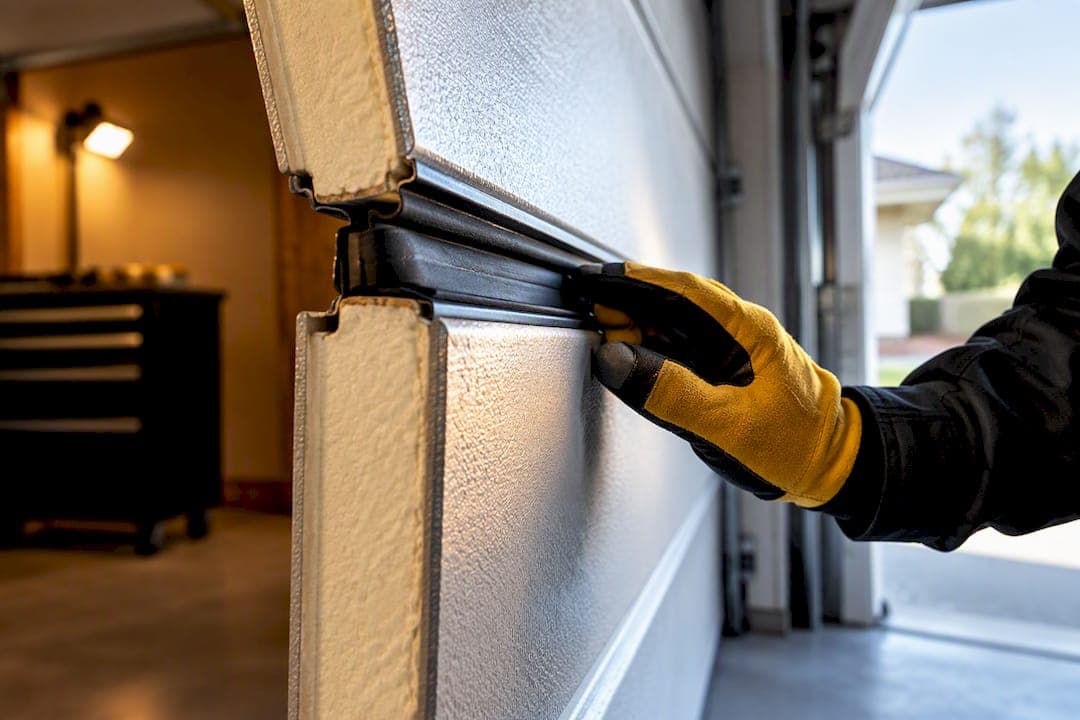
For most homeowners, target at least R‑10 for an attached garage, especially if it shares a wall or ceiling with living space. Detached or unheated garages can usually get by with R‑6 to R‑9. Either way, a high R-value number on a sticker means little if the door has gaps at the joints or a lousy seal around the edges.
TL;DR:
- U-factor ratings are more accurate for comparing garage doors because they account for joints, hardware, and perimeter sealing, unlike section R-values.
- Doors with injected polyurethane cores provide the highest R-values per inch and improve rigidity, but outdated or thin doors may offer inflated R-value claims.
- Retrofitting uninsulated doors with foam kits boosts R-value modestly and requires sealing and rebalancing to avoid damaging the door system.
- For attached garages in cold climates, R‑10 or higher is recommended, while detached or unheated garages can usually suffice with R‑6 to R‑9.
- Proper sealing and door balance are more critical for energy efficiency than simply choosing a higher R-value door or reading insulation labels alone.
Table of Contents
- What Does R-Value Mean for a Garage Door?
- R-Value vs U-Factor: Which Number Should You Trust?
- What Do Different R-Value Ranges Mean in Practice?
- Which Insulation Material Delivers the Best R-Value?
- Can You Insulate an Existing Garage Door?
- How Do You Choose the Right R-Value for Your Garage?
- A Local Technician's Take on Garage Door R-Value
- Get Your Garage Door's R-Value and Seals Checked
- Sources
- FAQ
What Does R-Value Mean for a Garage Door?
R-value measures thermal resistance. The higher the number, the better the material resists heat transfer, and it's typically expressed per inch of material and stacked cumulatively when you combine layers, according to Building America's insulation guidance. A 2-inch foam core with an R-value of 8 per inch gets you to roughly R‑16, assuming nothing else gets in the way.
That "assuming" is doing a lot of work. R-value for a garage door is a section calculation. It adds up the air films on both sides of the panel plus the resistance of the insulation itself, based on a formula DASMA lays out in its technical data sheet on garage door thermal ratings. One worked example in that sheet, combining air films with mixed foam thicknesses, lands at a section R-value near 16.47. That's a clean lab number for one panel. It says nothing about the joints between panels, the weatherstripping at the bottom, or the gap around the perimeter where most of your heat actually escapes.

R-Value vs U-Factor: Which Number Should You Trust?
U-factor measures the whole assembled door, not just one section of panel. It's tested under ANSI/DASMA Standard 105, which accounts for joints, hardware, and the perimeter as a complete unit rather than a slice of foam in isolation.
R-value and U-factor are not simple opposites of each other, and manufacturers often report whichever number makes their product look best. DASMA has pushed the industry toward reporting U-factor because it "better reflects installed environment performance," according to its Thermal Performance Verification Program documentation. If a manufacturer gives you a tested U-factor, use it for apples-to-apples comparisons. If only R-value is listed, treat it as a rough guide to the insulation core, not a promise about the finished door hanging in your opening.

What Do Different R-Value Ranges Mean in Practice?
Garage doors generally fall into four bands, and each one buys you something different:
- R‑0 to R‑3: Single-layer steel or wood with no real insulation core. Fine for a detached shed-style garage you never step into in January.
- R‑6 to R‑9: Light insulation, usually a thin polystyrene layer. Cuts down on drafts and rattling, but won't do much for temperature swings in an attached garage.
- R‑10 to R‑13: A solid mid-tier choice. This is the range most building science guidance points toward for garages attached to conditioned living space.
- R‑14 and up: High-performance doors with thick polyurethane cores. Worth it for workshops, heated garages, or anyone who spends real time out there in the cold.
The DOE and ENERGY STAR guidance on insulation levels points out that recommended levels shift by climate zone, the same way attic or wall insulation targets do. Every step up the R-value ladder buys you three things: steadier temperatures in the garage itself, less strain on the furnace or AC serving the rooms next door, and a noticeably quieter door. That last one surprises people. Thicker foam cores deaden sound almost as a side effect, which matters if a bedroom sits above or beside the garage.
Which Insulation Material Delivers the Best R-Value?
Polyurethane, injected as a liquid foam that expands and bonds directly to the steel skins, typically produces a higher R-value per inch than polystyrene panels because it fills the cavity completely and adheres to the surrounding structure instead of just sitting inside it, per Clopay's technical comparison of insulation cores. That bonding matters as much as the material itself, since a foam layer that shrinks away from the steel leaves a thermal gap no R-number accounts for.
Here's how the common core materials stack up:
- Injected polyurethane: Highest R per inch of the common options; bonds to the door skins, adding rigidity and reducing dents.
- Polystyrene (EPS/XPS) panels: Lower R per inch, cheaper to produce, but can shift or leave gaps over time if not fully bonded to the panel.
- Fiberglass bats: Rare on modern doors, mostly seen on older or budget models; lower performance and prone to sagging.
Pro Tip: Don't shop by R-value alone. Ask what the door weighs and how thick the panel is. A high R-value squeezed into a thin panel usually means a denser, pricier foam, while a suspiciously light "high R-value" door may be relying on marketing math rather than real core thickness. Our comparison of insulation materials and installed cost breaks down what you actually pay for each tier.
Can You Insulate an Existing Garage Door?
Retrofitting is possible, and it helps, but it has a ceiling. Here's the realistic path:
- Start with an insulation kit or rigid foam board. These snap or glue into the panel recesses and add a modest R boost, usually a few points, not a jump into the R‑14 range.
- Fix the weatherstripping first. A cracked or missing seal around the bottom and sides leaks more heat than a few extra inches of foam will ever recover. Our weatherstripping guide covers what a DIY kit costs versus a professional install.
- Weigh the added mass. Foam kits add weight to each panel, which can throw off spring tension and door balance if nobody rechecks it afterward.
- Call a technician for anything beyond stick-on kits. Rigid board installs and opener recalibration are where amateur retrofits go wrong.
Retrofits can't fix a leaky joint between panels or the gap where an old door never sealed well to begin with, which is why new interior doors improve energy efficiency in older Portland homes by addressing sealing and insulation comprehensively. If the door itself is warped, thin, or decades old, replacement usually outperforms any amount of add-on foam.
How Do You Choose the Right R-Value for Your Garage?
Work through the decision in order, not all at once:
- Climate first. Cold-winter regions justify chasing R‑14+; mild climates rarely need more than R‑10.
- Attachment second. Shared walls or ceilings with living space push you toward the R‑10+ range regardless of climate, since heat loss there hits your utility bill directly.
- Usage third. A workshop or home gym in the garage changes the math entirely compared to a space that just holds a car and some bins.
- Budget last, not first. Decide the R-value you need before you start pricing doors, or you'll talk yourself into whatever's cheapest.
Before hiring anyone, ask three questions: "Do you have a tested U-factor for the assembled door, not just the section R-value?" "How will you seal the perimeter and joints, not just fill the panel?" And if you're retrofitting, "Will this affect opener balance, and will you recheck it?"
Pro Tip: Walk away from any installer who can't answer the balance question. A door that's out of balance after a retrofit strains the opener and springs, which turns a $200 insulation job into a $400 spring replacement within a year. Watch for thin, single-skin doors marketed with inflated R-value claims. If the panel looks like it's a half-inch thick, the number on the sticker is doing more marketing than insulating.
A Local Technician's Take on Garage Door R-Value
After enough service calls, a pattern shows up: homeowners chase a big R-value number and skip the boring stuff, like whether the door actually seals when it's shut. Sealing and balance move the needle more than one extra number ever will.
— Eddie
Get Your Garage Door's R-Value and Seals Checked
If you're staring at a drafty garage door wondering whether the fix is a $40 weatherstrip kit or a full replacement, A local garage door repair service can give you a straight answer over the phone before any truck shows up. That's the real advantage here: no vague "we'll assess and quote later" runaround, just an upfront estimate so you know the cost before you commit.

If your garage shares a wall with living space and you suspect the door's R-value isn't pulling its weight, start with our garage door services page and get a quote that won't change once we're in your driveway.
Sources
- Building America Best Practices: Energy Renovations-Insulation (U.S. DOE / Building America)
- U-factor and R-value for Residential and Commercial Garage Doors (DASMA Technical Data Sheet)
- Clopay Intellicore® R-Value: Benefits & Savings | Clopay
FAQ
Is a Higher R-Value Garage Door Worth It?
Yes, if your garage is attached to living space or you spend real time working out there. The jump from R‑6 to R‑10 or higher typically means steadier indoor temperatures, less strain on adjacent HVAC systems, and a quieter door, though the biggest gains still depend on a tight seal around the perimeter.
What Garage Door Has the Best R-Value?
Doors with injected polyurethane cores generally post the highest R-value per inch among common materials, since the foam bonds directly to the steel skins and fills the cavity completely, per Clopay's core comparison. No single model claims a universal "best" rating, since R-value varies by thickness and how well the manufacturer seals the panel.
Can I Insulate an Uninsulated Garage Door?
Yes, with insulation kits, rigid foam board, or panel inserts, though the R-value gain is usually modest compared to a factory-insulated door. Retrofits also can't fix leaky joints between panels, so pairing any kit with better weatherstripping matters more than the foam alone.
What's the Difference Between R-Value and U-Factor on a Garage Door?
R-value is a calculated number for one section of the door's insulation, while U-factor is a tested rating for the entire assembled door, including joints and hardware, following ANSI/DASMA Standard 105. When both numbers are available, U-factor gives a more reliable picture of real-world performance.
Should Detached Garages Get the Same R-Value as Attached Ones?
No. Detached or unheated garages generally do fine with R‑6 to R‑9, since there's no shared wall or ceiling pulling heat from your living space. Attached garages benefit from R‑10 or higher because heat loss there affects the rooms next door directly.