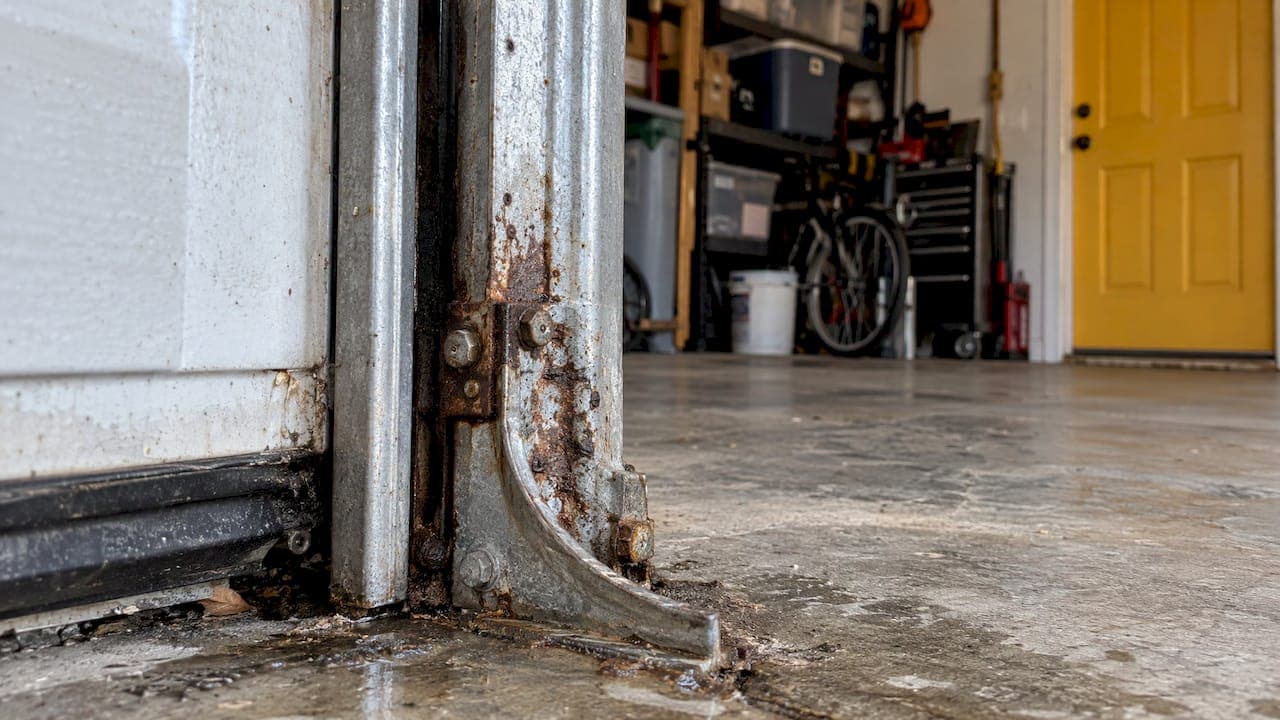
Rust on a garage door track starts as a few orange freckles and ends with a track that no longer holds its shape. Light surface rust on a track that is still straight and solid is a maintenance item. Flaking, pitted or crumbling metal, or a door that binds, shakes or sticks, is a repair. If you see the second kind, stop using the door and call a technician.
We repair garage doors in Loveland and across Northern Colorado every week. Here is how to tell the two situations apart, why tracks rust in the first place, and what keeps them healthy.
TL;DR
- Tracks rust when steel stays wet: condensation, rain blowing under the door, sprinklers, wet cars and ice-melt products all contribute.
- Light surface rust on a straight, solid track is usually cosmetic. Flaking, holes, a thinned bottom edge or a bent section mean the track needs a professional.
- Stop using a door that binds, sticks, jerks or will not stay put halfway up. Federal safety guidance says those doors need professional service.
- Prevention is simple: dry the track, keep moisture out, rinse off salt and inspect twice a year.
- We give honest phone estimates up front, and about 90% of our repairs are finished the same day.
Table of Contents
- What rust on a garage door track actually is
- Why your tracks are rusting
- How bad is it? A quick way to read the rust
- Can you stop using a rusty track? When to stop
- Surface rust or replacement: how we decide
- What to do between rust spotting and the technician's visit
- Keeping tracks from rusting again
- Our perspective
- Get your tracks looked at in Loveland
- FAQ
- Sources
What rust on a garage door track actually is
Rust is what happens when unprotected iron or steel meets air and water. Georgia State University's physics department explains that unprotected iron exposed to air and water rusts, and that salt water speeds the process up. A garage door track is formed steel with a protective coating. Once that coating is scratched, worn through or constantly wet, the bare steel underneath starts to corrode.
The track is a harder place for rust to hide than most people think. It runs along the floor, down at the lowest point of the door, where water collects. It also has joints, brackets and bolted overlaps, and those are exactly where trapped moisture does the most harm. A University of Pittsburgh corrosion report on steel structures notes that chloride exposure, moisture-carrying debris and damaged coatings all contribute to steel corrosion, including crevice corrosion at joints. That report is about bridges, not garages, but the same chemistry applies to any coated steel that stays damp at its seams.
Why your tracks are rusting
Most rusty tracks trace back to one of a handful of causes. Find yours, because fixing the rust without fixing the cause just resets the clock.
Trapped moisture and poor ventilation
A closed garage with little airflow holds humidity. When temperatures drop overnight, that moisture can condense on cool metal. One 2026 write-up on rusting tracks points to poor ventilation as a driver of overnight condensation on tracks. Colorado has big temperature swings between day and night, so this is easy to picture in a Loveland garage in spring and fall.
Water coming in at the bottom
The same source lists rain blowing under the door, sprinklers that hit the lower track and wet vehicles parked inside as common culprits. If your seal at the bottom of the door is worn or the driveway slopes toward the garage, water reaches the lowest track section every time it rains or snows melts.
Check these spots first:
- The lower 12 inches of each vertical track, where standing water sits.
- Where the track bolts to the wall brackets.
- The curved section where the vertical track meets the horizontal one.
- Any area directly in the path of a lawn sprinkler.
Salt and ice-melt products
This one matters in Northern Colorado. Door manufacturer Amarr's care and maintenance guidance identifies salt spray, rock salt and ice-melt products as corrosive to steel garage doors and their components. It recommends cleaning more often in salt-air climates or where driveway salt is used. If you de-ice your driveway and the slush melts right up to the door, the bottom of your tracks is taking that hit.

Damaged coating
A ding from a bumper, a scrape from a bike handlebar or a loose roller wearing a groove in the track all remove protective coating. Rust then begins at that spot. This is why a rust patch is sometimes a clue to a different problem, like a misaligned track or a worn roller. If you also see the door rubbing, our guide to a bent garage door track walks through what to do next.
How bad is it? A quick way to read the rust
Not all rust is equal. Use this table as a first look, not a diagnosis. Whatever the track looks like, if the door is acting up, treat it as the more serious row.
| What you see | What it usually means | What to do |
|---|---|---|
| A few orange spots or a light film, metal feels solid | Surface rust, coating just starting to fail | Dry the area, find the moisture source, schedule it for your next tune-up |
| Widespread orange or brown over the lower track, metal still straight | Moisture has been present a while | Have a technician look it over and check rollers and alignment |
| Bubbling, flaking or peeling metal | Rust is working under the surface | Book an inspection soon |
| Pitting, holes or a thin, crumbly bottom edge | The steel has lost thickness | Stop using the door and call for a repair |
| Track bent, loose at the wall, or rollers popping out | Structure has failed or is failing | Stop using the door and call right away |
A rust-eaten track is a real example of what we see. One homeowner in an online forum described a track so corroded that the bottom was gone and the door could be pushed inward. That is the far end of the scale, but it shows how rust at the base can quietly remove the part of the track that keeps the door in its path.
Can you stop using a rusty track? When to stop
Stop using the door when the track is no longer doing its job. A door rides in its tracks on rollers, and it hangs on springs under heavy tension. If the track shape changes, the door can bind, jump the track or come down unevenly.
The U.S. Consumer Product Safety Commission's garage door guidance gives you a simple signal. A balanced door stays in place when stopped in a partly open position. If a door is unbalanced, binds or sticks, the CPSC says it should be serviced by a professional. A rusted track that makes the door bind or stick falls squarely under that advice.
Put the door out of service, keep people and cars clear, and call us if you notice any of the following:
- The door shudders, scrapes or catches while moving.
- A roller pops out of the track or sits crooked in it.
- The door drifts up or down instead of holding still halfway.
- The opener strains, stops or reverses where it never did before.
- You can see light or daylight through rusted track metal, or the track flexes when you push on it.
You can check the balance yourself in a minute. Our garage door balance test covers how to do it and how to confirm the opener reverses. Our unbalanced door guide explains the lift test. If the door fails either, do not keep running it.
One firm rule: do not loosen or adjust the springs, cables or the bottom brackets yourself. Those parts hold the door's full weight under tension, and a mistake can cause serious injury. That work belongs to a trained technician.
Surface rust or replacement: how we decide
The honest answer is that it depends on how much steel is left. A track is a structural part. We look at three things.

Thickness and soundness. Surface rust sits on top of sound metal. Pitting and flaking mean the metal is being consumed. If the track has lost material at the bottom, it cannot hold the roller path reliably, and replacing the section or the full track is the safe call.
Shape. Rust can weaken a track until it flexes or bends. Even slight bending throws off alignment and can make the door bind.
Hardware. Rust on tracks often comes with rust on brackets, fasteners and rollers. A track that is fine on a good day may be held by bolts that are not.
When a tech is out, we check the whole system rather than just the one spot you pointed to. The CPSC recommends inspecting the garage door and opener every 30 days, including the springs, hardware and fittings. A monthly look is how a small rust spot gets caught before it becomes a replacement job.
What to do between rust spotting and the technician's visit
You do not need to do much, and what you do should be gentle.
- Wipe away visible moisture and dirt from the lower track with a dry cloth, and let the area dry fully. A wet track left to sit invites more rust.
- Check the door's bottom seal. If water is coming under it, mention that when you call.
- Move wet cars, snow shovels and lawn equipment out of the path of the door.
- Take a few photos of the rust, the lower track and the bottom brackets. They help us give you a better phone estimate.
- Leave the springs and cables alone.
We would rather you skip the wire brush, aggressive rust removers and spray lubricants on the track. Scrubbing hard can remove the last of a worn coating, and the wrong product on the track surface can leave residue that gathers grit. If you are unsure, the cheapest option is a quick phone call.
Keeping tracks from rusting again
Prevention is the dull, effective part. Here is a routine that matches what manufacturers recommend and what we see work in local garages.
Twice a year, inspect the whole system
Amarr's guidance calls for inspecting the full garage door system twice a year. Pick two reliable dates, such as when you change your clocks. Look at the tracks, rollers, hinges, cables, springs and the door's bottom seal. We laid this out season by season in our garage door maintenance schedule.
Wash the door, and more often if you use ice melt
The same Amarr guidance recommends washing the door exterior at least once a year with warm water and household detergent, rinsing thoroughly and not using a pressure washer. In salt-air climates or where driveway salt is used, it recommends doing it more often. In Loveland that means a rinse after a winter of de-icing is worth the ten minutes, especially along the bottom edge of the door and the lower tracks.
Control moisture in the garage
- Let wet cars drip dry before closing the door when possible, or leave the door open a while on dry days.
- Redirect sprinklers so they do not spray the door or tracks.
- Keep the door's bottom seal intact so rain and meltwater stay outside.
- Give the space some airflow so humid air does not sit overnight.
Keep the hardware healthy
Tracks wear faster when rollers are worn or the door is out of alignment. A tune-up that checks rollers, hinges, alignment and fasteners protects the track as well as the door. If you rent or just bought a place, a move-in inspection checklist is a good time to include the garage door, and the balance and reversal tests are the quick parts to run.
Commercial doors need a schedule
If you manage a building with dock or overhead doors, rust on tracks is a downtime risk. Doors that cycle all day wear faster and see more water from wet vehicles. We wrote a commercial garage door maintenance guide that shows how to schedule service so a rusty track never takes a door out during business hours.
Our perspective
Most of the rusty tracks we see did not get rusty overnight. They sat wet for a couple of winters, and no one looked at them. The owner noticed the door was louder, or slower, or a bit crooked, and put it off.
Our view is simple. A track is not decoration. It guides a door that can weigh a couple of hundred pounds, and the springs hanging off that door are under serious tension. When the guide is compromised, everything else works harder and fails sooner. That is why we do not treat track rust as just a cosmetic matter, and why we look at rollers, brackets, springs and the opener while we are there.
We are a family-owned local company, and we do the work ourselves. We give you a straight estimate over the phone before anyone drives out, so you know the number going in. Most repairs get done the same day, and our work is backed by written warranties on parts and labor. If your track needs a full replacement, we will tell you. If it needs a tune-up and a fix to the moisture problem, we will tell you that too.
Call early. A small rust problem handled in a tune-up is a better day than a stuck door on a cold morning.
Eddie
Get your tracks looked at in Loveland
If your track is rusting, we can inspect it, tell you whether it is a tune-up or a replacement, and fix it. We service homes and businesses across Loveland and Northern Colorado, with spring repair, opener repair and installation, tune-ups, commercial service, custom doors and parts, and 24-hour emergency repair. Veterans receive a 10% discount.

See everything we do on our garage door services page, or call for a phone estimate. Tell us what you see and, if you can, send photos. We will let you know what it needs before we roll a truck.
FAQ
Is surface rust on a garage door track dangerous?
Light surface rust on a straight, solid track is usually not an immediate danger, but it is a warning that moisture is reaching the steel. Have it checked at your next inspection. If the door binds, sticks or drifts, stop using it and call a professional, as federal safety guidance advises for any unbalanced or sticking door.
How often should I check my garage door tracks?
The CPSC recommends inspecting the door and opener every 30 days, including the springs, hardware and fittings. Manufacturer guidance suggests a full system inspection twice a year. A quick look at the lower tracks after winter is a good habit in Colorado.
Can rusted tracks be replaced without replacing the whole door?
Often yes, because the tracks are separate parts from the door panels. Whether a section or the full track is replaced depends on how much of the track is damaged and whether the door is aligned. A technician needs to see it to say for sure, and we can give you a phone estimate first.
What causes rust at the bottom of a track in particular?
The bottom is where water collects. Rain blowing under the door, sprinkler spray, meltwater and wet vehicles all land there, and ice-melt products make steel corrode faster. A worn bottom seal and a driveway that slopes toward the garage make it worse.
Does the door have to be replaced if the tracks rust through?
Not necessarily. The door panels and the track are separate parts, so a rusted-through track can be replaced while the door stays. We check the rollers, hinges and brackets at the same visit, since they often wear along with the track.
Sources
- Georgia State University, Corrosion as an Electrochemical Process
- University of Pittsburgh, Steel Bridge Corrosion Prevention and Mitigation Strategies
- Why Is My Garage Door Track Rusting Out?
- Amarr, Care & Maintenance
- U.S. CPSC, Garage door safety publication 523