Most homeowners pay between $125 and $350 to fix a garage door that's come off its tracks, according to national cost data from HomeGuide. A simple realignment lands at the low end. Replace a bent track section, a snapped cable, or a broken torsion spring, and you're looking at $300–$900 or more. If your door is hanging crooked right now, here's what to do before anything else:
- Stop using the opener immediately. Forcing a door that's off track can collapse it or snap a cable under tension.
- Pull the red emergency release cord to disconnect the opener from the door.
- Keep people and vehicles clear of the door's path until a technician has secured it.
Quick cost reference by repair type:
- Minor realignment: $125–$250
- Track section replacement: $125–$300
- Roller replacement: $100–$200
- Cable repair: $100–$200
- Spring replacement (torsion or extension): $150–$350
- Panel repair or replacement: $250–$800+
- Emergency/after-hours service call: add $50–$150 to the base estimate
Check for 9 signs your door needs repair now if you're unsure whether the situation is urgent.
Key Takeaways
Most garage door off-track repairs cost between $125 and $350 for simple realignment, rising to $300–$900 when springs, cables, or track sections need replacement.
| Point | Details |
|---|---|
| Typical repair cost range | Minor realignment runs $125–$250; multi-part repairs reach $300–$900 or more. |
| Stop using the opener | Disconnect the opener immediately and keep the area clear until a tech secures the door. |
| Never DIY spring work | Torsion springs store dangerous energy; always hire a licensed technician for spring or cable repairs. |
| Emergency calls cost more | After-hours and emergency service typically adds $50–$150 to the base repair estimate. |
| Mikes garage doors Loveland colorado | Offers same-day off-track repairs in Northern Colorado with upfront phone estimates and parts/labor warranties. |
Table of Contents
- How much does garage door off track repair cost?
- What causes a garage door to come off its tracks?
- What does a technician actually do on a service call?
- Safe DIY triage: what you can check and what to leave alone
- When should you hire a pro, and how do you pick the right one?
- Real repair examples and what they actually cost
- A note on safety-first repairs from our team
- Mikes garage doors Loveland colorado: same-day off-track repair in Northern Colorado
- Sources
- FAQ
How much does garage door off track repair cost?
The short answer: it depends on what broke, not just what shifted. A door that slipped off its track because a roller wore out costs far less to fix than one that derailed because a torsion spring snapped and took a cable with it. Here's a full breakdown.
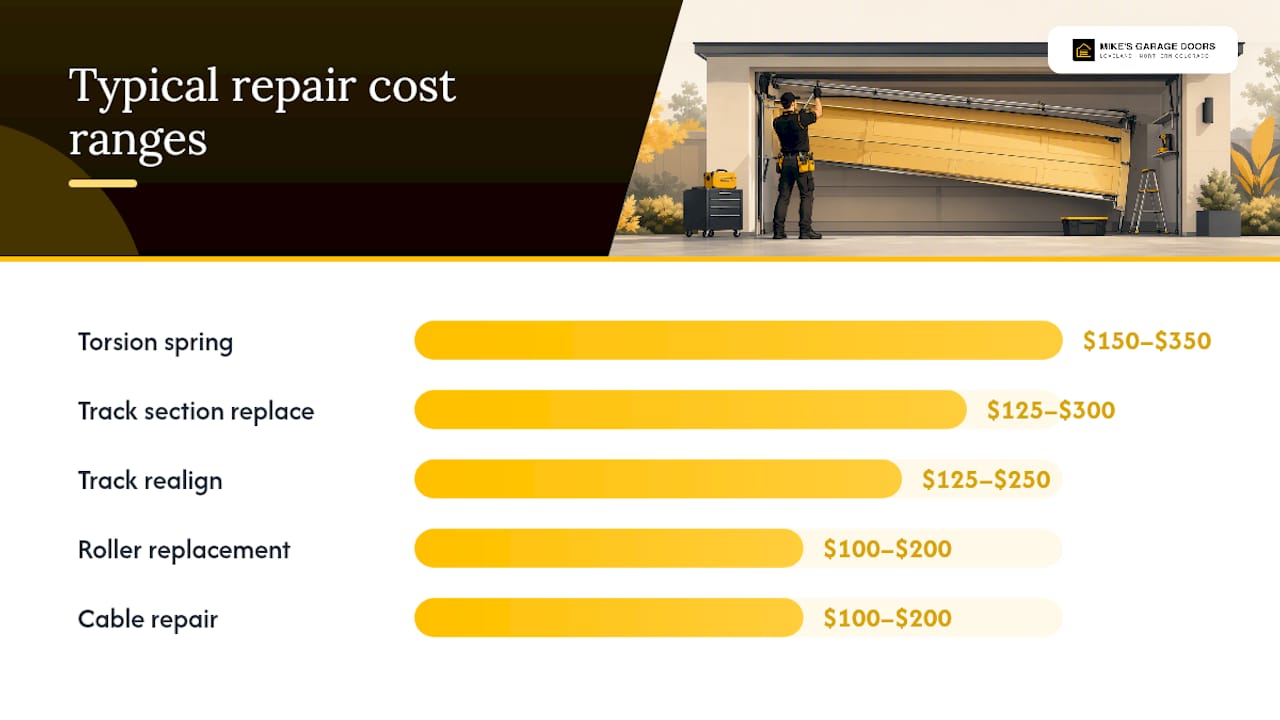
Repair type and typical price bands
| Repair Type | Typical Cost Range | Notes |
|---|---|---|
| Track realignment only | $125–$250 | Labor-only if no parts are bent or broken |
| Track section replacement | $125–$300 | Per section; steel tracks cost less than heavy-duty aluminum |
| Roller replacement (full set) | $100–$200 | Nylon rollers run higher than steel; 10 rollers per door |
| Cable repair or replacement | $100–$200 | Both cables usually replaced together |
| Torsion spring replacement | $150–$350 | Single spring; double-spring systems cost more |
| Extension spring replacement | $100–$200 | Per spring pair |
| Bottom bracket replacement | $75–$150 | Often replaced alongside cable work |
| Panel repair or replacement | $250–$800+ | Depends on material, size, and panel availability |
| Opener-related adjustment | $75–$150 | Limit switch, force setting, or sensor realignment |
| Service call fee | $50–$100 | Applied toward repair in most cases |
| Emergency/after-hours premium | $50–$150 | Added to base estimate for nights, weekends, holidays |
Regional labor rates and local parts availability can shift these numbers noticeably, especially in rural markets where technician travel time adds to the bill.
What drives the final price up or down
Door material matters more than most homeowners expect. A wood carriage-style door weighs two to three times what a standard steel door weighs. That extra mass puts more stress on rollers and tracks, so parts wear faster and cost more to replace. Aluminum doors are lighter but dent more easily, which can mean panel work on top of track repairs.
Sectional doors (the most common residential type) are generally cheaper to fix than one-piece tilt-up doors because individual sections can be swapped without replacing the whole door. One-piece doors require the entire panel to move as a unit, which complicates realignment significantly.
Labor time is the other big variable. A straightforward realignment takes 30–60 minutes. A job that involves replacing a torsion spring, two cables, and a bent track section can run two to three hours. At typical labor rates of $75–$150 per hour, that time adds up fast.
Three real-world pricing scenarios
Scenario 1 — Minor realignment, $175. A homeowner backed into the door with a car bumper, nudging one roller out of the lower track. No bent metal, no broken parts. A technician reseated the roller, checked the track alignment, and tested the door in under an hour.
Scenario 2 — Moderate repair, $480. The door had been making grinding noises for weeks before it finally came off track. Diagnosis: two seized nylon rollers and a bent lower track section. The tech replaced the full roller set and one track section, then realigned and lubricated the system.
Scenario 3 — Major repair, $850. A broken torsion spring caused the door to drop unevenly, pulling a cable off its drum and bending the vertical track. The repair included a new torsion spring, both cables, a replacement track section, and a bottom bracket. At this price point, it's worth comparing against repair vs. replacement costs before signing off.
Additional fees to watch for
Watch out for hidden repair fees that don't show up in the initial quote: haul-away charges for old hardware, permit fees if your HOA requires approved replacements, and markup on parts sourced same-day from a local supplier. Always ask whether the service call fee is credited toward the repair total.
On insurance: Homeowners insurance may cover garage door damage if it resulted from a covered peril like a storm or vehicle impact. Routine mechanical failure is typically excluded. Before filing a claim, compare the repair estimate to your deductible. A $300 repair against a $500 deductible means paying out of pocket is the smarter move.
What causes a garage door to come off its tracks?
Off-track doors rarely happen without a reason. Here are the most common causes, matched to the symptoms you'll likely see or hear:
- Impact or collision: A car bumper, a falling ladder, or a hard object strike can knock a roller out of the track instantly. You'll usually see a visible dent or gap where the door pulled away from the channel.
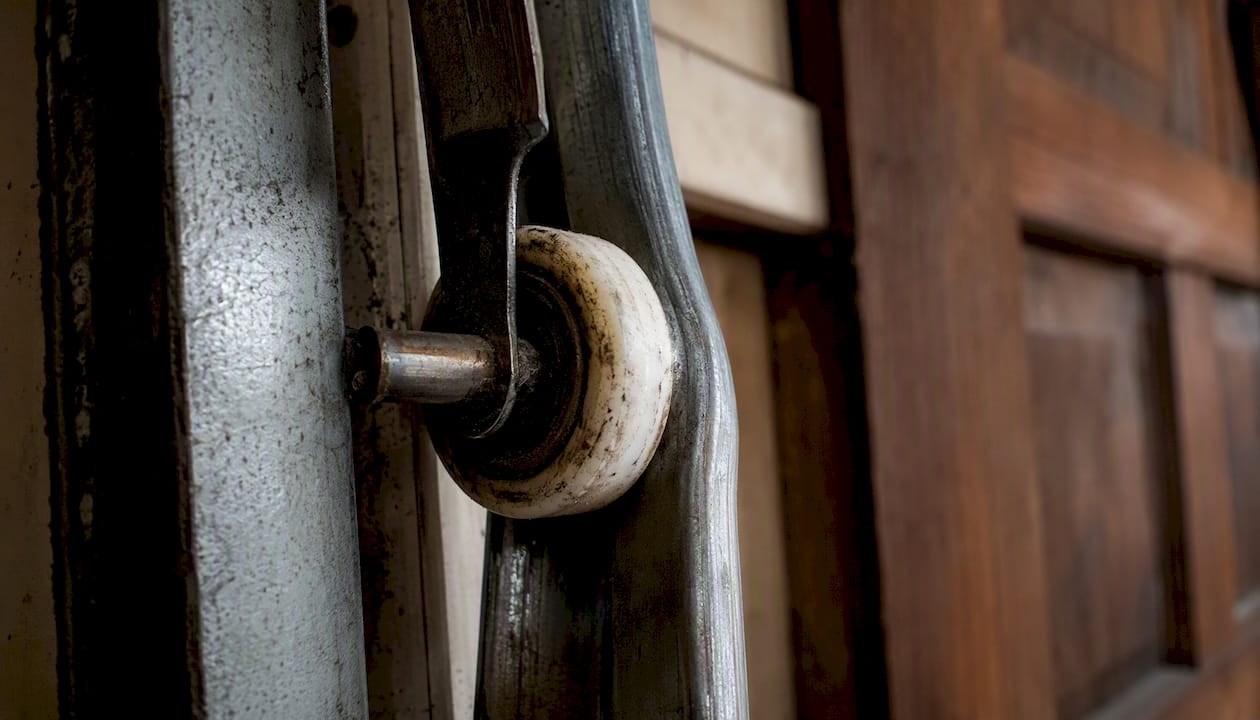
- Worn or seized rollers: Rollers that haven't been lubricated in years develop flat spots or frozen bearings. The door starts to wobble, then eventually skips the track entirely. Look for a grinding or scraping sound during operation.
- Broken torsion or extension spring: A snapped spring sounds like a gunshot inside the garage. Without spring tension, the door becomes dead weight on one side, pulling the cables unevenly and forcing the door off track.
- Frayed or snapped cable: Cables run from the bottom bracket up to the spring drum. A frayed cable lets the door drop on one side, which is why an uneven door (one corner lower than the other) almost always points to a cable problem.
- Bent or loose track: Tracks can bend from impact, rust, or loose mounting hardware. Even a quarter-inch of misalignment is enough to catch a roller and derail the door over time.
- Failed bottom bracket: The bottom bracket anchors the cable to the door. When it cracks or pulls away from the panel, the cable loses its anchor point and the door drops.
- Excessive rust or corrosion: In climates with road salt or high humidity, tracks and rollers corrode until they bind. The door may reverse mid-close or refuse to open fully before it finally comes off track.
- Opener misalignment: If the opener's trolley pulls the door at an angle rather than straight up, it creates lateral stress on the rollers. This is a common cause of a garage door that reverses while closing or runs unevenly.
Pro Tip: If your door has come off track more than once in the past year, the real problem is almost certainly a failing spring, a worn cable, or a track that's been bent and never properly straightened. A recurring off-track event is a symptom, not the root cause. A thorough technician will inspect all three systems before closing the job.
Uneven gaps at the bottom of the door when it's closed are a reliable early warning sign. If one corner sits higher than the other, something in the cable or spring system is already losing tension.
What does a technician actually do on a service call?
Knowing what to expect makes the whole experience less stressful. Here's the typical sequence a trained technician follows, from the moment they pull into your driveway:
- Visual inspection: The tech walks the full perimeter of the door, checking track alignment, roller condition, cable tension, spring integrity, and panel damage before touching anything.
- Secure the door: If the door is partially open and unstable, the technician secures it with locking pliers or a clamp on the track before disconnecting power to the opener.
- Diagnose the root cause: This is where experience pays off. A good tech doesn't just reseat the door. They identify why it came off track so the same failure doesn't happen again.
- Provide a written estimate: Parts and labor costs are quoted before any work begins. You should never agree to a repair without a written number in hand.
- Perform the repair: Depending on the diagnosis, this means reseating rollers, replacing track sections, swapping cables, or installing a new spring. Most repairs are completed in a single visit.
- Test and safety-check: The tech runs the door through several open/close cycles, checks the auto-reverse safety feature, and confirms the opener's force settings are within safe limits.
Technicians treat off-track doors as safety-priority jobs because an unsecured door is a security and injury risk. Many shops offer same-day response for off-track calls, though after-hours visits typically carry a $50–$150 premium on top of the base repair cost.
Timeline expectations: A realignment or single-part swap usually takes 30–90 minutes. A multi-part repair involving a spring, cables, and a track section runs 1–3 hours. Same-day scheduling is common for off-track emergencies in most markets, including Northern Colorado.
Ask about warranties before the work starts. A reputable shop will offer a parts warranty of at least 90 days and a labor guarantee. Mikes Garage Doors Loveland Colorado backs repairs with warranties on both parts and labor — ask about specific terms when you call for your phone estimate.
Safe DIY triage: what you can check and what to leave alone
You can do a useful visual assessment without putting yourself at risk. Here's how to do it safely.
Before you touch anything:
- Pull the red emergency release cord to disconnect the opener.
- Put on safety glasses and work gloves.
- Make sure no one is standing under or near the door.
- Never attempt any inspection if you heard a loud bang — that's a broken spring, and the door is under dangerous stored energy.
Safe triage steps:
- Look at the tracks. Stand to the side and check both vertical tracks for visible bends, gaps, or sections that have pulled away from the wall bracket.
- Check the rollers. Rollers should sit fully inside the track channel. If one is sticking out or visibly cracked, that's your likely culprit.
- Inspect the cables. Look at the cables running from the bottom corners of the door up to the spring drum. Frayed strands, kinks, or a cable lying slack on the floor means a cable failure.
- Try manual operation — only if the springs are intact. With the opener disconnected, lift the door by hand. It should move smoothly and stay in place when you let go at mid-height. If it drops or feels extremely heavy, the spring system is compromised.
- Listen for what happened. A grinding sound before the door stopped points to rollers. A sudden drop with no warning often means a cable. A loud bang followed by a heavy door is almost always a broken torsion spring.
What not to do:
- Do not reconnect the opener and try to force the door back on track.
- Do not attempt to hammer a bent track back into shape. You'll make the bend worse and risk cracking the track.
- Do not attempt spring replacement or adjustment under any circumstances. Torsion springs store enough energy to cause severe injury. This is a job for a licensed technician, full stop.
- Do not try to lift a door with a broken spring. A 200-pound door with no spring tension doesn't lift — it falls.
If the door is partially open and won't move, cables are visibly detached and under tension, or the door looks like it could fall, treat it as an emergency. Clear the area and call a technician immediately. Off-track door safety guidance covers this in more detail if you want a full walkthrough.
When should you hire a pro, and how do you pick the right one?
Some situations are non-negotiable: call a professional. Others give you a little more time to shop around.
Hire a pro immediately if:
- You heard a loud bang (broken spring)
- A cable is detached or visibly frayed
- The door is stuck partially open and won't budge manually
- The door looks structurally bent or a panel is visibly buckled
- The door has come off track more than once in the past year
For anything beyond a visual inspection, a licensed technician is the right call. Springs and cables under tension can cause serious injury when handled without the right tools and training.
How to choose a technician you can trust
Pro Tip: Call at least two shops and ask for a phone estimate. A technician who refuses to give a ballpark over the phone without an in-person visit first is a yellow flag. Most experienced techs can give you a reasonable range based on your description.
Questions to ask before booking:
- Are you licensed and insured in Colorado?
- Do your technicians carry common replacement parts on the truck?
- Is your pricing flat-rate or hourly?
- What's your warranty on parts and labor?
- Is there an after-hours or emergency fee, and how much is it?
Red flags to avoid:
- A quote that's dramatically lower than every other estimate, given without an inspection
- Pressure to replace the entire door when you called about a single roller
- Refusal to provide a written estimate before starting work
- No proof of insurance when you ask for it
- Vague answers about warranty terms
Finding a reliable local technician matters more than finding the cheapest one. A botched spring installation or an improperly tensioned cable creates a hazard that costs more to fix the second time. For Northern Colorado homeowners, the local provider guide covers what to look for when comparing shops in the region.
Real repair examples and what they actually cost
These examples reflect typical repair scenarios and average cost ranges. Actual prices vary by location, parts availability, and door type.
Case 1: Minor off-track, single roller failure Symptom: Door stopped mid-cycle and wouldn't close fully. One corner was visibly lower than the other. Diagnosis: A single seized steel roller had jumped the lower track section. Work done: Full roller set replacement (10 rollers), track realignment, lubrication. Typical cost range: $150–$250.
Case 2: Multi-part failure after years of deferred maintenance Symptom: Door made grinding noises for months, then came completely off track on both sides. Diagnosis: Two broken rollers, a bent lower track section, and a frayed cable on the left side. Work done: Roller replacement, one track section replaced, cable replacement (both sides), full system test. Typical cost range: $450–$700.
Repeated off-track events almost always signal an underlying component failure. Addressing only the visible symptom — reseating the door without replacing worn rollers or a weakening cable — means the door will come off track again, often within weeks.
Mikes Garage Doors Loveland Colorado completes 90% of repairs on the same day, provides upfront phone estimates so there are no surprises at the invoice, and offers a 10% discount for veterans. Warranties cover both parts and labor on completed repairs.
Pro Tip: Ask your technician to photograph the worn or broken parts before they're removed. It takes 30 seconds and gives you a clear record of what failed and why — useful if the same component fails again within the warranty period.
A note on safety-first repairs from our team
Every off-track repair we run starts the same way: secure the door before anything else. A door that's partially open and off its tracks is a security gap and a physical hazard. We've seen homeowners try to force doors back on track with a pry bar, and the results are never good — bent panels, snapped cables, and occasionally a door that falls completely.
Transparent pricing isn't a sales pitch for us. It's how we've built trust in Loveland and Northern Colorado over the years. You get a real number over the phone before we ever pull into your driveway. If the diagnosis changes the scope, we tell you before we start the additional work.
Our warranties on parts and labor mean that if something we fixed fails within the coverage period, we come back and make it right. No runaround.
Mikes garage doors Loveland colorado: same-day off-track repair in Northern Colorado
When your door comes off track, you need it fixed today, not scheduled for next week.

Every job starts with a transparent phone estimate so you know the cost before anyone shows up. Parts and labor are backed by warranty, so you're covered if anything goes wrong after the repair. No pressure, no surprise fees, no upselling a full door replacement when a track section is all you need.
Call us or schedule your repair online to get a same-day appointment and an upfront estimate from a licensed, insured technician who carries common parts on the truck.
Sources
The cost ranges and safety guidance in this article draw from the following sources. Each is worth a direct read if you want to verify numbers or dig deeper into a specific topic.
- Garage door repair costs $150 to $350 on average — HomeGuide
- Home Depot — Garage door repair and installation service cost information
- Garage Door Repair Cape Coral: Costs, Timelines & DIY Limits | Ido Garage Door Repair
- Garage Door Insurance Coverage: Homeowners Insurance Guide! — GoPro Garage Door Service
National average cost summary:
FAQ
How do you fix a garage door that's off track?
Disconnect the opener using the emergency release cord, then call a licensed technician. A tech will inspect the rollers, tracks, cables, and springs, reseat the door, replace any damaged parts, and test the full system before leaving.
What's the average cost to repair a garage door?
Garage door repairs average $150 to $350 nationally for common fixes. Off-track repairs involving broken springs, cables, or bent track sections can push the total to $300–$900 depending on parts and labor time.
Does homeowners insurance cover a damaged garage door?
Insurance covers garage door damage when it results from a covered peril like a storm or vehicle impact. Routine mechanical failure and wear-and-tear are typically excluded. Compare your repair estimate to your deductible before filing a claim.
How do you fix a misaligned garage door track?
A technician loosens the track mounting bolts, repositions the track so it sits flush against the door's roller path, retightens the hardware, and tests the door through several cycles. Severely bent tracks need to be replaced rather than bent back into shape.
When is it cheaper to replace the door than repair it?
A technician can help you run that comparison on-site.