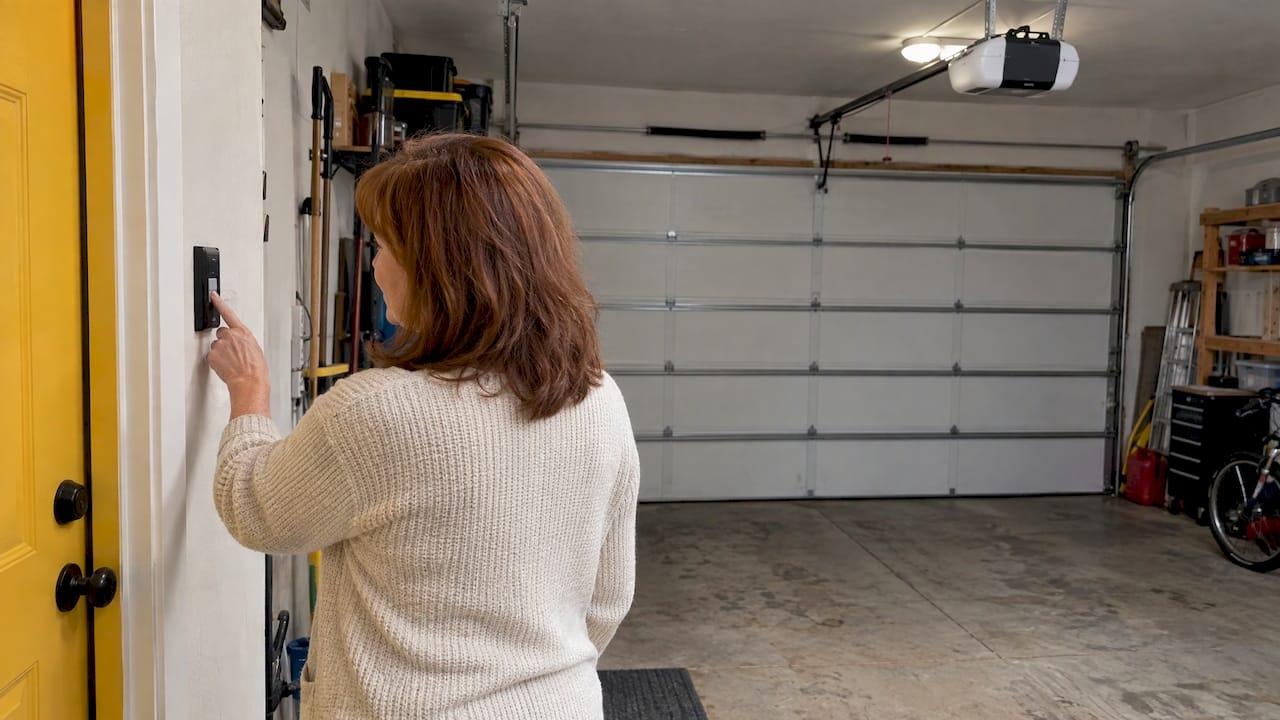
When your opener clicks and the door stays put, the opener is usually getting your command but can't turn it into movement. That points to one of four things: a lock or power problem, a safety sensor, a door that is binding or has a broken spring, or a worn-out opener part. Two of those you can check in minutes. The other two are jobs for a technician, and we handle them in Loveland and across Northern Colorado, with 90% of our repairs finished the same day.
This guide walks you through the checks in the order we'd do them, tells you what each click means, and shows you where to stop before you get hurt.
TL;DR
- A click means the opener's logic board heard you. The motor either didn't start or couldn't move the door.
- Start with the easy stuff: the door lock, power at the outlet, and the safety sensors.
- Then run the manual lift test. A door that feels heavy or won't stay up usually has a broken spring, and that is not a DIY repair.
- Never touch the springs, cables or bottom brackets. They are under extreme tension.
- Call us if the checks don't solve it. We give upfront estimates over the phone, and veterans get 10% off.
Table of Contents
- What the click actually tells you
- Step 1: Check the lock and the wall control
- Step 2: Confirm power and try a simple reset
- Step 3: Check the safety sensors
- Step 4: Do the manual lift test
- Step 5: Look for a binding or obstructed door
- Step 6: Check whether the trolley is disengaged
- When the clicking is the opener itself
- What does it cost to fix a door that won't open?
- A fast way to decide: fix it yourself or call
- Commercial doors and downtime
- Perspective: why we start with the lift test
- Get it fixed in Loveland
- FAQ
- Sources
What the click actually tells you
A garage door opener is two systems working together. The logic board receives your signal from the remote or wall button. The motor and drive then pull the door along the track. A click is the board, or a relay on it, responding. If you hear it, the opener has some power and is listening.
That narrows the problem. A completely silent opener with no light usually has a power or remote problem. A clicking opener has a different problem: something is stopping the next step. How the click sounds helps:
| What you hear | What it often means | Who fixes it |
|---|---|---|
| One click, nothing moves | Door lock engaged, door binding, broken spring, or a board that isn't sending power to the motor | You (lock), then a technician |
| Repeated clicking when you press the button | Low power, a failing board, or a safety sensor interrupting the cycle | You (sensors), then a technician |
| Click, then the motor hums or runs, door stays down | Disengaged trolley, stripped gear or a broken spring making the door too heavy | Technician |
| Click, door moves an inch, then reverses | Sensors misaligned or the door is hitting something | You, then a technician |
These are the usual patterns. Garaga's emergency troubleshooting table lists the same suspects for a single click with no movement: door binding, an obstruction, a broken spring, a door lock, and in some cases the logic board itself.
Step 1: Check the lock and the wall control
Many garage doors have a slide lock or a side lock on the inside. If the lock bolt is engaged, the opener will click and the door will stay shut. Look at the center of the door and along both edges. If a bolt sits in the track or a lock bar is extended, slide it open and try again.
The wall control matters too. Many wall panels have a lock or vacation button. When it is on, the remotes are ignored, and some openers click or flash in response. Press and hold the lock button for a couple of seconds and try the remote again. If a lock is jammed and won't release, our technician-vetted checks for a stuck garage door lock walk you through it.
Step 2: Confirm power and try a simple reset
Check that the opener is plugged in and the outlet works. Garage outlets on a GFCI circuit trip often in Colorado's cold, damp stretches. Plug a lamp in to confirm.
If power is fine, a quick reset can clear a confused logic board. Sears PartsDirect's 2023 guidance says unplugging an opener for about a minute resets the board, though it does not pair your remotes. After you plug it back in, test the wall button first, then the remotes. Reprogram any remote that no longer responds.
Don't confuse that with the Learn button on the motor unit. Per the same source, holding Learn for about six seconds, or until its light goes out, erases every remote code. You then have to reprogram every remote and keypad you still want to use. Do it only if you think a lost or stolen remote is a problem, not as a first fix for a clicking opener. If the reset brings the door back, the board may still be on its way out, so note it for your next maintenance visit.

Step 3: Check the safety sensors
Safety sensors are the two small eyes near the floor, one on each side of the door. They send an invisible beam across the opening. Federal rules for residential openers require this kind of entrapment protection, and the Consumer Product Safety Commission urges owners to test the reversing feature monthly. When a sensor is blocked, knocked out of line or dirty, many openers will refuse to close and flash their lights. Some will click and do nothing.
Here's the check:
- Look at each sensor's indicator light. Steady light on both usually means they are aligned. A dark or blinking light means a problem.
- Wipe each lens with a soft cloth. Cobwebs, dust and snow glare matter more than you'd think.
- Nudge the sensor bracket gently until the light holds steady.
- Clear anything in the beam path: a bike wheel, a bag, a snow berm at the threshold.
Sensors mostly stop a door from closing. If your door clicks and won't open, sensors are less likely to be the cause. They are still a two-minute check worth doing, and our 4-minute opener diagnostic covers the full routine.
Step 4: Do the manual lift test
This check tells you whether the problem is the opener or the door. It is the most useful step on this list.
- Close the door if you can. Park cars outside the door's path.
- Pull the red emergency release cord to disconnect the door from the opener. If the cord won't release, stop and read our guide on what to do when the emergency release is stuck.
- Lift the door by hand, using the handles or the bottom edge of the door's inside panel. Keep your fingers away from the section joints.
- Lift it to about waist height and let go slowly. A balanced door should stay put or drift only slightly.
What you find tells you where to go next:
- The door lifts easily and stays up. The springs are probably fine. The opener is the likely culprit: the board, the drive gear, or the motor.
- The door feels very heavy, barely lifts, or slams back down. A spring is likely broken. The opener may be clicking because it senses a load it can't lift. A broken spring leaves you with a door that has turned into dead weight, often around 150 to 200 pounds.
- The door sticks, scrapes, or jumps in the track. The door may be binding or off its track. Our guide on a garage door that is off the track explains why you shouldn't force it.
For a fuller walkthrough, see our homeowner guide to the manual lift test.
What not to touch
Springs, cables, and the bottom brackets that hold the cables are under extreme tension. Hands-on work with them can cause serious injury. Do not loosen bolts on the brackets, do not try to wind or unwind a spring, and do not hold up a door that you suspect has a broken spring. If you heard a loud bang from the garage in the last day or two, treat that as a broken spring until proven otherwise. Stop here and call.
Step 5: Look for a binding or obstructed door
A door that is dragging can overload the opener and cause it to click, stall or reverse. Doors in the Front Range deal with ice at the threshold in winter, swelling in wet seasons and dust all year. Look for:
- Ice or packed snow frozen to the bottom seal.
- A bent track, a loose track bracket or a gap between a roller and the track.
- Debris in the track, such as gravel, dried leaves and old grease.
- A panel that has cracked or buckled.
Sticking is not unique to garage doors. Most sliding and rolling doors share the same causes, including dirt in the channel and hardware that has drifted out of line, and this write-up on sticking door causes and fixes covers the basics. Wipe out the tracks and clear debris. If a track looks bent, or a roller sits out of the track, leave it alone. A door that is partly out of line can fall.
Step 6: Check whether the trolley is disengaged
If you pulled the red cord for the lift test, the trolley that links the door to the opener's drive may still be detached. That's the most common reason for a motor that runs or hums while the door sits still. Pull the cord toward the door and then back toward the opener, or let the carriage re-engage the next time the opener moves along the rail. Then run the opener with the door closed. If the trolley catches, you are done.
If the trolley doesn't catch, or the motor runs and nothing moves along the rail, the drive gear, chain or belt may be worn or stripped. That's a repair, not a reset.
When the clicking is the opener itself
If the door lifts easily by hand, the springs look intact and the lock, sensors and trolley are fine, the opener is the likely suspect. The usual culprits:
- A worn logic board. The board clicks its relay but can't deliver power to the motor.
- A stripped drive gear. The motor spins but the gear can't grip the drive.
- A failing capacitor or motor. The opener hums, clicks and gives up, often more often in cold weather.
- A frayed or stretched chain or belt. It slips instead of pulling.
Boards, gears and motors aren't in the same class of risk as springs, but they sit above your head and wiring is involved. This is where a tech pays off. We repair and install openers, and we can tell by the symptom and the age of the unit whether a repair or a new opener makes more sense.
What does it cost to fix a door that won't open?
The price depends on the cause. In 2026, Angi reports a national average of $265 for garage door repair across more than 42,000 projects, with most homeowners paying between $155 and $379. Its table lists opener repair at $100 to $500 and track repair at $5 to $400, plus service call fees of $50 to $75. Those are national figures and your price will differ with the door, the part and the repair.

Our approach is simple: we give you an upfront estimate over the phone, so you know what to expect before a truck rolls. We don't publish a price list, because a clicking opener can be a $0 lock fix or a spring replacement, and the symptom tells us a lot. Tell us what you hear, what the manual lift test showed and the age of the door, and we'll tell you what we expect.
A fast way to decide: fix it yourself or call
| Your finding | Next move |
|---|---|
| Lock was engaged | Unlock it and you're done |
| Outlet was dead or GFCI tripped | Reset it and test the opener |
| Sensor light was blinking | Clean and realign, then test |
| Door is heavy or drops after lifting | Call us. Likely a broken spring |
| Door binds, scrapes or is out of the track | Stop and call us |
| Door lifts easily, opener still clicks | Call us. The opener likely needs repair |
| Red cord won't release | Call us. Don't force it |
Commercial doors and downtime
If you manage a shop, warehouse or office, a door that won't open can hold up deliveries, block loading bays or leave a building unsecured. The checks above apply, but don't spend time on them if the door is critical. We service commercial garage doors and offer 24-hour emergency repair. Calling early and giving us the symptoms lets us plan the right parts for the visit.
Perspective: why we start with the lift test
We get these calls every day. The caller says the opener is clicking and the opener must be dead. In many cases the opener is fine and the door is what's wrong.
That's why we start with the manual lift test and not a new opener. A broken spring will make a good opener look broken. Replace the opener first and you've paid for a part you didn't need, and the door still won't open.
We're a family-owned shop and we care about being honest. We give upfront estimates over the phone, we stand behind our work with written warranties on parts and labor, and we're out there on the same day for 90% of repairs. If you do the safe checks in this guide and call us with what you found, we can usually tell you what's going on before we arrive.
Eddie
Get it fixed in Loveland
If your checks point to a spring, a track or an opener problem, we can take it from here. Mike's Garage Door Repair handles spring repair, opener repair and installation, tune-ups, custom doors and parts, commercial doors and 24-hour emergency repair across Loveland and Northern Colorado. Veterans receive a 10% discount.
Call with what you heard and what the lift test showed, and we'll give you an estimate over the phone before we come out.
FAQ
Why does my garage door opener click but not open the door?
The logic board is receiving your command, but the door isn't moving. The most common causes are an engaged door lock, a broken spring, a door that is binding in the track, a disengaged trolley or a failing board or gear. The manual lift test tells you whether the door or the opener is the problem.
Does unplugging the garage door opener reset it?
Unplugging for about a minute can reset the logic board, according to Sears PartsDirect. It doesn't pair remotes, so you may need to reprogram them after you plug the opener back in. If the opener still clicks, the cause is probably mechanical or in the board itself.
How do I reset my remotes?
On many openers, you hold the Learn button on the motor unit for about six seconds, until its light goes out, which erases all remote codes. Then you reprogram each remote you still use by following your owner's manual. Do this only when you suspect a remote problem, since it wipes every remote at once.
Is it safe to open the door by hand when the opener clicks?
It can be, if you pull the red release cord first and the door feels balanced. If the door feels very heavy, drops when you let go, or you heard a loud bang, don't hold it up. Leave it closed and call a technician, because a broken spring can't safely support the door's weight.
How much does it cost to fix a garage door that won't open?
Angi's 2026 data puts the national average repair at $265, with most jobs between $155 and $379. Your cost depends on the cause, from a simple reset to a spring or opener repair. Call us and we'll give you an upfront estimate over the phone.
Sources
- Garaga: Garage door openers emergency troubleshooting
- Sears PartsDirect: Garage door opener remotes won't work
- Angi: How much do garage door repairs cost? (2026 data)
- U.S. Consumer Product Safety Commission: Final rules for automatic garage door openers
- Sticking door causes and fixes