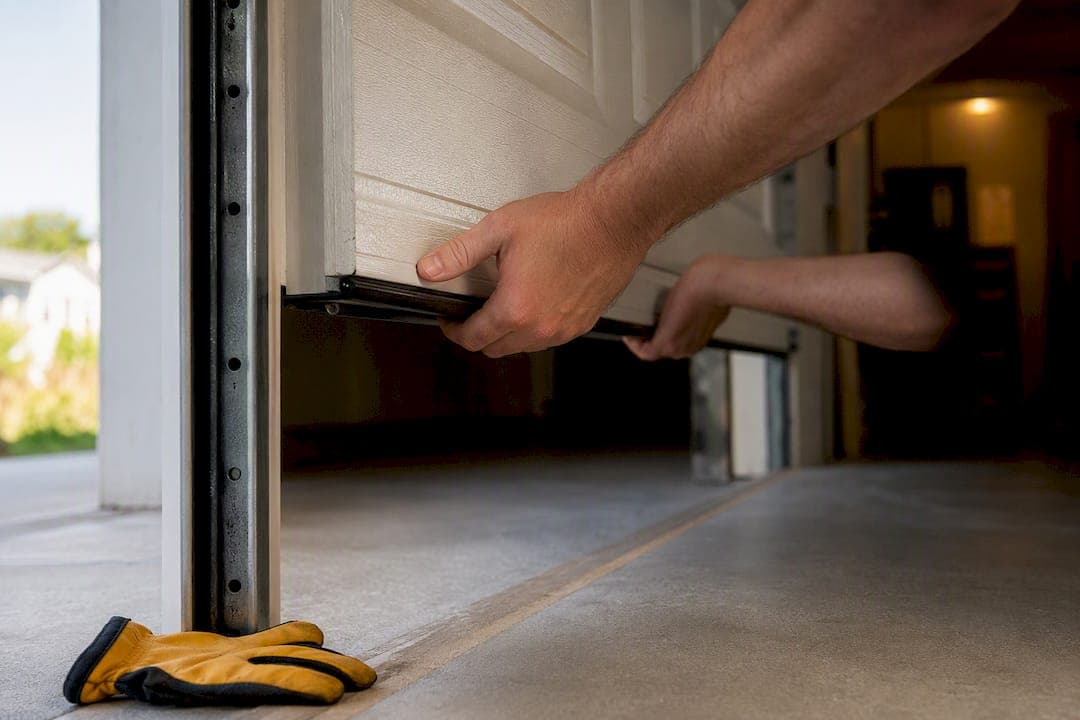
Most garage doors that won't open come down to five suspects: dead power, dead remote batteries, misaligned sensors, a disconnected trolley, or a broken spring. Press the wall button or remote once, then stop. Pull the emergency release cord and lift the door by hand. If it lifts easily, you're dealing with an opener problem. If it barely budges, stop immediately and treat it as a spring or cable issue.
TL;DR:
- Power issues are the most common cause, so checking the breaker, GFCI outlets, and remote batteries can often fix the problem without tools.
- Misaligned safety sensors frequently prevent the door from closing or cause it to reverse immediately, and cleaning or realigning the lenses usually resolves the issue.
- A humming motor with no movement indicates either a drive gear failure or a heavy door caused by broken springs, which require professional repair.
- Visible spring gaps, broken cables, or crooked tracks suggest dangerous damage that must be left to trained technicians for safety reasons.
- Resetting settings, clearing interference, or unplugging for a reset can fix many issues, but recurring problems typically signal critical component degradation needing expert help.
Table of Contents
- Why Won't My Garage Door Open? Start With This Checklist
- Is It a Power or Remote Problem?
- Why Won't the Door Close? Check the Safety Sensors
- Opener Hums but the Door Won't Move: What's Actually Wrong?
- Broken Springs and Cables: The Signs You Should Never Ignore
- Settings, Weather, and Other Overlooked Culprits
- When Should You Call a Garage Door Technician?
- What Makes Mike's Garage Door Repair Different
- A Homeowner-First Note on Garage Door Safety
- Ready for a Same-Day Fix?
- Sources
- FAQ
Why Won't My Garage Door Open? Start With This Checklist
Before you touch tools, run through this in the order below. It takes less time than brewing coffee.
- Check power first. Look for opener lights, check the breaker box, and test any nearby GFCI outlet by plugging in a lamp.
- Test the wall button, then the remote. If the wall button works but the remote doesn't, swap the batteries before assuming a bigger problem.
- Pull the emergency release cord (the red handle hanging from the trolley) and lift the door by hand.
- Scan for visible damage: a gap in the spring coil, a slack or hanging cable, crooked tracks, or anything blocking the door's path.
- Act on the manual-lift result. Easy lift means the opener is the problem. A door that's heavy or won't budge points to a broken spring or cable, and that's not a DIY job.
Pro Tip: Never press the opener button more than once per attempt. A door that's already struggling can burn out a capacitor or strip a plastic gear in seconds if you keep mashing the button hoping it'll catch.
Is It a Power or Remote Problem?
A dead remote gets blamed for a lot of things that are actually a tripped breaker. Work through the electrical side methodically before assuming the opener itself has failed.
- Plug a lamp into the same outlet the opener uses. No light means no power, so check the breaker panel and reset any GFCI outlet nearby.
- If the wall button opens the door but the remote doesn't, swap the batteries first, then reprogram using the Learn button on the motor head.
- Weak reprogramming range sometimes traces back to a bent or loose antenna hanging from the opener unit.
- Look for a lock or vacation switch on the wall console or motor head. It's a small toggle, but it disables every remote in the house until you flip it off.
Fixes like replacing dead batteries, resetting a GFCI, or disabling vacation mode resolve a surprising share of "won't open" calls without a single tool. If none of that works and the opener still won't respond, the logic board itself may have failed, and that's a job for a technician.
Why Won't the Door Close? Check the Safety Sensors
If your garage door opens fine but refuses to close, or reverses right back up, look at the two small sensors near the bottom of each track before anything else. One sends an infrared beam, the other receives it. Manufacturer guidance and UL 325 safety standards require these photo eyes to sit low, typically within 6 inches of the floor, so the door refuses to close on anything that might be in the way.
- The sending sensor's LED usually stays on steady no matter what.
- The receiving sensor blinks or goes dark the moment alignment is off, even slightly.
- Loosen the mounting bracket, gently pivot the sensor, and watch for the receiving LED to hold steady.
- Wipe both lenses clean. Dust, spider webs, and lawn clippings block the beam just as effectively as misalignment.
- Direct sunlight can also blind the sensor. Shade it temporarily with a piece of cardboard to test.
If the LEDs still won't cooperate after cleaning and realigning, the wiring itself may be damaged, and that's where troubleshooting should stop.
Opener Hums but the Door Won't Move: What's Actually Wrong?
A motor that hums or buzzes without moving the door is telling you something specific: either the opener's drive system has failed, or the door itself is too heavy to lift. The manual-lift test you already ran settles which one it is.
- Door lifted easily by hand? The opener is at fault. Look for fine white plastic shavings under the motor head, a classic sign of a stripped drive gear.
- Motor clicks but never starts? That points to a failed start or run capacitor, a repair that usually calls for an electrician's touch.
- Chain or belt looks slack or disconnected from the trolley? That's a slipped drive component, not a dead motor.
- Door felt heavy or wouldn't lift at all? Stop there. That's a spring problem, not an opener problem.
Cut power at the wall switch before inspecting anything closer. A humming opener with no door movement almost always splits cleanly into one of these two categories, and repeated button presses only make the eventual repair more expensive.
Broken Springs and Cables: The Signs You Should Never Ignore
A visible gap in the torsion spring above the door, or a cable hanging loose instead of running taut along the track, means the door is running on borrowed support. On a two-spring system, the door often still looks level because both springs share the same shaft, but it becomes too heavy to lift safely by hand.
- Gap in the coiled spring above the door opening.
- Slack, frayed, or snapped cable running along either side of the track.
- Door that's crooked, tilted, or visibly off one of its tracks.
These parts hold enormous tension, and that's exactly why they're dangerous to touch. Leave the door closed, keep kids and pets away from the area, and snap a few photos for the technician. Don't attempt a repair yourself.
Settings, Weather, and Other Overlooked Culprits
Sometimes the door isn't broken at all. It's just misconfigured or fighting the weather.
- Force or travel-limit settings that are dialed too tight can make the door stop short, reverse, or refuse to fully open. Most openers have small adjustment dials or screws on the motor head for this.
- Frozen bottom seal in winter can glue the door to the concrete. Use a hair dryer or warm water to melt the ice; never force the opener to power through it.
- Interference from LED bulbs or nearby wireless devices can scramble remote signals. Try turning off garage lights during a test run.
- A full opener reset, unplugging for 30 seconds then reprogramming remotes, clears out a surprising number of glitches.
Pro Tip: If a reset or reprogram fixes the issue for a day and then it comes back, the logic board is likely degrading. Don't keep resetting it as a permanent fix.
When Should You Call a Garage Door Technician?
Some symptoms are your cue to stop troubleshooting entirely.
- Visible spring gap, off-track door, or a snapped cable. These require a professional every time.
- Grinding metal noise or a door that's heavy on manual lift. Both signal serious mechanical wear.
- Have these details ready: opener brand and approximate age, exact symptoms, any noises you heard, and photos of visible damage.
- Rule out the quick fixes first, power, batteries, sensors, and settings, so the technician isn't diagnosing something you could've solved in five minutes.
A same-day visit matters here. A door stuck in an unsafe position, whether open or closed, is a security gap and a hazard every hour it sits that way.
What Makes Mike's Garage Door Repair Different
Roughly 90% of Mikes garage doors Loveland colorado repairs get completed the same day the call comes in. Estimates are quoted over the phone before a technician shows up, helping to avoid surprise invoices. Technicians handle everything from stripped gears to snapped springs, backed by real warranties, and veterans get a 10% discount on the work. If you've run the 4-minute opener diagnostic and still can't get the door moving, or you've spotted an off-track door that needs a trained eye, that's exactly where the next step leads.
A Homeowner-First Note on Garage Door Safety
The manual-lift test isn't a formality. It's the fastest way to know whether you're looking at a $20 fix or a job that needs a trained technician and the right tools. Try the quick checks first: power, batteries, sensors, settings. But the moment a door feels heavy or a spring shows a gap, stop and call. Write down what you heard and saw before you dial. That five minutes of notes saves the technician a diagnostic trip and gets your door fixed faster.
— Eddie
Ready for a Same-Day Fix?
A door that won't open rarely fixes itself, and forcing it usually turns a $200 spring job into a $600 opener replacement. The company handles spring replacement, opener repair and replacement, and emergency same-day calls in the local area, backed by upfront phone estimates and warranties on the work.

Pricing depends on what actually failed, a sensor clean and realignment costs far less than a broken torsion spring, but you'll know the number before anyone touches your door. Veterans get 10% off every repair. If you've already run the checks above and the door still won't move, book a service call and get a technician out the same day.
Sources
- LiftMaster — safety guidance
- GarageDoorPedia — My garage door won’t open but the motor runs
- The Garage Guide — manual-lift diagnostic
FAQ
Why Does My Garage Door Opener Open But Not Close?
This almost always points to the safety sensors near the bottom of the tracks. Dirt, misalignment, or direct sunlight can block the photo-eye beam, and the opener refuses to close as a built-in safety measure.
Why Isn't My Garage Door Responding to the Remote or Wall Button?
Check power first, a tripped breaker or GFCI outlet is a common cause, then test whether the wall button works while the remote doesn't. If only the remote fails, swap batteries and reprogram it using the Learn button.
Why Won't the Door Open Even Though the Motor Is Running?
A motor that runs without moving the door usually means a stripped drive gear, a failed capacitor, or a slipped chain. The manual-lift test tells you whether the problem sits with the opener or the door itself.
What Would Stop a Garage Door From Opening at All?
The most common causes are lost power, dead remote batteries, a disconnected emergency release, misaligned sensors, or a broken spring. Running the manual-lift test narrows it down in under a minute.
Can I Fix a Stripped Gear or Broken Spring Myself?
A stripped gear kit is sometimes manageable for a handy homeowner, but a broken spring or cable carries enough stored tension to cause serious injury and should always go to a professional.