
The single best phone-estimate practice is this: state your service call fee, give a realistic price range, promise the exact number once a technician sees the door, and book the visit before you hang up. That's it. No dodging the money question, no fake precision either.
This works because it kills the two things that lose jobs and start arguments: vague pricing that spooks a caller into calling three more shops, and confident-sounding numbers that turn into an awkward "actually, it's more" conversation on-site. Transparent, upfront communication about the trip fee versus the total job cost prevents mid-job surprises and builds the kind of reputation that gets referrals. Mike's Garage Door Repair in Loveland runs this exact model: customers get a straight answer on the phone, a written quote before any work starts, and in 90% of cases, the job's done the same day.
- State the service call fee out loud, every time.
- Give a range, not a guess dressed up as a fact.
- Promise the firm number on-site, in writing.
- Lock in the appointment window before ending the call.
Key Takeaways
Accurate phone estimates depend on stating a service fee and range upfront, confirming the price on-site, and booking with a tight, confirmed window.
| Point | Details |
|---|---|
| Quote fee and range | State the service call fee and a realistic price range on every call, never a bare guess. |
| Triage before pricing | Run the five-question safety and symptom triage before offering any number. |
| Reserve exact pricing for on-site | Promise the firm total once a technician inspects the door, not before. |
| Confirm to prevent no-shows | Send a booking confirmation text immediately; follow up with an "on the way" message. |
| Mike's Garage Door Repair as the model | Mike's Garage Door Repair pairs transparent phone quotes with 90% same-day completion and warranty-backed work. |
Table of Contents
- Phone Estimate Accuracy Best Practices Start With a Cheat Sheet
- Scripts That Book Jobs Without Overpromising
- What to Quote on the Phone (and What to Hold Back)
- Booking That Actually Shows Up
- The Minimum Logging Setup That Makes Calls Measurable
- Training That Sticks: Role-Plays and Call Reviews
- Why Most Shops Get Phone Estimates Backward
- How Mike's Garage Door Repair Puts This Into Practice
- Sources
- FAQ
Phone Estimate Accuracy Best Practices Start With a Cheat Sheet
Every technician answering phones needs a laminated card, not a mental checklist they're rebuilding call by call. Sixty seconds of triage tells you almost everything: Is the door stuck open or closed? Is a car trapped inside? Did anyone hear a loud bang? Is the door visibly off track? What does the opener do when the wall button is pressed?
From there, the ranges write themselves. A basic torsion spring replacement commonly runs around $200 for standard residential doors, with cost climbing based on door weight, spring type, and whether cables or the track are also damaged. Opener repairs, roller replacement, and full door swaps each carry their own band. State the service call fee plainly, and mention upfront whether it gets credited toward the repair if the customer books, which most callers appreciate hearing without having to ask.
- Ask the five triage questions in order, every call.
- Match the answer to a price range on the cheat sheet.
- Quote the service call fee and mention the credit policy.
- State clearly that the exact price gets confirmed on-site.
Pro Tip: Print the cheat sheet in a font big enough to glance at mid-conversation. If your tech has to squint at it, they'll skip it, and consistency is the whole point.
Scripts That Book Jobs Without Overpromising
Consistency doesn't come from talent. It comes from a script your team runs every single time, whether it's a slow Tuesday or the phone hasn't stopped ringing since the last cold snap. Confirming the caller's location early, running a tight triage set, and closing on two specific time windows measurably cuts no-shows and boosts bookings.
Open simply: "Thanks for calling [company name], this is [tech name]. What's going on with the door today?" That single line confirms who you are and gets the caller talking about the actual problem instead of guessing what to say.
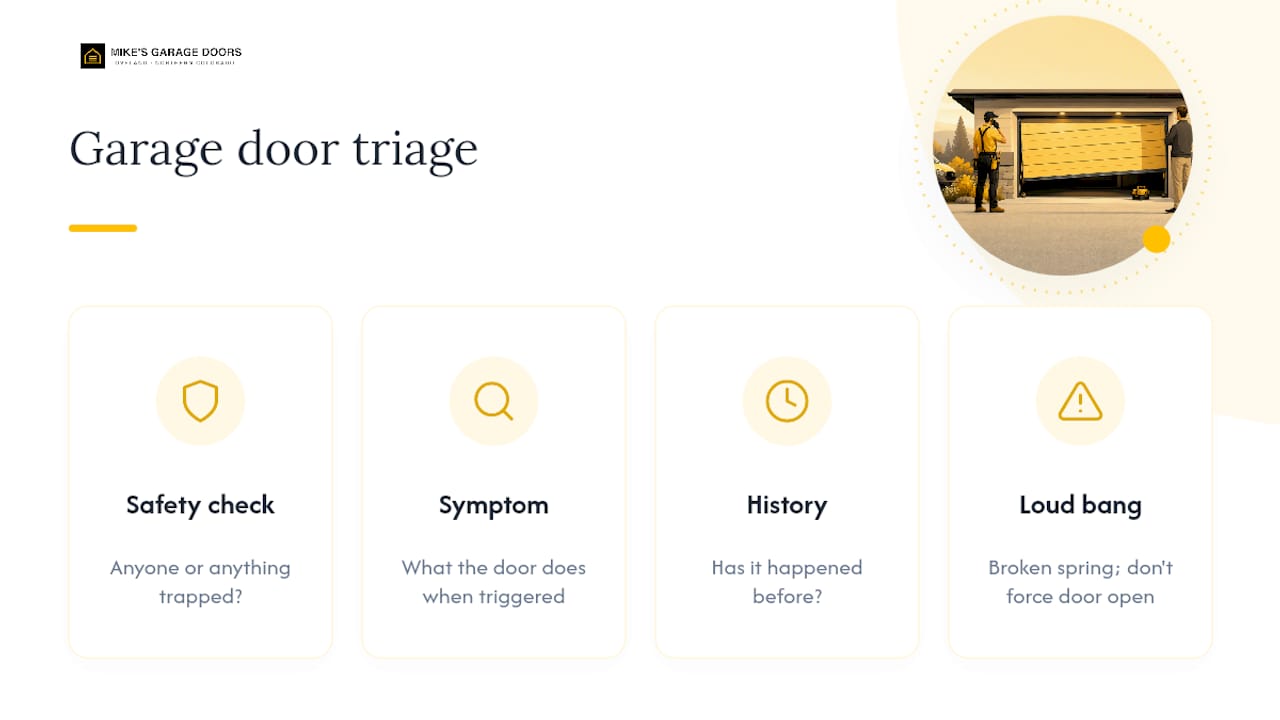
- Triage order: safety first ("Is anyone or anything trapped?"), then symptom ("What does it do when you try to open it?"), then history ("Has this happened before?").
- Sample line for a loud bang: "That sound usually means a spring broke. Please don't try to open it manually, that's a heavy door with no support right now."
- De-escalation for price pressure: "I hear you, nobody likes surprises. Here's what I can tell you for certain right now, and here's what we'll confirm the second we're looking at it."
Pro Tip: When a caller pushes for an exact number before you've seen the door, redirect to what you CAN promise: the fee, the range, and the on-site confirmation. That reframe usually ends the negotiation.
What to Quote on the Phone (and What to Hold Back)
Some numbers you can give with confidence. Others you shouldn't, because guessing wrong costs you the job or the trust that got you in the door.
Quote these every time:
- The service call or diagnostic fee, stated as a dollar figure.
- Typical ranges for the most common jobs: spring replacement, opener repair, full door replacement.
- Any after-hours or emergency premium, mentioned before the caller asks.
Reserve these for the visit:
- The final total, which depends on what's actually damaged.
- Parts availability for less common door sizes or discontinued opener models.
- Whether the track, cables, or rollers need replacing alongside the primary repair.
A garage door has too many interacting parts, torsion springs, cables, rollers, tracks, sensors, for a phone call to substitute for eyes on the hardware. Explain that plainly and most homeowners accept a range without pushback. One coherent industry view holds that low-balling an estimate just to win the call is what causes onsite conflicts, not the other way around. For larger jobs like full system replacements, offer a written estimate after a quick measure visit rather than a phone number at all, as explained in our guide to new sliding door installation and replacement.
Booking That Actually Shows Up
A great phone estimate means nothing if the appointment falls through. Booking discipline is what separates a shop with a full schedule from one chasing no-shows.
- Offer two specific windows ("between 1 and 3, or 4 and 6") instead of a vague "sometime this afternoon."
- Confirm the service address and the best callback number before hanging up.
- State the trip fee one more time so there's no confusion at the door.
- Send an immediate confirmation text with the tech's name and estimated arrival.
Confirmation texts sent right after booking cut no-shows nearly in half, and a simple "your tech is on the way" text 20 minutes out does the rest. Emergency calls, trapped car, broken spring, door stuck open, need same-day routing with a tight ETA. Scheduled replacement estimates can wait for a measure appointment, and treating those two workflows differently keeps your emergency slots from getting clogged by non-urgent calls.
The Minimum Logging Setup That Makes Calls Measurable
You can't fix what you don't track. A basic call log, even a shared spreadsheet, needs six fields: date and time, caller name, address, call type (repair, replacement, emergency), urgency level, and outcome (booked, quoted, lost). Review it weekly for fifteen minutes. Patterns show up fast: which triage questions get skipped, which price ranges cause hangups, which technicians close at a higher rate.
- Log every call, even the ones that don't book.
- Flag missed calls and note the time to callback.
- Route emergency calls to a 24/7 answering option when a technician is mid-repair and can't safely pick up.
- Set a callback SLA of five minutes for missed calls and track how often you hit it.
Technicians shouldn't be answering the phone while winding a spring or up a ladder. That's how injuries happen and how leads get lost simultaneously. A dedicated answering line or after-hours service captures the address and callback number so nothing falls through.
Training That Sticks: Role-Plays and Call Reviews
Reading a script once in onboarding doesn't make it stick. Weekly ten-minute role-plays do. Run three scenarios on rotation: a car-trapped emergency with a loud bang, an opener that reverses or won't close, and a scheduled new-door measure call. Score each on five criteria: greeting, triage order, safety language, pricing clarity, and whether the call closed with a booked window.
- Rotate who plays the caller so staff hear different tones and pressure tactics.
- Keep a one-page scorecard, not a lengthy review form nobody fills out.
- Review flagged calls from the weekly log alongside the role-plays.
- Track same-day completion rate and phone-to-booking ratio as your two core metrics.
Mike's Garage Door Repair treats these drills as non-negotiable, not extra credit. The result shows up in the numbers: 90% same-day completion, transparent phone quotes with no hidden add-ons, and warranties backing the work. That's what following this exact playbook looks like in practice, not theory.
Why Most Shops Get Phone Estimates Backward
The conventional wisdom says give the caller a low number to hook them, then explain the real price once you're standing in their garage. That approach wins the call and loses the relationship. Every homeowner who's felt bait-and-switched from a contractor becomes permanently suspicious of the next one, and that suspicion costs the whole industry business.
What actually works is closer to the opposite instinct: say less about the exact dollar figure, but say it with total confidence. A caller doesn't need an exact price on the phone. They need to believe the person on the other end knows what they're doing and isn't hiding anything. A stated service call fee and an honest range do more for trust than a fake-precise quote ever will.
Where I'd push back on standard training advice is the obsession with "closing" every call. A tech who correctly tells a caller "we need eyes on this before I promise a number" and books a same-day slot has done a better job than one who quotes a fake fixed price to force a yes. Prioritize the triage script and the honest range first. The booking rate follows the trust, not the other way around.
How Mike's Garage Door Repair Puts This Into Practice
Every rule in this article is the day-to-day operating standard at Mike's Garage Door Repair. Callers get a clear service call fee, a realistic range based on the symptoms described, and a firm written quote before any technician touches the door. There's no guessing game and no padded invoices waiting at the end.

That transparency shows up in the results: 90% of repairs finish the same day they're called in, every job carries a warranty, and veterans get a 10% discount as a standing thank-you for their service. Whether it's a snapped torsion spring, a failing opener, or a full commercial door replacement, the technicians answering your call are the same ones showing up at your address. If your garage door needs attention today, visit the garage door services page to see what's covered and get a straight answer over the phone.
Sources
- Garage door phone etiquette and triage (SkipCalls)
- Garage Door Repair Cost (HomeGuide)
- Garage door repair cost guide (This Old House)
FAQ
What should I always quote on the phone?
State the service call fee, a realistic price range for the likely repair, and any after-hours premium. Reserve the exact total for after a technician inspects the door.
How do I stop callers from demanding a fixed price upfront?
Explain what you can promise with certainty (the fee and the range) and what needs eyes-on confirmation, then redirect toward booking a visit. Most callers accept this once they hear the reasoning instead of a flat refusal.

What triage questions matter most for garage door calls?
Ask about safety first (anyone or anything trapped), then the symptom (what the door does when triggered), then whether it's happened before. A loud bang almost always signals a broken spring and warrants a warning not to force the door open.
How does Mike's Garage Door Repair handle phone estimates differently?
Mike's Garage Door Repair gives a transparent service call fee and range over the phone, then confirms the exact price on-site before starting work, backed by a 90% same-day completion rate and standard warranties.
How much does a typical garage door spring replacement cost?
Common published ranges put standard residential spring replacement around $200, though door weight and spring type shift that number up or down.