
Repair service transparency means a provider discloses costs, gets your explicit approval before doing extra work, and hands you an itemized invoice that matches what was agreed. The top takeaway: you should always get a pre-authorized estimate, a documented change order for anything added mid-job, and a final bill you can check line by line. Federal guidance from the FTC and the Magnuson-Moss Warranty Act back this up, and shops like Mikes Garage Doors Loveland Colorado build their whole process around it.
Key Takeaways
Repair service transparency works because it forces three checkpoints, an upfront estimate, documented mid-job changes, and an itemized final invoice, into every transaction.
| Point | Details |
|---|---|
| Get it in writing | Always request a written estimate, even where state law sets no dollar threshold requiring one. |
| Know your labels | Ask whether a number is a binding quote or a non-binding estimate before authorizing work. |
| Document every change | Insist on a signed or written change order any time new work or cost gets added mid-job. |
| Check the final invoice | Match the final bill against the original estimate plus authorized change orders, line by line. |
| Know your legal backing | The FTC and Magnuson-Moss Warranty Act require clear warranty disclosure and ban certain tie-in provisions. |
Table of Contents
- What Does Repair Service Transparency Actually Cover?
- How Does a Transparent Repair Transaction Actually Run?
- What Laws Protect Consumers From Opaque Repair Pricing?
- What Are the Most Common Repair Transparency Failures?
- What Should Be on Every Repair Order?
- What Should You Ask Before Hiring a Repair Technician?
- What Does a Transparent Repair Look Like in Practice?
- Why Repair Transparency Actually Changes Outcomes
- Get an Upfront Estimate Before You Book a Repair
- Sources
- FAQ
What Does Repair Service Transparency Actually Cover?
Repair service transparency governs three moments in a transaction: the estimate before work starts, any changes discovered mid-job, and the final invoice. A transparent provider tells you the diagnostic fee upfront, explains whether that fee applies toward the repair if you proceed, and separates labor from parts on paper before touching your equipment.

It does not automatically extend to voluntary service contracts (extended warranties you buy separately) or purely commercial agreements between businesses, which often follow different disclosure rules than consumer transactions. State law can widen the net. Florida, for example, requires a written estimate and a conspicuous disclosure statement once a motor vehicle repair exceeds $150. Not every state sets a dollar threshold, so the safest habit is asking for a written estimate no matter the job size.
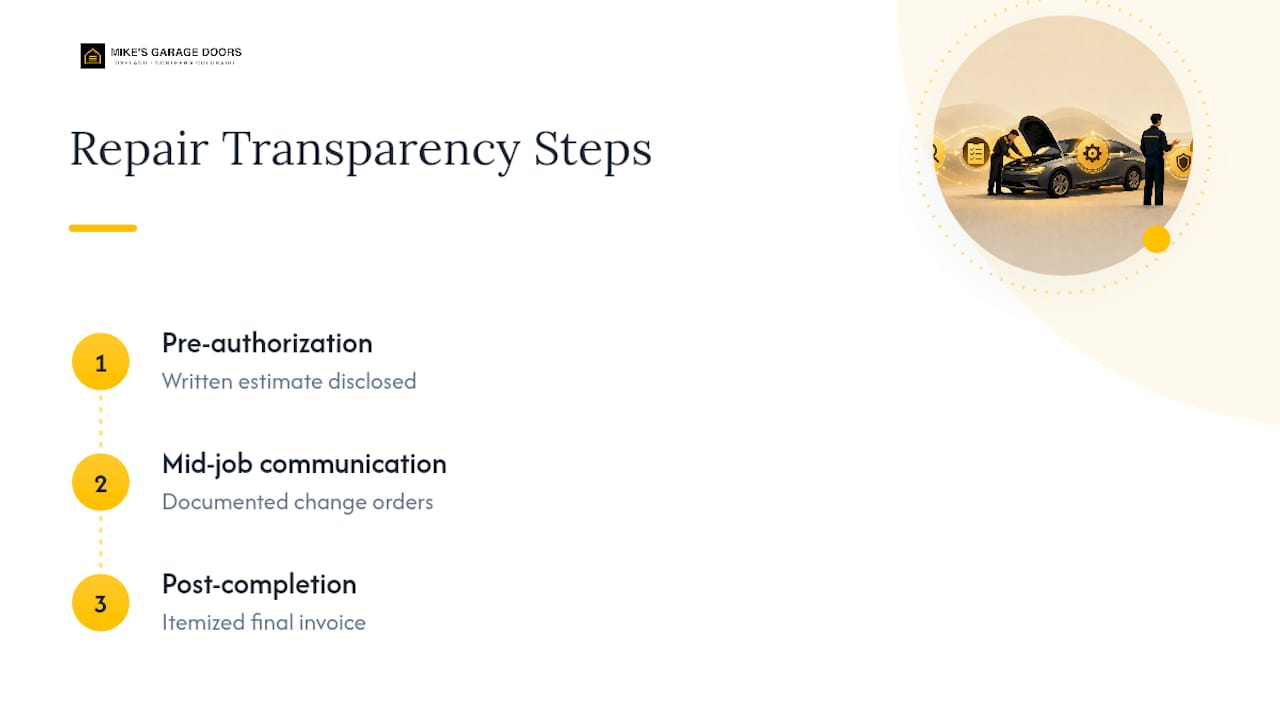
The three core pieces to watch for:
- Pre-authorization disclosure: a written estimate or quote before work begins.
- Mid-job change communication: a documented change order any time scope or cost shifts.
- Post-completion itemization: a final invoice broken into parts, labor, and taxes.
How Does a Transparent Repair Transaction Actually Run?
A transparent repair follows a predictable sequence, and once you've seen it laid out, you'll spot a shop that skips steps almost immediately.
- Intake and diagnostic disclosure. The technician explains what they're checking and what the diagnostic visit costs, including whether that fee gets credited toward the repair.
- Written estimate. You get a number in writing, not just a verbal figure over the phone, and the estimate states whether it's binding (fixed) or non-binding (subject to change within a stated range, often 10 to 15 percent).
- Explicit authorization. You sign off, by text, email, or a signed form, before the technician starts.
- Change orders. If the tech finds something new, like a stripped gear or a second broken cable, they stop and get your approval in writing before proceeding.
- Final invoice reconciliation. The bill matches the original estimate plus any authorized changes, itemized so you can trace every dollar.
Pro Tip: Save every approval in writing, even a text message that says "yes go ahead," and keep it until the warranty period ends. If a dispute comes up, that message is your evidence.
A binding quote means the number will not change unless you approve a modification. A non-binding estimate leaves room for adjustment, but any provider worth hiring will tell you the range before starting, not after the bill arrives.
What Laws Protect Consumers From Opaque Repair Pricing?
You have more legal backing here than most people realize. The FTC's consumer guidance requires that written warranties be available for you to read before you buy, and manufacturers generally cannot force you to use specific parts or services just to keep your warranty valid, unless those parts are provided free or the FTC grants a waiver.
The Magnuson-Moss Warranty Act goes further. It requires conspicuous disclosure of written warranty terms, mandates that warranties be available before purchase, and bans certain tie-in provisions that would otherwise lock you into a single provider.
The FTC has flagged repair restrictions, like limiting access to parts, manuals, or diagnostic tools, as a direct harm to consumers, and has said it will prioritize enforcement against practices that unlawfully shrink repair choice.
That policy stance, detailed in the FTC's repair restrictions statement, reflects a broader push documented in the agency's Nixing the Fix report to Congress.
State law adds another layer. Florida's statute requiring written estimates above a specified threshold shows how specific state rules can get, even though not every state has an equivalent threshold on the books.
What Are the Most Common Repair Transparency Failures?
Most complaints trace back to a handful of repeat offenders:
- Undisclosed diagnostic fees. You're charged for the visit without ever being told the price upfront.
- Unauthorized repairs. Work gets done that you never approved, verbally or otherwise.
- Parts substitution without re-authorization. The shop swaps in a different part than quoted and never tells you.
- Vague flat-rate quotes. A single number with no breakdown, so you can't tell what's labor and what's parts.
- Post-completion surprise charges. New line items appear on the final bill that weren't in the estimate or any change order.
Each of these has a paper trail you should demand: a written estimate, a photo of the replaced part, a signed change order, or an itemized invoice. When a fee shows up with no disclosure and no consent, it can edge toward the kind of practice the FTC's enforcement priorities are built to address.
What Should Be on Every Repair Order?
A real repair order is not a scribbled total on a receipt pad. Look for these pieces before you sign anything:
- Diagnostic fee amount and whether it credits toward the repair.
- A label that says clearly whether the number is an "estimate" or a "binding quote."
- Itemized parts (with part numbers where possible) and labor rates or flat-rate codes.
- A defined process for change orders if something new turns up.
- Warranty or service-contract terms spelled out in writing, not promised verbally.
- Contact information for warranty claims or disputes.
- An estimated completion time.
On the invoice itself, expect a job description, parts list, labor hours or flat-rate code, subtotal, taxes, any change-order entries, and a final signature with a date. The BBB's Standards for Trust echo the same expectations around honest advertising and clear dispute handling. Keep photos, timestamps, and saved messages from the whole job. If a dispute ever comes up, that record is often the difference between a quick resolution and a drawn-out argument.
What Should You Ask Before Hiring a Repair Technician?
Ask these before any tool touches your equipment:
- What does the diagnostic visit cost, and does it apply to the repair?
- Is this a binding quote or a non-binding estimate?
- Where do the replacement parts come from?
- What warranty coverage applies, and is it in writing?
- How will you get my approval if you find something extra?
Watch for these signs that a provider is not being straight with you:
- Refusing to put an estimate in writing.
- Dodging direct questions about parts.
- Pushing you to accept a verbal "yes" instead of a signed or written approval.
- Pressuring you into extra work on the spot with no documentation.
If you spot any of these, ask for a written estimate before proceeding, decline any undocumented work, and consider filing a complaint with your state consumer protection office or the FTC.
What Does a Transparent Repair Look Like in Practice?
A homeowner calls about a garage door that won't close. The shop sends a written estimate by email before the technician even arrives, breaking out the diagnostic fee, the likely part (a broken torsion spring), and the labor rate. On site, the tech finds a second issue, a worn cable, and stops to send a change order rather than just fixing it and adding the cost later.
The final invoice lines up with the original estimate plus the signed change order, dollar for dollar, with nothing unexplained.
That is the standard homeowners should expect, and it's the same approach behind Mikes garage doors Loveland colorado's phone estimates and same-day repair model. When you get your invoice, check for:
- A part list that matches what the technician actually showed you.
- A change order for anything not in the original estimate.
- A total that adds up without unexplained extra lines.
Why Repair Transparency Actually Changes Outcomes
Clear pricing and documented approvals do more than avoid an awkward argument over a bill. They shorten disputes because both sides have a paper trail instead of competing memories of a phone call. They also tend to extend the life of the thing being repaired, since a documented change order usually means the technician caught a real problem instead of padding the invoice.
I'd argue the bigger win is what it does to the repair market itself. Shops that write everything down compete on the actual quality of their work, not on who can bury a fee the fastest. That's the same logic behind upfront phone estimates at Mikes Garage Doors Loveland Colorado. It's not a courtesy. It's how the whole system is supposed to work.
Get an Upfront Estimate Before You Book a Repair
Mikes Garage Doors Loveland Colorado handles spring replacement, opener repair, tune-ups, and emergency service across Northern Colorado, and every job starts with a transparent phone estimate rather than a surprise bill. Many repairs finish the same day, and veterans often receive discounts as part of some companies' commitment to the local community. If you want to see how a documented, itemized approach to garage door repair actually works, check the full range of services before you schedule a visit.
Sources
- Warranties | Consumer Advice
- Businessperson's Guide to Federal Warranty Law | Federal Trade Commission
- 2024 Statutes 0559.905 | Florida House of Representatives
FAQ
What Are Examples of Repair Service Transparency?
Examples include a written estimate before work starts, a signed change order for any added repairs, and an itemized final invoice that separates parts, labor, and taxes.
What Are the Signs of a Lack of Transparency?
Warning signs include refusing to provide a written estimate, vague answers about parts, pressure to accept verbal approval for extra work, and surprise charges on the final bill.
What Are the Most Important Parts of a Service Repair Order?
A complete repair order includes the job description, an itemized parts list, labor rate or flat-rate code, taxes, any change-order entries, and a final signature with a date, plus clearly defined roofing warranty types contractors offer to ensure your coverage is understood.
What Are the Key Principles of Repair Transparency?
The core principles are pre-authorization disclosure through a written estimate, mid-job communication through documented change orders, and post-completion itemization on the final invoice.
Does the Magnuson-Moss Warranty Act Apply to Repair Estimates?
The Magnuson-Moss Warranty Act mainly governs written warranty disclosure and prohibited tie-in provisions, not repair estimates directly, though it reinforces your right to clear terms before you buy.