Most garage door locks fall into a handful of types: slide locks, keyed T-handles, deadbolts, lock bars, automatic opener-linked locks, keypads and smart systems. Some physically pin the door to its track. Others control who can run the opener. The most secure setup usually combines both, and the right pick depends on your door, your opener and how you use the space. Here is how each one works, where it falls short and how to choose.
TL;DR
- Mechanical locks (slide locks, T-handles, deadbolts, lock bars) physically hold the door in its track. They are cheap, but a weak one can be forced.
- Automatic locks engage whenever the door closes, so you never have to remember. They must match your opener model.
- Keypads and smart locks control access, not the door's strength. They are about convenience and monitoring.
- For the best protection, pair a mechanical lock (when you are away) with a rolling-code opener and a solid door into the house.
- Unplug the opener before installing a slide lock, and never run the opener while one is engaged.
Table of Contents
- Two jobs a garage door lock can do
- Mechanical garage door locks
- Automatic garage door locks
- Keypads and smart locks: access control
- Garage door lock types compared
- Which garage door lock is the most secure?
- How to choose for your door
- Our perspective
- Need a lock installed or a door checked?
- Common mistakes with garage door locks
- FAQ
- Sources
Two jobs a garage door lock can do
Before you compare types, sort them by what they actually do. Garage door hardware does one of two things.
It holds the door shut. A bolt, bar or latch keeps the panels from being lifted or pried up. Think slide locks, T-handles, deadbolts and lock bars.
It controls who can open it. A keypad, a smart app or an opener's rolling code decides who can send the "open" command. These do nothing if someone pries the door by hand, and a physical lock does nothing about a stolen remote.
Most of the confusion in guides comes from mixing the two. Once you see the split, the choice gets simpler: you usually want one of each.
Mechanical garage door locks
These are the oldest and simplest options. Clopay's residential buying guide describes manual locks as metal arms that slide into brackets on the track, wall or floor. They are inexpensive and easy to install, but enough force can break them.
Slide locks (latch locks)
A slide lock mounts on the inside of the door. You push a steel bolt through a hole in the vertical track, and the door cannot move upward. Today's Homeowner explains that the bolt engages a hole in the track, and that you should unplug the opener while installing it.
The upside: low cost, no key to lose, easy to understand. The downsides:
- You can only lock it from inside, so it works for vacations or overnight but not when you leave through the overhead door.
- If you forget to slide it open and press the wall button, the opener will fight the bolt. Running the opener while a slide lock is engaged can bend the track or damage the door, so make it a habit: lock engaged, opener off.
A slide lock is a good second layer when you are away for a week. It is not a daily-use lock.
Keyed T-handle locks
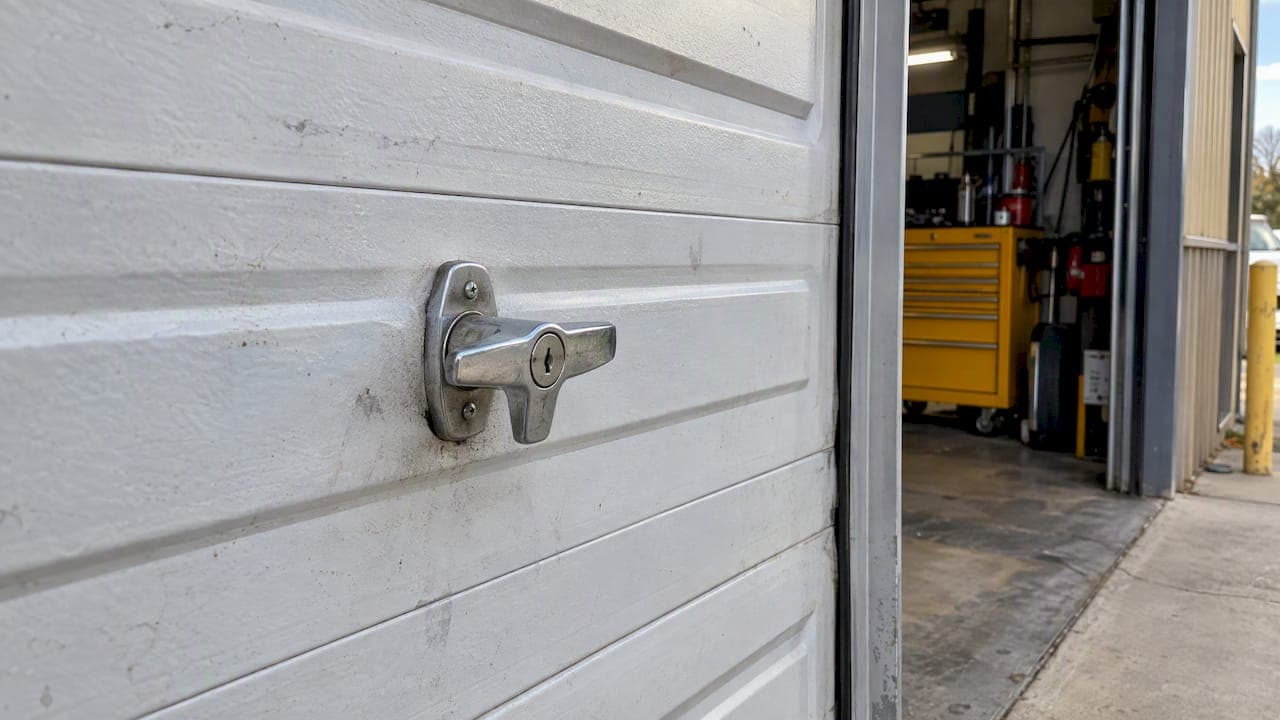
A T-handle is the lock you often see on the outside of older and metal-skinned doors. Per Today's Homeowner, it is installed on the outside, and turning the key cylinder pulls cables and rods connected to spring-loaded locking mechanisms. It is the usual choice when you want to lock the door from outside with a key.
Center-lock systems work on a similar idea. A center equalizer and cables operate spring-loaded latches on both sides of the door, so it is held at two points, not one. If you are curious how that kind of paired latch mechanism behaves in other doors, this latch repair basics page covers the idea at a smaller scale.
Watch for: wear. Cables stretch, rods go out of alignment and cylinders gum up. If your T-handle feels loose or the key sticks, see our walkthrough on a stuck garage door lock.
Deadbolts
A garage door deadbolt extends a thick bolt into the floor, the wall or the track. Clopay's guide lists it alongside manual locks as a budget-friendly choice for people who put physical security first. Single cylinder versions use a key on one side. Double cylinder versions take a key on both sides, which is stronger against a thumb-turn being reached through a gap, but harder to get out in an emergency. Think about how you would exit before choosing.
Lock bars
A lock bar is a steel bar that slides across the inside of the door and is guided into an engaging slot in the vertical track. Clopay's commercial steel-door installation manual specifies side locks, inside slide bolts and lock bars as options. The same manual makes a point that applies to every mechanical lock: it only works when the bolt or bar lines up precisely with the slot in the track. A lock that is half a finger-width off is a lock that rattles and does not hold.

Padlocks, hasps and cane bolts
On hand-lifted doors (no opener), the King County Sheriff's home-security guidance recommends hardened-steel hinges, hasps and padlocks. For extra interior protection it suggests cane bolts or sliding hasps. These are blunt tools, but on a detached shed-style garage or a workshop door they do the job.
Automatic garage door locks
An automatic lock is a deadbolt tied to the opener. LiftMaster describes its automatic lock as a deadbolt that engages whenever the door closes and operates in tandem with the opener. When you press the remote, it retracts, then the door rises.
The appeal is obvious. You cannot forget it. The catch is compatibility: that LiftMaster model is specified for particular LiftMaster opener models, so you need to match the lock to your opener before buying. Today's Homeowner makes the same point and adds that the electrical installation may call for professional help.
If you are not sure what opener you have, our guide to types of garage door openers helps you identify it.
Keypads and smart locks: access control
These do not hold the door shut by themselves. They decide who can send the command.
Wireless keypads
A keypad mounts outside the door and lets you open it with a code. Chamberlain says its universal wireless keypad has encrypted access, temporary PINs and a backlit pad, and that one-touch close works with Chamberlain, LiftMaster and Craftsman openers made after 1997. It works with most openers made after 1993 when safety sensors are present. Another Chamberlain model, the KLIK2U-P2, offers four-digit keyless access and works with over 90% of garage door openers, including Genie and other major brands.
The practical value is that nobody needs to hide a key under a planter or leave a remote in a car. Temporary PINs are handy for a dog walker or contractor. If your keypad stops responding, our six-step keypad troubleshooting guide walks through the usual causes.
Smart lock systems
Smart systems add app control, automatic locking and unlocking and access alerts. Clopay's guide notes that they need Wi-Fi, while a basic keypad only needs a code. Real-time status alerts are the best feature: you can see that the door was left open at 10 p.m. and close it from your phone.
A smart system has limits, though. Clopay's connected-garage article says monitoring improves awareness but cannot make up for a door that fails to close or a weak entry door into the house. We agree.
Rolling code: the quiet security feature
Most modern openers use rolling codes. According to Clopay's smart garage security post, a rolling-code opener generates a new encrypted code for every use, which makes an intercepted signal far less useful. If your opener is decades old and uses a fixed code, that is a better reason to upgrade than any lock. We cover the details in our garage door opener security guide.
Garage door lock types compared
| Type | How it works | Locks from | Best for | Watch out for |
|---|---|---|---|---|
| Slide lock | Bolt slides into a hole in the vertical track | Inside only | Vacations, overnight | Opener must be off while engaged |
| Keyed T-handle | Key turns a cylinder that pulls rods or cables to latches | Outside | Doors locked from outside, no opener | Worn cables, rods out of alignment |
| Deadbolt | Thick bolt into floor, wall or track | Inside or outside | Budget-minded physical security | Double cylinder makes exit harder |
| Lock bar | Steel bar into an engaging slot in the track | Inside | Commercial and steel doors | Needs precise alignment |
| Automatic lock | Opener-linked deadbolt engages when door closes | Automatic | Never forgetting to lock | Must match opener model |
| Keypad | Code sent to the opener | Outside | Keyless access, guests | Opener age and sensor compatibility |
| Smart system | App, alerts, automatic open and close | Anywhere | Monitoring and remote control | Needs Wi-Fi, does not strengthen the door |
Which garage door lock is the most secure?
There is no single winner, and we would not trust a guide that named one. Security comes from layers.
Here is how we think about it:
- Hold the door shut when nobody is home. A deadbolt, lock bar or slide lock that engages a track or floor beats any app for stopping a forced entry.
- Protect the signal. A rolling-code opener and a keypad with a PIN that is not your house number.
- Secure the entry door into the house. An attached garage is only as safe as the door behind it.
- Remove easy tricks. Our article on common garage break-in tactics covers how thieves actually get in and how to block them.
Clopay's guide frames the choice by budget, how often you open the door and your security needs: manual locks and deadbolts suit cost-conscious people who put physical security first, while smart systems put convenience and monitoring first. That is a fair split.
How to choose for your door
If you have a detached garage or rarely use the overhead door: a keyed T-handle or a deadbolt with a hasp is simple and strong.
If the garage is attached and you drive in daily: an opener with rolling code, a keypad, and a slide lock you engage when you travel. Add an automatic lock if your opener supports one.
If you manage a commercial property: lock bars or side locks on rolling and sectional doors, plus an opener lock that prevents after-hours access. Downtime matters here, so choose hardware that can be serviced quickly.
If you have a smart home setup: a smart controller is a great layer, but keep a mechanical lock for extended absences.
Before buying any lock, check three things: the door material (steel, wood and aluminum take fasteners differently), where the lock will sit relative to the track, and your opener's brand and age. Follow the manufacturer's instructions for installation.

Our perspective
We repair and install garage doors across Loveland and Northern Colorado, and the same pattern shows up on calls. People spend money on a fancy lock while the door itself is out of balance, the track is bent or the opener is twenty years old. A lock only helps when the door underneath it closes straight and sits square in the track.
Three things we tell customers:
- Fix the door first. A sagging panel or a bent track leaves a gap that no lock can close. A tune-up often does more for security than new hardware.
- Keep it simple. The best lock is the one you will actually use. If a slide lock makes you unplug the opener every morning, you will stop using it. Pick something that fits your routine.
- Do not DIY the risky parts. Springs and cables are under serious tension. Replacing a lock is fine for a handy owner, but anything that touches the spring system should go to a technician.
We give upfront estimates over the phone, so you know what a repair or lock install will cost before anyone shows up.
— Eddie
Need a lock installed or a door checked?
If your lock is stuck, misaligned or not engaging, or you want an opener-linked lock fitted properly, we can help. We handle opener repair and installation, spring repair, tune-ups, commercial doors and 24-hour emergency repairs for homes and businesses in Loveland and across Northern Colorado. About 90% of our repairs are completed the same day, and veterans get a 10% discount. Call us for an honest estimate over the phone.
Common mistakes with garage door locks
- Locking the slide bolt, then pressing the button. The opener strains against the bolt. Unplug the opener or use the disconnect habit your installer recommended.
- Buying an automatic lock without checking the opener. Compatibility is not universal.
- Ignoring the emergency release. Anything that blocks the release also blocks you in an emergency. Get the release set up correctly, and read our overview of garage door safety codes.
- Leaving a remote in the car. A keypad or phone-based control is safer.
- Skipping alignment. A misaligned bolt rattles, wears and eventually fails.
FAQ
What type of lock is the most secure for a garage door?
No single type wins on its own. A mechanical lock such as a deadbolt, lock bar or slide lock physically holds the door, while a rolling-code opener and keypad control access. Use a mechanical lock when you are away and an access-control layer for daily life.
What are the different types of garage door latches?
The most common are slide locks inside the door, keyed T-handles outside, and center-lock systems that use cables to work latches on both sides. Roller doors use locks that pass through the curtain and guide rails and need a key. Lock bars and padlocked hasps are common on commercial and hand-lifted doors.
Can I use a slide lock with an automatic opener?
Yes, but do not run the opener while the slide lock is engaged. Unplug the opener during installation, and disengage the lock before using the door. Many owners use a slide lock only for vacations for this reason.
Do smart garage door locks make the door harder to break into?
Not by themselves. They add monitoring, alerts and remote control, but they do not strengthen the door or stop someone from forcing a weak panel or entry door. Treat them as a convenience layer on top of good physical security.
Sources
- Guide to Garage Door Locks and Security Features, Clopay
- Securing Your Garage: Best Garage Door Locks, Today's Homeowner
- Doors and locks, King County Sheriff
- Installation and maintenance manual, Clopay
- Garage Door Lock 841LM, LiftMaster
- CHU48 Universal Wireless Keypad, Chamberlain
- KLIK2U-P2 Universal Wireless Keypad, Chamberlain
- Smart Garage Security, Clopay
- Connected Garage Doors: Smart Home Security, Clopay