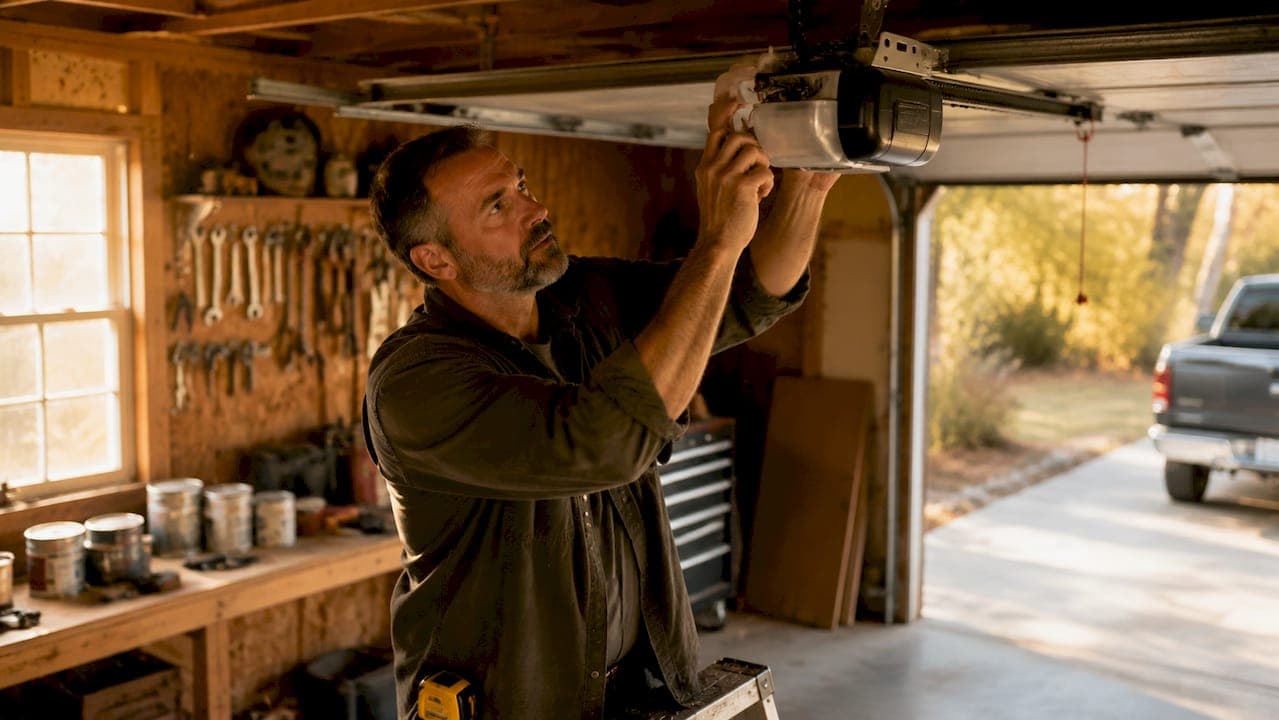
Garage door openers are classified by their drive mechanism and mounting style, and the four main types are chain drive, belt drive, screw drive, and wall-mount jackshaft. Each type delivers a different balance of noise, cost, maintenance, and installation requirements. For most attached residential garages, belt drive is the top choice because it runs quietly and needs minimal upkeep. Knowing which type fits your home saves you money and avoids a noisy, frustrating mistake.
1. What are the main types of garage door openers?
The four primary drive types are chain drive, belt drive, screw drive, and wall-mount jackshaft. Each one moves your door differently, and that difference shows up in how loud, how reliable, and how expensive the system is over time. Chain drives pull a metal chain like a bicycle. Belt drives use a reinforced rubber belt. Screw drives turn a threaded steel rod. Jackshaft openers mount on the wall beside the door and drive the torsion spring shaft directly.
The right choice depends on three things: how close your garage is to living spaces, how much temperature swings in your area, and how much ceiling space you have. Noise matters most for attached garages. Temperature matters most for screw drives. Ceiling clearance matters most for jackshaft systems.

2. Chain drive garage door openers: affordable and durable
Chain drive openers are the most affordable option on the market. They use a metal chain to pull or push a trolley along a rail, which moves the door. They are built tough and last for years with basic maintenance.
The tradeoff is noise. Chain drives operate at 60–80 dB, which is roughly as loud as a vacuum cleaner. That level of noise is fine for a detached garage but disruptive if a bedroom sits above or beside the garage.
Key facts about chain drive openers:
- Lowest upfront cost of all four types
- Best suited for detached garages
- Require periodic lubrication of the chain
- Metal chains expand and contract with temperature changes, requiring tension adjustments
- Compatible with most standard residential doors
Temperature-related chain expansion is a real issue in places like Northern Colorado, where winters are cold and summers are hot. Belt drives hold tension far better across those swings. Homeowners in Loveland who pick chain drives for a detached garage should plan to check chain tension at least twice a year.
Pro Tip: Run a quick tension check every fall and spring. A chain that sags more than half an inch below the rail will wear out your drive gear faster than normal use ever would.
3. Why belt drive openers are the preferred residential choice
Belt drive openers replace the metal chain with a reinforced rubber belt, and that single change makes a dramatic difference in noise. Experts recommend belt drives for most attached residential garages because they run quietly and smoothly without the rattling that wakes up the house at 6 a.m.
The belt does not expand and contract the way metal does, so it holds tension consistently through Colorado's temperature swings. That means fewer adjustments and a longer service life on the drive components.
Key facts about belt drive openers:
- Quietest of the trolley-mounted drive types
- Ideal for attached garages with living spaces above or beside
- Slightly higher upfront cost than chain drives
- Many models include Wi-Fi connectivity and battery backup
- Lower maintenance frequency compared to chain or screw drives
The price premium over chain drives is real but modest. For a garage attached to your home, that extra cost pays for itself quickly in peace of mind. If you want guidance on quiet operation for larger doors, the belt drive category covers most residential needs well.
Pro Tip: When shopping belt drive models, check whether the belt is steel-reinforced. A steel-reinforced belt lasts significantly longer than a standard rubber belt, especially on heavier doors.
4. How screw drive openers differ and where they work best
Screw drive openers use a threaded steel rod to move the trolley along the rail. The motor rotates the rod, and the trolley rides the threads like a nut on a bolt. The design has fewer moving parts than chain or belt systems, which means less to lubricate and less to break.
That simplicity is the main selling point. Maintenance is minimal compared to chain drives. The opener runs at a moderate noise level, sitting between chain and belt drives.
Key facts about screw drive openers:
- Fewer moving parts than chain or belt drives
- Low lubrication requirements
- Moderate noise level
- Slower door travel speed than belt drives
- Performance drops in climates with wide temperature swings
The climate limitation is the critical factor. Screw drives often underperform in regions with large temperature swings because the metal rod expands and contracts, causing the trolley to bind or slip. Loveland, Colorado sits at the edge of that risk zone. If you choose a screw drive here, check the manufacturer's temperature rating before buying. Read more about Colorado winter prep to understand how cold snaps affect opener performance.
5. What are wall-mount jackshaft openers and why are they a premium option?
Jackshaft openers mount on the wall beside the door, not on the ceiling. The motor drives the torsion spring shaft directly, which turns the drums and lifts the door. Because there is no overhead rail, the entire ceiling stays open.
That ceiling clearance is the reason many homeowners with high-lift doors, carriage-house doors, or garage workshops choose jackshaft systems. You can park a tall truck, hang storage racks, or install a car lift without a rail running down the center of the ceiling.
Key facts about jackshaft openers:
- Mounts on the wall beside the door, freeing up ceiling space
- Ultra-quiet operation, quieter than belt drive systems
- Compatible with high-lift and carriage-house door configurations
- Higher purchase and installation cost than trolley-mounted types
- Requires about 7 inches of side clearance and 3 inches above the torsion rod
That clearance requirement catches a lot of homeowners off guard. If your garage walls are tight or your torsion rod sits close to the ceiling, a jackshaft system may not fit without modifications. Installation requirements often determine feasibility more than cost does. Always have a technician measure before you buy.
Pro Tip: If you are converting a single-car garage into a workshop, a jackshaft opener is worth every extra dollar. The ceiling space you reclaim is genuinely useful, not just a nice-to-have.
6. Garage door opener types comparison: noise, cost, and maintenance
Choosing between the four types comes down to matching the opener's strengths to your specific garage setup. The table below breaks down the key factors side by side.
| Type | Noise Level | Relative Cost | Maintenance | Best Use Case |
|---|---|---|---|---|
| Chain drive | 60–80 dB | Lowest | Moderate (chain lubrication, tension checks) | Detached garages, budget installs |
| Belt drive | Low | Moderate | Low | Attached garages, noise-sensitive homes |
| Screw drive | Moderate | Moderate | Low (but climate-sensitive) | Stable-climate regions, simple setups |
| Jackshaft | Very low | Highest | Low | High-lift doors, ceiling-space-limited garages |
One factor the table cannot show is door balance. A poorly balanced door puts extra strain on the motor regardless of which type you choose. Before you upgrade your opener, test your door's balance by disconnecting the opener and lifting the door by hand to waist height. It should stay in place without drifting up or down. If it does not, fix the spring tension first.
For commercial properties, the decision gets more complex. Commercial operators range from $1,000 to over $4,000 depending on mounting style and capacity. Trolley operators run $1,000–$3,000, while jackshaft commercial units run $1,500–$4,000. Selecting excessive horsepower is a common and costly mistake. Match the operator to door weight, cycle frequency, and layout rather than buying the most powerful unit available.
For scenario-based help, the garage door opener diagnostic guide from Mikes garage doors Loveland walks through common issues that appear after installation.
Key takeaways
The best garage door opener type is a belt drive for most attached residential garages, but chain, screw, and jackshaft systems each serve specific needs based on noise tolerance, climate, and ceiling space.
| Point | Details |
|---|---|
| Belt drive is the default choice | Quietest trolley-mounted option, low maintenance, best for attached garages. |
| Chain drive suits detached garages | Most affordable type, but requires tension checks twice yearly in variable climates. |
| Screw drive has climate limits | Fewer moving parts, but metal rod expansion causes problems in wide temperature swings. |
| Jackshaft needs clearance checks | Frees up ceiling space but requires 7 inches of side clearance before installation. |
| Door balance affects every type | Fix spring balance before replacing any opener to protect motor life. |
What I've learned after years of opener installs
The question I get most often is: "Which opener is the best?" My honest answer is always the same. The belt drive wins for attached garages, full stop. The noise difference between a chain and a belt drive is not subtle. It is the difference between waking up your family at 5 a.m. and not waking them up.
What surprises most homeowners is how often the opener is not the real problem. Door balance is fundamental to motor life. I have seen brand-new belt drive openers burn out in two years because the springs were out of balance. The motor was working twice as hard as it needed to. We always check balance before recommending a replacement.
Jackshaft systems are genuinely impressive, but they are not for everyone. The clearance requirements are strict, and the cost is real. Do not buy one because it looks cool. Buy one because you need the ceiling space or you have a high-lift door that a trolley system cannot handle.
My advice for property managers running commercial doors is to resist the urge to overbuy on horsepower. Match the operator to the door, not to your anxiety about whether it is strong enough. A professional installation assessment catches the compatibility issues that spec sheets miss.
— Eddie
Get the right opener installed by people who know Loveland
Mikes garage doors Loveland installs all four garage door opener types and handles everything from a basic chain drive swap to a full jackshaft system on a custom carriage-house door. The team knows Northern Colorado's climate and what it does to chain tension and screw drive performance over time.
Every job starts with a free phone estimate and a door balance check before any opener gets ordered. That step alone saves homeowners from buying the wrong unit. Mikes garage doors Loveland completes 90% of repairs the same day, and veterans receive a 10% discount on all services. Browse the full list of garage door services in Loveland or call to talk through which opener type fits your garage before you spend a dollar.
FAQ
What is the quietest type of garage door opener?
Jackshaft openers are the quietest overall, followed closely by belt drive systems. Belt drives are the quietest trolley-mounted option and the most practical choice for most attached residential garages.
Are belt drive openers worth the extra cost over chain drives?
Yes, for attached garages. Belt drives run significantly quieter, require less maintenance, and hold tension better in temperature-variable climates like Northern Colorado.
Can I install a jackshaft opener in any garage?
Not always. Jackshaft installation requires about 7 inches of side clearance and 3 inches above the torsion rod. Garages with tight walls or low ceilings may not accommodate the system without modifications.
How do I know if my garage door opener type is right for my door?
Test your door's balance first by disconnecting the opener and lifting the door to waist height. A balanced door stays in place. If it drifts, fix the springs before choosing or replacing any opener type.
What types of garage door openers work best for commercial doors?
Commercial properties typically use trolley or jackshaft operators sized to the door's weight and cycle frequency. Trolley operators run $1,000–$3,000 and jackshaft commercial units run $1,500–$4,000. Matching capacity to actual use prevents unnecessary cost.