
Expect $125 to $300 for minor track realignment or a bent-track fix, and $350 to $900 for full track replacement, depending on door size and material. Most single bends can be repaired. cracked, rusted, or repeatedly bent tracks should be replaced instead of straightened again. Get a firm quote based on your door's measurements before committing either way.
TL;DR:
- Minor track realignment costs between $125 and $300, with most being fixable without extensive labor or replacement.
- Bent tracks with cracks or multiple bends should be replaced rather than straightened, especially if near the transition curve.
- Full track replacements typically range from $350 to $900, with larger or insulated doors pushing toward the higher end.
- Emergency repairs outside regular hours add $75 to $150, primarily to cover technician availability rather than parts.
- Accurate quotes depend on measuring door dimensions, noting damage location, and sharing clear photos before scheduling repair visits.
Table of Contents
- Garage Door Track Cost Breakdown: Real Scenarios and Sample Quotes
- What Actually Drives Your Garage Door Track Repair Cost?
- How Much Do Garage Door Parts Cost Per Foot?
- Can You Fix a Garage Door Track Yourself?
- What to Expect From a Garage Door Repair Visit
- Why Homeowners in Loveland Trust Mike's Garage Door Repair
- The Real Math Behind Repair vs Replace
- Get an Upfront Track Repair Quote in Loveland
- Where These Cost Figures Come From
- Sources
- FAQ
Garage Door Track Cost Breakdown: Real Scenarios and Sample Quotes
The price you pay depends almost entirely on how far the damage has traveled down the track, not just whether the door is stuck. A door that's merely rattling in its channel costs a fraction of one where the vertical section has folded at the transition point.
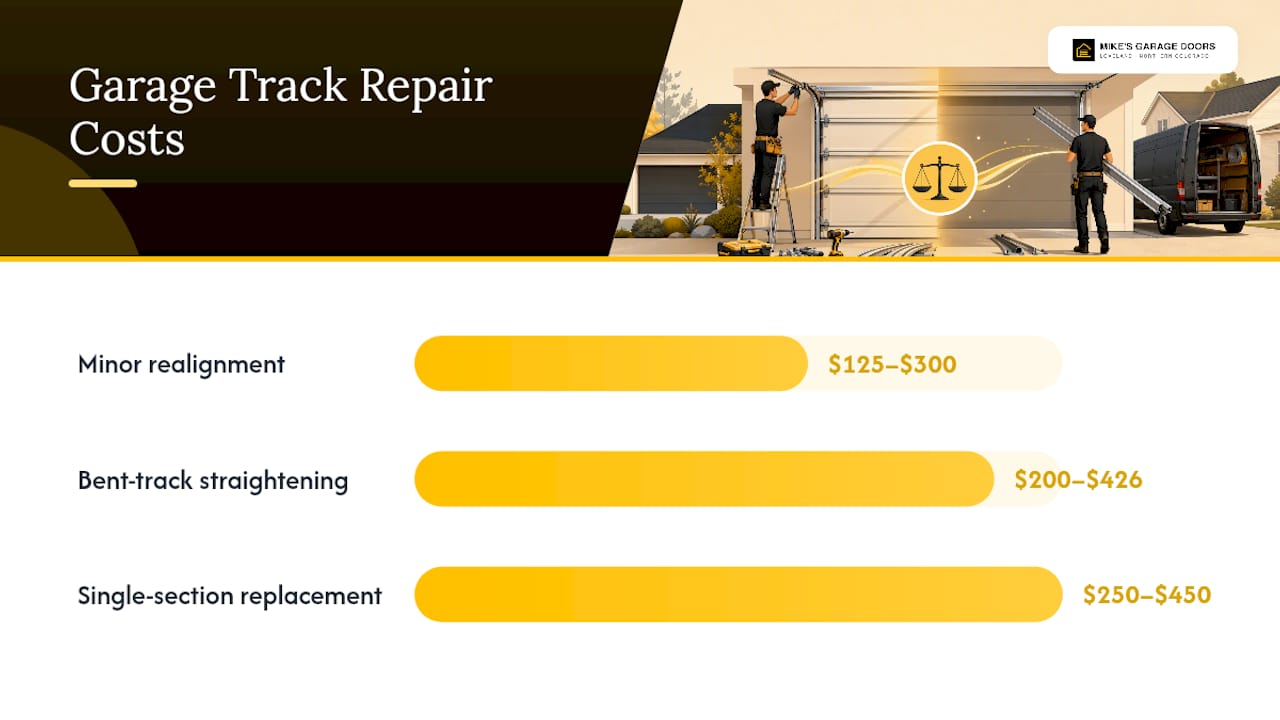
Minor realignment is the cheapest fix in this whole category. If your track has slipped slightly out of position, maybe from a bumped car or a loose bracket, a technician can often nudge it back into place, tighten the mounting hardware, and check the level in under an hour. HomeGuide's national data puts these smaller repair jobs in the $125 to $300 range, with the lower end covering straightforward re-tightening and the upper end covering jobs where a bracket also needs replacing.
Bent-track straightening costs more because it takes longer and requires more finesse. A technician has to work the metal back to true without weakening it further, then test the door through several full cycles to make sure it doesn't bind. This typically runs $200 to $426, according to HomeGuide's cost data, with the spread driven by how many bend points there are and whether the roller carriage needs adjustment afterward. One clean bend away from a transition point is usually salvageable. Multiple bends, or any crack, usually is not.
Single-section replacement sits in a middle zone. If only the horizontal or vertical run on one side needs swapping, you're paying for roughly $8 to $22 of material per foot (DDM Garage Doors) plus one to two hours of labor. On a standard single-car door, that often lands between $250 and $450 all in.
Full track set replacement is the most expensive and most common recommendation once damage shows up at the transition point, where the vertical rail curves into the horizontal ceiling track. That curve concentrates stress every time the door cycles, and a bend there rarely holds after straightening. Full replacement on a standard door typically runs $350 to $900, per Well Built Florida's cost breakdown, with larger double-wide doors and heavier insulated panels pushing toward the top of that range because the track has to support more weight without flexing.
Here's how those numbers typically stack up by scenario:
- Loose bracket, minor slip: $125–$225 (parts minimal, labor under an hour)
- Single moderate bend, not at transition: $200–$350 (straightening plus alignment check)
- One damaged section on a single-car door: $250–$450 (material plus 1–2 hours labor)
- Full track replacement, single-car door: $350–$650
- Full track replacement, double-wide or insulated door: $600–$900+
- After-hours or weekend emergency call: add $75–$150 on top of the standard quote
That last line matters more than people expect. If your door is stuck open at 9 p.m. with a car trapped inside, the urgency drives the price up, not the repair itself. Emergency premiums typically cover the technician's time getting to you outside normal hours, not extra parts.
What Actually Drives Your Garage Door Track Repair Cost?
Two identical-looking dents in a track can cost wildly different amounts to fix, and the reason almost always comes down to a handful of specific factors a technician checks before quoting you.
Door size and weight is the first variable. A standard single-car door (roughly 8 to 9 feet wide) needs less track material and less structural reinforcement than a double-wide 16 foot door or a heavy insulated model. More weight riding the rails means the track has to be straighter and stronger, which raises both material grade and labor time.
Track type and material changes the per-foot cost directly. Standard galvanized steel track is the most common and most affordable option. Heavier-gauge steel for oversized or commercial doors costs more, and specialty track for high-lift or vertical-lift configurations (common in taller garages) adds complexity most residential techs quote separately.
Rollers and related hardware often ride along for the repair even when they're not the primary problem. If your rollers are worn, cracked, or the wrong size for a new track, a good technician will flag it, since mismatched hardware causes the same failure to repeat within months.
Frame and jamb damage is the wildcard that turns a $300 job into a $600 one. If the impact that bent your track also cracked the wood jamb or bent the mounting bracket into the framing, that's additional carpentry or hardware work layered on top of the track itself.
Site access matters more than most homeowners assume. A detached garage with tight clearance, a second-story mounting point, or a door that requires a ladder and extra bracing time all add labor minutes that show up on the final bill.
Weekend and emergency service fees are the last lever. Scheduling a repair during normal business hours, even a same-day appointment, almost always costs less than an after-hours emergency call.
Before you call anyone for a quote, gather a few basics:
- Measure your door's width and height in feet
- Note whether the bend or damage is near the transition curve or along a straight run
- Take three or four clear photos: the damaged section, the roller carriage, and the mounting bracket
- Write down what happened (car impact, wind, age-related wear) since it helps a technician anticipate hidden damage
Pro Tip: Text your photos and measurements ahead of the appointment. Technicians who see the damage before arriving can often quote a firmer price over the phone and bring the right replacement track on the first trip, saving you a second visit fee.
How Much Do Garage Door Parts Cost Per Foot?
Material is usually the smaller line item on your invoice. Labor and diagnostic time typically account for more of the total than the steel itself, according to Well Built Florida's cost analysis, which is worth knowing before you assume a quote is padded just because the parts seem cheap on paper.
Here's what individual components typically run when priced separately:
| Component | Typical price range | Notes |
|---|---|---|
| Steel track (per foot) | $8–$22 | Price varies by gauge and finish |
| Aluminum track (per foot) | $10–$18 | Lighter, common on smaller doors |
| Steel rollers (each) | $2–$8 | Lower cost, louder operation |
| Nylon rollers (each) | $5–$20 | Quieter, longer lifespan |
| End bearings (each) | $3–$10 | Often replaced with new track |
| Mounting brackets | $5–$20 | Price rises with reinforced steel |
Track hardware and small components like brackets and fasteners are commonly bundled by suppliers such as Parts4GarageDoors, which lists typical unit pricing for the rollers and brackets that make up a standard job.
A full track replacement almost always comes as a set price rather than piece by piece, because installers typically swap the rollers and bearings at the same time they replace the track. Doing all three at once avoids a second labor call a few months later when an old roller fails against a brand new rail, even though it raises the upfront parts total. Expect a disposal fee of $10 to $30 on top if the old track and hardware need hauling away.
A rough material list for a single-car door replacement looks like this: 16 to 18 feet of track at roughly $150 to $250 total, six to eight rollers at $30 to $80, four end bearings at $12 to $30, and mounting brackets at $20 to $60. That puts raw materials in the $210 to $420 range before labor, which lines up with why a full quoted job often lands closer to $400 to $650 once installation time is added.
Can You Fix a Garage Door Track Yourself?
Some garage door track problems are genuinely safe weekend fixes. Others put you one bad moment away from a door slamming down on something you don't want it to.
Here's a general order of what's reasonable to attempt versus what to hand off:
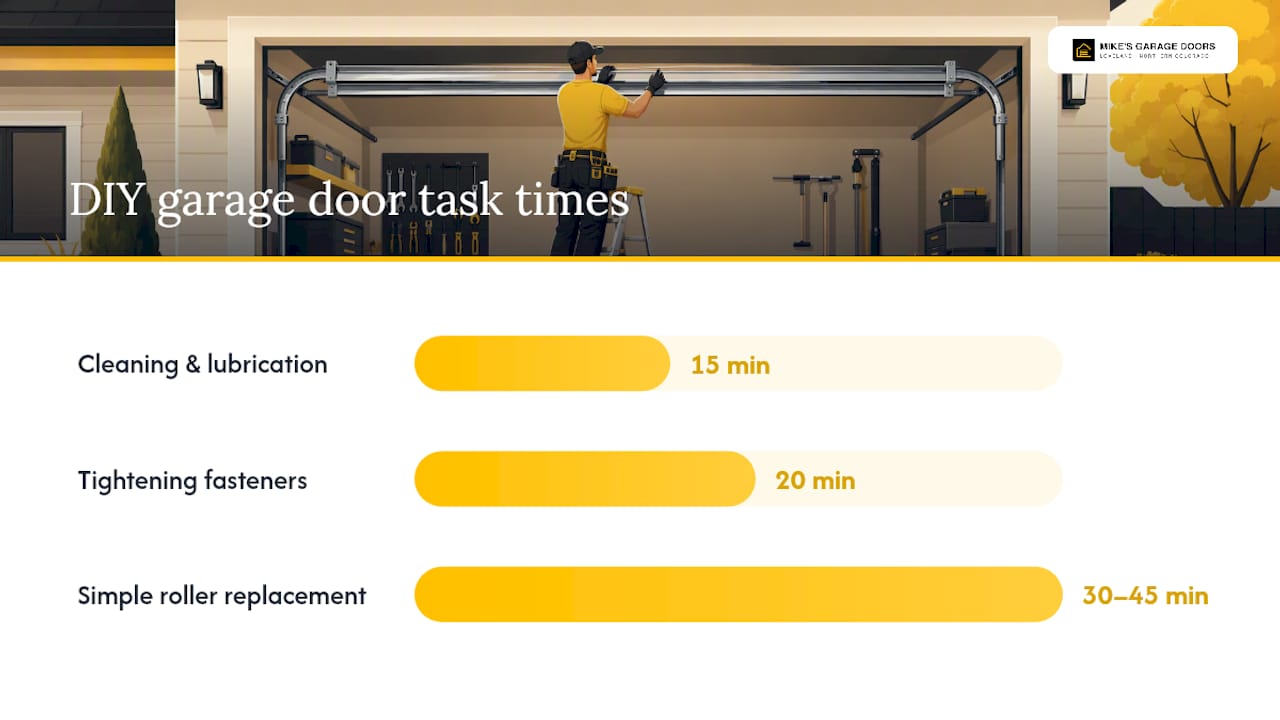
- Cleaning and lubrication — Wiping down the track and applying a silicone-based lubricant to the rollers takes 15 minutes and costs under $10 in supplies. This is the single most effective free maintenance step most doors never get.
- Tightening loose fasteners — If a bracket bolt has worked loose, a wrench and 20 minutes usually solves it. Check every bracket while you're at it.
- Simple roller swaps — Replacing a worn roller on a low-tension section (not near the spring assembly) is doable with basic tools and about 30 to 45 minutes per roller.
- Minor track realignment — A slight gap between the roller and track can sometimes be corrected by loosening and re-tightening brackets, but if the door doesn't roll freely afterward, stop and call someone.
Where DIY stops making sense: anything involving the transition point curve, any track showing a crack rather than just a bend, anything that requires removing the spring assembly to access the track, and any job where the door is currently jammed under tension. A garage door spring under load holds enough force to cause serious injury if it's released incorrectly, and a track repair that requires disconnecting the door from its cables falls into that same risk category.
Repeated straightening of the same bend point is a false economy. If you've already had one section fixed twice, the metal has fatigued past the point where a third repair holds, and you're better off budgeting for full replacement the next time it fails.
Pro Tip: Before calling anyone, film a 10 second video of the door opening and closing (from a safe distance). A technician can often spot exactly where the binding happens just from watching the motion, which speeds up diagnosis on-site.
What to Expect From a Garage Door Repair Visit
A straightforward track repair, realignment or a single bend, typically takes a technician one to two hours on-site. Full track set replacement runs closer to two to five hours depending on door size, whether rollers and bearings are being swapped too, and whether any bracket or jamb repair is layered in.
Most companies charge a trip or service call fee that's either a flat rate ($50 to $100 range) or waived entirely once you approve the repair. This is one of the most common places homeowners get surprised on an invoice, so ask upfront whether the visit fee applies if you decline the work.
A solid written estimate should include:
- Parts listed by name and quantity, not a lump "materials" charge
- Labor hours or a flat labor rate, clearly separated from parts
- Any applicable warranty on parts and labor
- Exclusions, like whether jamb repair or disposal is extra
Many shops price small jobs at a one to two hour labor minimum rather than by the exact minute, according to HomeGuide's cost data, so a 20 minute fix quoted at a full hour of labor isn't necessarily a red flag. It's simply how minimum call pricing works industry wide.
Same-day service is standard for most daytime calls at companies built around fast turnaround. True after-hours emergency response, a door stuck open overnight with a car trapped, for instance, usually costs more but can often still happen within a few hours of the call.
Why Homeowners in Loveland Trust Mike's Garage Door Repair
Every estimate is given upfront over the phone, so homeowners know the likely range before a technician even arrives, not after the invoice lands.
A few things worth knowing about how this local, family-owned shop operates:
- Transparent phone estimates before any work begins, no hidden line items added later
- 90% same-day completion rate on repair calls
- A 10% discount extended automatically to veterans
- Extensive written warranties on both parts and labor
For readers who want more detail on adjacent issues, the garage door off-track repair cost breakdown covers a related failure mode that often shows up alongside track damage, and the step-by-step guide for an off-track door walks through the safety basics before any technician arrives.
The Real Math Behind Repair vs Replace
The conventional advice on garage door tracks, straighten it if you can, replace it only if you must, isn't wrong, but it skips the part that actually costs homeowners money over time. A single clean bend, away from the transition curve, genuinely is worth straightening. That's real savings, not a corner cut.
What gets overlooked is the second and third repair on the same spot. Metal fatigue is cumulative, and a track that's been bent back twice is structurally weaker than a fresh one, even if it looks fine sitting still. Homeowners who keep authorizing the cheap fix on a chronically failing section often spend more across three visits than they would have on one full replacement, plus they carry the risk of a heavier door coming loose in the meantime.
The other underrated factor is speed. A quote is only as good as the technician's ability to diagnose it correctly on the first visit, which is why companies with strong same-day track records tend to save homeowners a second service call fee just by getting it right once.
— Eddie
Get an Upfront Track Repair Quote in Loveland
If you're staring at a bent track wondering whether it's a $200 fix or an $800 one, the fastest way to find out is a phone call that gives you a real number before anyone shows up. This local garage door service provides upfront, transparent estimates over the phone, so you know the likely range before committing to a technician visit, not after.

Beyond track repair and replacement, the team handles garage door tune-ups, spring repair, opener repair and install, and 24-hour emergency repair services for residential and commercial properties. To get an accurate quote fast, have your door's width and height ready, a couple of clear photos of the damaged section, and a description of when the problem started.
Ready to get a number instead of a guess? Visit the garage door services page to request your upfront phone estimate today.
Where These Cost Figures Come From
The pricing ranges in this guide are drawn from a mix of national cost aggregators, parts suppliers, and labor data rather than a single source, since track repair pricing varies enough by region that no one number tells the whole story.
- HomeGuide's garage door repair cost data for national repair and replacement ranges
- BLS Occupational Employment and Wage Statistics for labor-rate context and regional wage variation
- DDM Garage Doors' track hardware pricing for per-foot material costs
- Well Built Florida's cost breakdown for component and labor tables
Sources
- Garage door repair cost — HomeGuide
- Garage Door Tracks & Track Hardware — DDM Garage Doors
- Garage door track replacement cost — Well Built Florida
- Occupational Employment and Wage Statistics — BLS
FAQ
How Much Does It Cost to Replace a Garage Door Track?
Full track set replacement typically costs $350 to $900, while single-section replacement or minor realignment often falls between $125 and $450, according to HomeGuide's cost data. The exact number depends on door size, track material, and whether rollers and bearings are replaced at the same time.
What Is the Standard Size of a Garage Door Track?
Standard residential garage door tracks are sized to match the door itself, with vertical and horizontal sections sized according to door height and garage clearance. Double-wide doors need proportionally longer and often heavier-gauge track to support the added weight.
How Do I Replace the Track on My Garage Door?
Track replacement involves disconnecting the door safely, removing the old track and rollers, installing new track sections, and realigning the entire system so the door glides without binding. This is one of the tasks best left to a professional once springs or the transition curve are involved, since incorrect reassembly can cause the door to fall unexpectedly.
What Is a Garage Door Track Called?
The vertical and horizontal channels that guide a garage door's rollers are simply called the garage door track, sometimes referred to as the track system or rail assembly. It works alongside rollers, brackets, and bearings to keep the door moving in a straight, controlled path.
Should I Repair or Replace a Bent Garage Door Track?
A single bend away from the transition point can usually be straightened economically, but cracks, rust, or repeated bending at the same spot call for full replacement instead. Repeated straightening on a fatigued section tends to fail again, which ends up costing more across multiple visits than one full replacement would.