
Commercial springs wear faster because they're built for a job that's fundamentally different from residential doors, and most facilities never adjust their spec or maintenance to match. High daily cycle counts, undersized wire ratings, corrosion, and skipped lubrication all stack up to cause premature metal fatigue. Before you call anyone, do this:
- Check your door's daily cycle count (open plus close = one cycle)
- Look for rust, pitting, or an obvious lean when the door sits half open
- Log the date of the last spring replacement
- Tag the bay for a full inspection if you don't know either number
A door cycling frequently on a spring rated for 10,000 cycles under the ANSI/DASMA testing standard is going to eat through hardware fast, and it's the single most common issue Mike's Garage Door Repair Loveland Colorado sees on commercial service calls.
Key Takeaways
Commercial springs wear out faster because their cycle rating rarely matches actual daily use, and that mismatch compounds with corrosion, poor maintenance, and hardware wear.
| Point | Details |
|---|---|
| Match rating to real cycles | Count daily door cycles and choose a 25k, 50k, or 100k spring that covers your desired replacement interval. |
| Replace springs in pairs | Both springs on a shaft age together, so replacing only the failed one invites a second truck roll. |
| Corrosion accelerates fatigue | Rust reduces wire diameter and creates pit sites where fatigue cracks start, so dry storage and coating matter. |
| Fix the system, not just the spring | Worn rollers, frayed cables, and misalignment add load that shortens spring life regardless of rating. |
| Schedule expert inspection | Mikes garage doors Loveland colorado offers on-site cycle assessment, high-cycle spring upgrades, and maintenance contracts for Loveland facilities. |
Table of Contents
- Torsion vs. Extension Springs: What Each One Does
- Top Reasons Commercial Springs Wear Faster
- How Many Years Will Your Spring Rating Actually Last?
- Warning Signs a Spring Is About to Fail
- Maintenance Steps That Actually Extend Spring Life
- Choosing Springs by Cycle Count, Not Just Price
- What We See on Commercial Service Calls
- Get Your Commercial Springs Specced Right the First Time
- Sources
- FAQ
Torsion vs. Extension Springs: What Each One Does
Every garage door spring exists to counterbalance the weight of the door so the opener isn't doing all the lifting alone. Without that counterbalance, a 200 pound commercial door turns into dead weight the motor has to muscle up every single cycle.
- Torsion springs sit above the door on a shaft and twist to store energy. They distribute load evenly and hold their calibration longer under heavy use.
- Extension springs run alongside the horizontal tracks and stretch to do the same job, but they concentrate stress at the end coils.
- Torsion setups dominate commercial and high-cycle applications because they balance more predictably and tolerate frequent operation better. Extension springs still show up on older installations and lighter-use doors, but they're rarely the right call for a busy loading dock.
Picture a labeled diagram of both systems side by side. It makes the visual difference obvious in a way text alone can't.
Pro Tip: If your commercial door was originally built as a residential-style installation and later converted for business use, check which spring type it has. A lot of "mystery wear" traces back to an extension spring system never upgraded to torsion when the usage changed.
Top Reasons Commercial Springs Wear Faster
Here's the order we see these show up on actual service tickets, from most to least common.
-
High cycle counts and mismatched cycle rating. A door opening 30 to 50 times a day burns through a standard 10,000-cycle spring in well under a year. Check the sticker on the spring or shaft for its rated cycle count, then compare it against your actual daily traffic. If there's a mismatch, the fix is upgrading to a 25k, 50k, or 100k rated spring, not just replacing like for like.
-
Incorrect spring size or improper tension. A spring wound too tight or too loose forces the opener and the coils to fight each other on every cycle. Watch for a door that slams down fast or one the opener struggles to lift. Retensioning or resizing by a trained technician corrects this before it snaps a coil.
-
Poor installation or door imbalance. An unevenly hung door puts more load on one spring than the other. Disconnect the opener and lift the door by hand. If it doesn't stay put roughly halfway open, it's out of balance and stressing the springs unevenly.
-
Corrosion and environmental attack. Rust reduces the effective wire diameter and creates pits that become the starting point for fatigue cracks, according to DASMA's technical data sheet. Coastal salt air, road de-icing chemicals, and washdown environments all accelerate this. A quick visual check for orange staining or flaking on the coils tells you if this is already underway.
-
Lack of lubrication and maintenance. Dry coils generate friction that adds wear with every cycle. A dry silicone or lithium-based garage door lubricant applied on schedule cuts that friction significantly.
-
Damaged hardware transferring stress to the spring. Worn rollers, frayed cables, or loose hinges make the door work harder to move, and that extra load lands on the springs. Frayed cable strands or a door that shudders during travel are the tells.
-
Extreme temperature swings and chemical exposure. Steel contracts in cold and expands in heat, and repeated swings fatigue the metal over time faster than stable indoor conditions would.
Pro Tip: If one spring on a two-spring shaft breaks, replace both. They're the same age and have absorbed the same cycles, so replacing both prevents early failure of the other. Replacing only the failed one just guarantees a second truck roll within weeks.
How Many Years Will Your Spring Rating Actually Last?
A cycle is one full open-and-close, and spring life is measured in cycles, not calendar years. That's the number that actually matters when you're deciding what to buy.
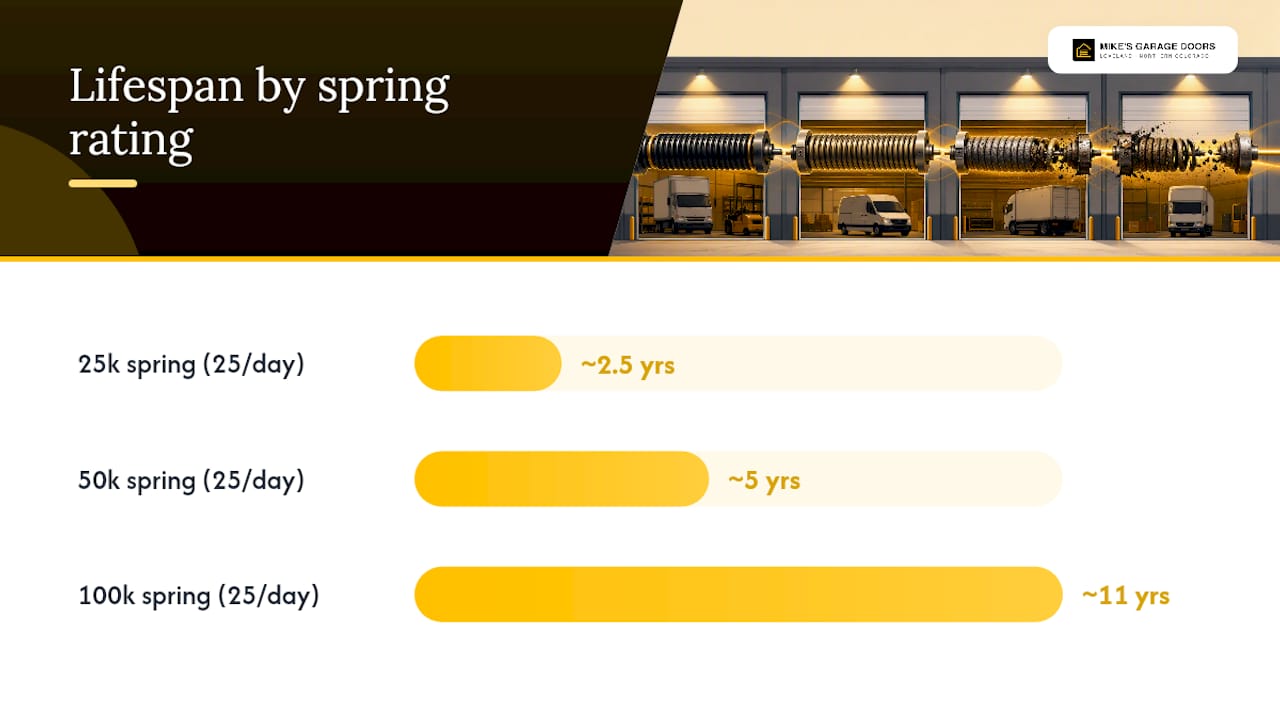
| Cycles/Day | 25,000-Cycle Spring | 50,000-Cycle Spring | 100,000-Cycle Spring |
|---|---|---|---|
| 10 | ~6 years | ~13 years | ~27 years |
| 25 | ~2.5 years | ~5 years | ~11 years |
| 50 | ~1 year | ~2.5 years | ~5 years |
To pick the right spec:
- Count or estimate your actual daily cycles using an operator counter or a simple usage log.
- Decide how often you want to schedule a replacement, say every five years.
- Choose the cycle rating that clears that interval at your daily volume, and treat the extra steel cost as cheaper than the labor for repeat truck rolls.
Warning Signs a Spring Is About to Fail
Watch for these during your normal walk-through, not just during a formal inspection:
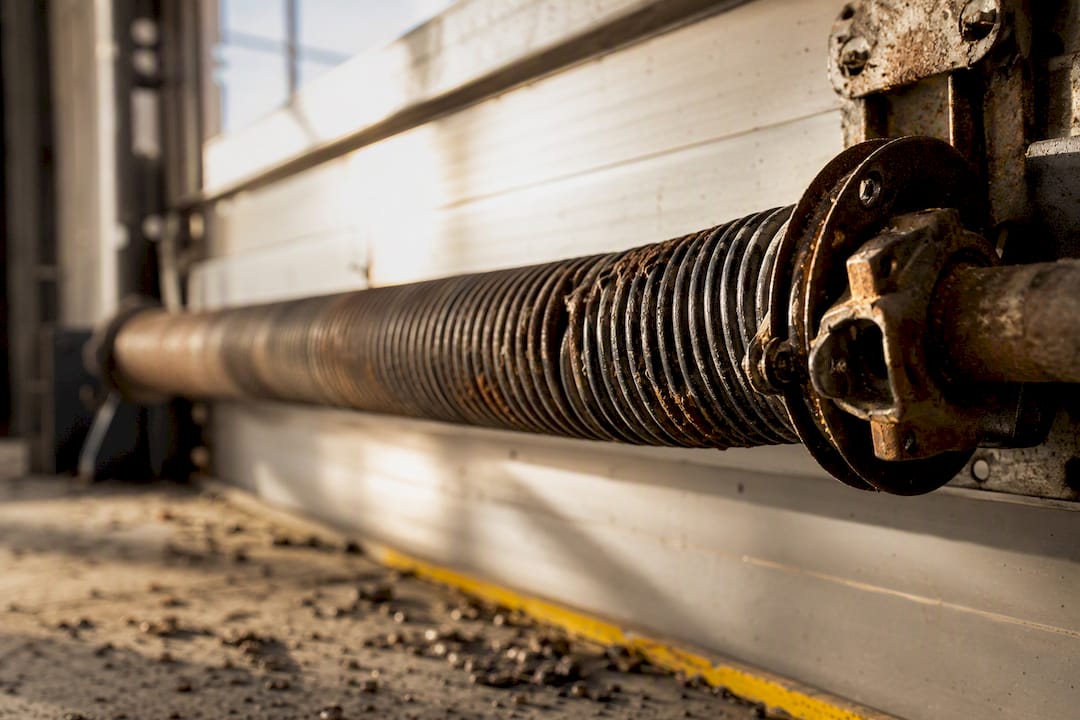
- Visible rust, pitting, or flaking on the coils
- A door that no longer holds its position halfway open
- A loud metallic bang or grinding noise during operation
- Uneven travel, sagging panels, or a visible tilt
- Sudden jerky motion or the opener straining harder than usual
- Frayed strands or visible gaps in the lift cables
- One spring already broken while its twin still looks fine
Never attempt a spring replacement yourself. A wound torsion spring stores enough energy to cause serious injury, and that's not a job for anyone without the right bars and training. Our guide on 5 warning signs your garage door spring is about to snap walks through each symptom in more detail.
Maintenance Steps That Actually Extend Spring Life
Most premature failures trace back to a maintenance gap, not a bad spring. This checklist closes the common ones.
- Clean coils and keep replacement stock stored dry, away from moisture and chemical fumes.
- Lubricate on a schedule using a silicone or lithium-based product, never household oil or grease.
- Run a visual inspection for rust, gaps, or stretching every service visit.
- Test balance by disconnecting the opener and checking the door holds position unassisted.
- Inspect cables, rollers, and hinges for fraying or wear.
- Verify opener torque settings match the door weight and spring spec.
Match your inspection frequency to actual use:
- Weekly for bays running 50+ cycles a day
- Quarterly for bays in the 10 to 25 cycle range
- Annually for anything under 10 cycles a day, with a spec review at every replacement
Correcting alignment, swapping worn rollers, and rebalancing the door all reduce the physical load the spring carries on every cycle, which slows fatigue even before you touch the spring itself. If your facility is in a coastal or road-salt environment, a protective coating service like Refinishing Studio's garage door refinishing can help slow corrosion on exposed hardware. See our full commercial maintenance schedule guide for interval planning, and read why spring repair needs a professional before anyone on staff considers a DIY fix.
Choosing Springs by Cycle Count, Not Just Price
Cycle count should drive every decision on your spec sheet, including spring rating, hardware grade, and opener duty cycle. Standard 25,000-cycle systems are considered entry level for commercial applications, while loading docks running high volume commonly need 100,000-cycle springs to avoid replacing hardware every year.
Measuring cycles doesn't require guesswork:
- Pull counts from your opener if it logs cycles
- Install a basic door sensor that tallies opens
- Keep a simple daily log at the bay for two weeks to establish a baseline
A dock replacing 10,000-cycle springs every eight months pays for labor and a truck roll far more often than one that spent slightly more upfront on a 50,000-cycle system. DASMA's technical guidance also flags that improper handling and damp storage of replacement stock, not just the wire spec itself, shortens service life before the spring is even installed.
What We See on Commercial Service Calls
Residential-grade springs installed on commercial doors is the single most common mistake we run into. Spec to your measured cycles, and always replace both springs together.
Get Your Commercial Springs Specced Right the First Time
If your bay is eating through springs every few months, the fix usually isn't another like-for-like replacement, it's the right cycle rating for how hard that door actually works. Mikes garage doors Loveland colorado handles on-site inspections, upgrades to high-cycle torsion springs, and preventive maintenance contracts built around your facility's actual usage, not a generic schedule.
Most repairs are completed the same day, and estimates are given upfront over the phone so there are no surprises on the invoice. Veterans get 10% off service. If you're not sure whether your current springs match your daily cycle count, schedule an inspection through our commercial garage door services page and we'll spec it correctly the first time.
Sources
- Factors Affecting Spring Cycle Life (TDS190) — DASMA
- The Commercial Garage Door Buyer's Guide: What Facility Managers and Business Owners Need to Know Before They Specify - CU Independent
- Spring Cycle Ratings Explained: Why Your Busiest Bay Door Keeps Eating Springs | Smart Garage Doors Blog
FAQ
How long do commercial garage door springs typically last?
It depends entirely on cycle rating versus actual daily use. A 10,000-cycle spring on a door cycling frequently can wear out in under a year, while a properly specced 100,000-cycle spring on the same door can last well over a decade.
Are thicker springs stronger?
Thicker wire generally handles more load and more cycles before fatigue sets in, but wire gauge alone doesn't guarantee longer life if the spring isn't matched to your door weight and cycle count.
What is the lifespan of a compression or torsion spring under commercial use?
Lifespan is measured in cycles, not years or calendar time. A spring rated for 25,000 cycles running at 30 cycles a day lasts roughly two and a quarter years before it needs replacement.
What's the average lifespan of garage door springs on a busy loading dock?
There's no single average because usage varies so widely, but a dock running 50+ cycles a day needs at least a 50,000-cycle spring to avoid replacing hardware annually. Mikes garage doors Loveland colorado can measure your actual cycle count and recommend the right rating during an inspection.
Should I replace one spring or both when one breaks?
Replace both. Springs on the same shaft absorb the same cycles and age together, so the surviving spring is usually close to failure even if it looks intact.