Most small, shallow dents in a garage door panel can be repaired, either by you or a technician, but creases, damage near edges and hinges, or anything that affects how the door opens usually means panel replacement. Check two things first: where the dent sits (center of a panel versus a seam or edge) and whether the door still opens, closes, and seals properly. Before you touch anything, disconnect the opener and stay away from springs and cables.
TL;DR:
- Most shallow, centered dents in garage doors are repairable with minimal tools, but creases or damage near seams and edges usually require panel replacement.
- Aluminum responds well to suction pullers, while steel dents are best fixed with a wood block and mallet, with deep creases often needing section replacement.
- Always disconnect the opener and avoid springs or cables before attempting repairs, and stop if the door binds, visibly cracks, or hardware is broken.
- Minor repairs generally cost between 98 and 371 dollars, but damage affecting multiple panels or hardware can significantly raise the total price.
- Regular maintenance, like lubricating rollers and hinges or promptly fixing paint chips, helps prevent future dents and extends the door’s lifespan.
Table of Contents
- How to decide: repair vs replacement
- Material-specific fixes: what works for aluminum, steel, wood, and roller doors
- Step-by-step: safe DIY for a small, shallow dent
- Safety, standards, and when to call a trained technician
- Cost guide: ballpark prices and what raises or lowers an estimate
- Prevention and maintenance to reduce future dents
- What years of dent calls have taught us about when to fix and when to replace
- How Mike's Garage Door Repair handles dents and panel damage
- Sources
- FAQ
How to decide: repair vs replacement
A dent's location tells you almost everything you need to know. A shallow ding in the middle of a steel or aluminum panel is usually cosmetic and forgiving. A crease near a seam, hinge, or edge is a different animal, because that's where the panel carries load, and a dented garage door can often be fixed but the decision hinges on depth and position as much as looks.
Run through this before you decide:
- Check the dent type and location: a shallow center ding is likely repairable; a crease or anything touching a seam or edge often is not.
- Test operation: open and close the door manually and watch for binding, scraping, or gaps in the weatherstripping.
- Consider material and age: aluminum dents differently than steel, wood can crack instead of bending, and older insulated panels may not have a matching replacement available.
- Weigh repair versus replacement long term: patching an aging door repeatedly often costs more over time than replacing the one damaged section.
If the door still runs smoothly and the dent is cosmetic, DIY repair is reasonable. If matching panels aren't available or the damage touches multiple sections, replacement tends to hold up better than repeated patch jobs.
Material-specific fixes: what works for aluminum, steel, wood, and roller doors
Garage doors aren't all built the same, and neither are their dents. What straightens an aluminum panel can crack a wood one.
Aluminum panels respond well to suction-cup dent pullers or thin-metal pull kits, since the metal is soft enough to reshape without much force. Go slow. Overstretching aluminum thins it out and can leave a slightly warped surface that needs refinishing anyway.
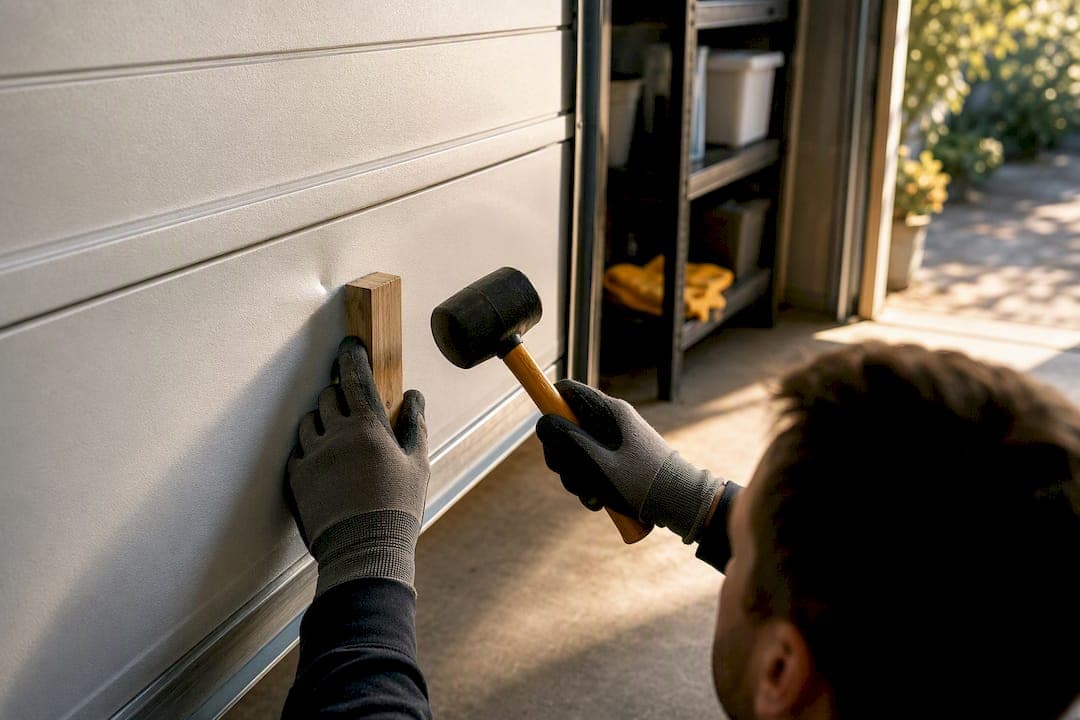
Steel is tougher and usually needs the classic wood-block-and-mallet method: hold a block of wood against the back of the dent and tap the front with a rubber mallet until it pops back into shape. Controlled heat or cold can help soften stubborn spots, but deep creases in steel almost always mean the section needs replacing rather than reshaping.
Wood doors take cosmetic patching and refinishing reasonably well for shallow surface dents, but wood cracks and splits under the same pressure that would just dent metal. If you see any splitting at all, that's a job for a professional, not a mallet.
Roller and one-piece doors work differently from sectional doors mechanically, and dents in these systems carry more risk if you push too hard. Many fixes here are cosmetic only, since the curved or continuous panel doesn't reshape the way individual sections do.
- Aluminum: suction pullers, gentle technique, expect to refinish.
- Steel: wood block and mallet, heat or cold assist, replace if creased.
- Wood: patch and refinish shallow dents, stop at any sign of cracking.
- Roller/one-piece: treat most repairs as cosmetic, not structural.
Pro Tip: Test your pulling or tapping technique on a hidden section first, since a panel's paint and primer can flake before the metal even moves.
Step-by-step: safe DIY for a small, shallow dent

Before you start, disconnect the opener using the release cord, clear the area, and never touch springs, cables, or the counterbalance system. That single step prevents most garage door injuries.
You'll want a 2x4 wood block, a rubber mallet, a suction dent puller, a heat source like a hair dryer, mild soap and water for cleaning, and touch-up paint that matches your door.
- Inspect the dent closely to confirm it's shallow and centered, not creased or near a seam.
- Disconnect the opener and manually move the door to a comfortable working height.
- Try suction first: attach the dent puller and pull steadily rather than yanking.
- Use the wood block and mallet if suction alone doesn't work, tapping in small, controlled strokes from behind the dent.
- Clean, fill, and paint any remaining shallow depression to match the surrounding finish.
If the door binds, travels unevenly, or you find broken hardware or a crease you missed, stop. Basic repairs often run in the $98 to $371 range, which is a far smaller bill than the one that follows a DIY attempt that damages the track or panel further.
Safety, standards, and when to call a trained technician
Garage doors carry serious stored energy, and that's exactly why federal safety rules exist around them. Under 16 CFR Part 1211, openers must include reversing systems that stop and reverse the door if it meets resistance, and a quick 2x4 reverse test tells you whether that safety feature still works after any impact or repair.
Watch for these red flags:
- The door feels unbalanced when you lift it manually about halfway.
- It binds, scrapes, or hesitates anywhere along the track.
- You notice broken springs, frayed cables, or bent tracks.
- A seam, stile, or strut looks visibly cracked or buckled.
DASMA's technical guidance recommends leaving spring, cable, and load-path repairs to trained technicians, and its inspection checklist covers sections, stiles, struts, hinges, rollers, and fasteners for exactly this reason. If you spot any of these signs, document them and call a pro rather than pushing forward with DIY tools.
Cost guide: ballpark prices and what raises or lowers an estimate
Cost depends heavily on how far the damage goes. Minor repair jobs often land between $98 and $371, covering basic touch-ups and small panel work. Single-panel replacement runs higher once you factor in matching the finish and hardware, and full-door replacement sits at the top of the range.
Several factors move the number up or down:
- Material and finish matter, since wood and custom finishes cost more to match than standard steel.
- Number of panels affected raises cost quickly if damage spans more than one section.
- Access and travel for the technician can add to labor time on harder-to-reach doors.
- Emergency or after-hours service typically costs more than a scheduled appointment.
- Hardware replacement, like hinges or rollers damaged alongside the panel, adds to the total.
A clear quote should break down diagnostic or inspection time, parts, labor, and any paint or finish work separately, so you know exactly what you're paying for.
Prevention and maintenance to reduce future dents
A little routine care goes further than most homeowners expect. Park with enough clearance and keep bikes, tools, and bins organized away from the door's swing path. Lubricate rollers and hinges on a regular schedule, check fasteners for looseness, and touch up small paint chips before they turn into rust spots, since manufacturers point to early touch-ups as one of the simplest ways to keep minor damage from spreading.
- Keep vehicles and equipment clear of the door's full swing radius.
- Lubricate rollers, hinges, and tracks on a regular schedule.
- Touch up chipped paint quickly to prevent rust from taking hold.
- Add temporary protection before hailstorms or nearby construction work.
What years of dent calls have taught us about when to fix and when to replace
Center dents on a panel are almost always worth a repair attempt. The moment damage touches a seam, hinge, or the door's travel, replacement saves you money over time. Safety and a straight answer on price matter more than a quick patch job.
— Eddie
How Mike's Garage Door Repair handles dents and panel damage

A dent that's purely cosmetic is a quick fix, but one that affects balance, seals, or hardware needs a technician who can tell the difference in minutes, not guess over the phone. We handle panel repair and replacement, tune-ups, and the hardware issues that often ride along with dent damage, all backed by written warranties on parts and labor.
- Panel repair or replacement for dents that go beyond cosmetic.
- Prompt service for many repair calls.
- Clear phone estimates to help understand costs before service.
- Emergency repair services available for doors that won't operate safely.
If your door binds, won't reverse, or has a crease near a seam, call now rather than waiting. For everything else, check our services page to schedule a standard repair or get a straight answer on cost.
Sources
CPSC safety guidance, Clopay repair and support pages, DASMA technical data sheets, and This Old House cost data.
- Repair or Replace Dented Garage Door? | Clopay Garage Doors
- Automatic residential garage door operators (CPSC)
- Repairing damaged garage door sections (DASMA tech data sheet)
- How much does a garage door repair cost? (This Old House)
FAQ
Can a dented garage door be fixed?
Yes, many dents can be repaired when they're shallow and centered on a panel rather than near a seam or edge. Deep creases, cracked stiles, or dents that affect the door's operation typically call for panel replacement instead.
How much is it to fix a dent on a garage door?
Basic dent repairs commonly fall between $98 and $371, while single-panel replacement costs more once finish matching and hardware are included. The final price depends on material, panel count, and whether emergency service is needed.
How do you get a dent out of a metal garage door?
For steel, the wood-block-and-mallet method (holding a block behind the dent and tapping the front) is a common approach, while aluminum often responds to a suction-cup dent puller. Deep creases in either material usually mean the section should be replaced rather than reshaped.
How do you get dents out of a roller garage door?
Roller and one-piece doors work differently from sectional doors, so most dent fixes on them are cosmetic touch-ups rather than true reshaping. If the dent affects how the door rolls or seals, that's a sign to have a technician inspect it rather than continue DIY work.