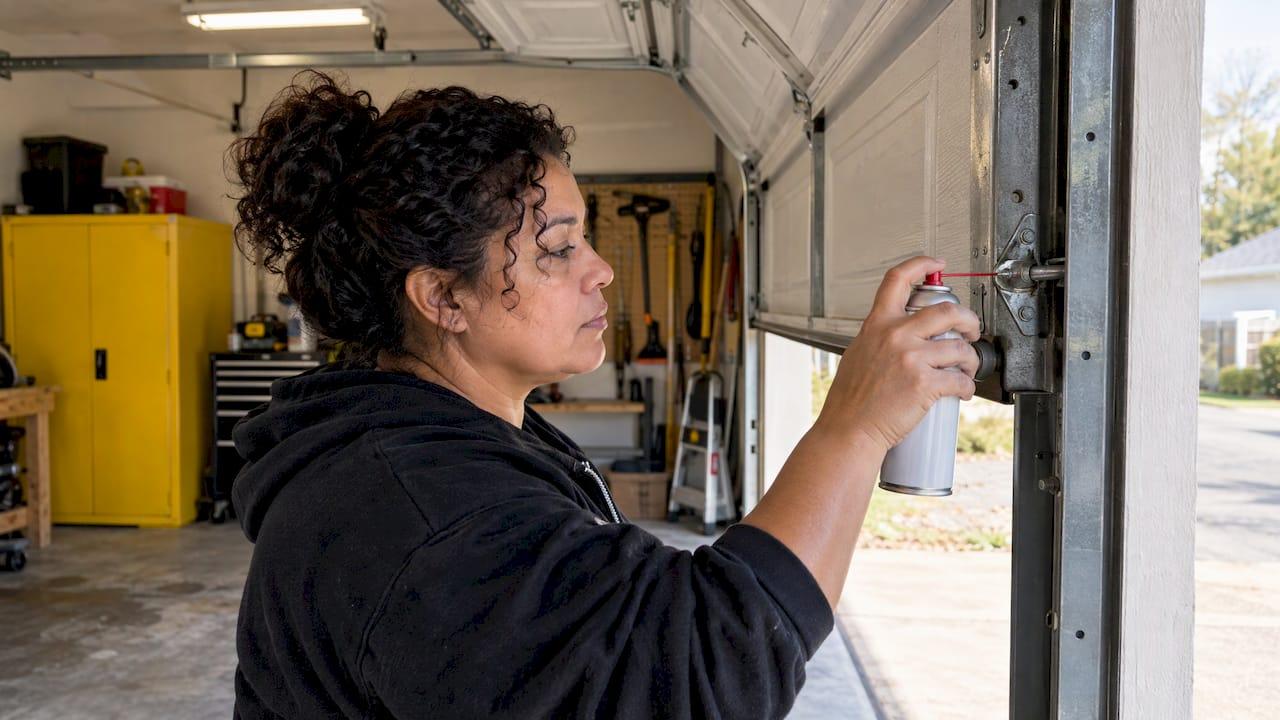
For most garage doors, a silicone-based spray is the safest all-around lubricant. White lithium grease works for metal-to-metal contact. Check your door maker's manual first, because a few manufacturers name a specific product. Skip standard WD-40, which is a cleaner and light penetrant, not a lasting lube. Put the lubricant on hinges, roller bearings and springs, and keep it off the tracks and plastic parts.
We repair garage doors in Loveland and across Northern Colorado every day. A lot of the squeaking, shuddering and slow doors we see come down to the wrong product, or the right product in the wrong place. This guide walks through each type, what it does well, and exactly where it goes.
TL;DR
- Silicone spray is the best general choice for hinges, roller bearings and springs. It won't attract dirt and dust, and it holds its consistency across temperature swings.
- White lithium grease is built for metal-to-metal parts. Use it sparingly, because too much can collect dirt.
- 3-in-1 style garage door lubes are made for the whole system and leave a clear, low-residue film.
- Standard WD-40 and plain oils tend to attract dust. Leave them for other jobs.
- Never lubricate the tracks or plastic and nylon parts. Lubricate twice a year, or more often in harsh weather.
Table of Contents
- The main garage door lubricant types
- Quick comparison
- 3-in-1 lube vs. white lithium grease
- Silicone vs. WD-40: why the blue-and-yellow can stays on the shelf
- Where to lubricate a garage door
- How to lubricate your garage door, step by step
- How often to lubricate
- When lubricant isn't the fix
- Our perspective
- Let us handle the tune-up
- FAQ
- Sources
The main garage door lubricant types
There are four families of product you will see on the hardware store shelf. They are not interchangeable.
Silicone-based lubricants
Silicone is the one most door manufacturers point to. Clopay says silicone lubricants give long-lasting lubrication and won't attract dirt or dust, which makes them a good fit for hinges, rollers and springs. The same guidance notes that silicone keeps its viscosity across temperatures. That matters here, where a garage can sit near freezing in January and get stuffy in July.
Some products in this family are made specifically for garage doors. B'laster's silicone garage door lubricant leaves a tack-free film that won't accumulate dust and dirt, and the maker says it reduces friction and wear and quiets noisy operation. It comes as a 9.3 oz. aerosol and in larger pour cans.
Best for: hinges, roller bearings, springs, and a general twice-a-year tune.
White lithium grease
White lithium grease sprays on as a liquid and then sets into a thick coating. That thick coating is the point. It stays put on parts that rub metal against metal. WD-40's white lithium grease is rated for use from 0°F to 300°F, and the maker lists overhead door tracks, pulleys, cables and guide rails among its uses.
The catch is where it goes. Bob Vila's testing notes say white lithium is recommended only for metal-to-metal applications and should be kept off plastic and rubber. Clopay adds that lithium grease can attract dirt if overused. A thin coat is plenty.
Best for: metal hinge pivots, torsion spring coils, and other bare steel contact points.
Garage door-specific "3-in-1" lubes
These are sprays formulated for the whole door in one can. 3-IN-ONE Garage Door Lube is made for residential and commercial doors. The maker says you can use it on hinges, chains, springs, pulleys and latches. It protects against rust and corrosion, leaves a clear film without messy residue, and helps minimize dust buildup. It also has a two-way spray straw, with a narrow or wide pattern.
If you want one can that covers most of the door without thinking about chemistry, this category is the simple pick. Read the label and keep it off the tracks and plastic parts like any other lube.
Best for: homeowners who want a single, easy product for hinges, springs and hardware.

Motor oil and "manufacturer lubes"
Some door makers name a specific product. Amarr's owner's manual calls for Amarr Super Lube or a similar non-silicon-based lubricant, such as 10W-30 motor oil, at least twice a year. That is a different answer than the silicone advice above, and it is a good reminder that the manual for your own door wins.
If your door came with a manual, read the lubrication paragraph before you buy anything. If it is long gone, look up the brand and model on the manufacturer's site, or call us and we will tell you what that door has been built to take.
Quick comparison
| Type | Best on | Strength | Watch out for |
|---|---|---|---|
| Silicone spray | Hinges, roller bearings, springs | Doesn't attract dirt and dust, steady across temperatures | Check your manual if the maker names a non-silicone lube |
| White lithium grease | Metal hinges, spring coils | Thick, long-lasting film on metal-to-metal contact | Keep off plastic and rubber; too much collects dirt |
| 3-in-1 garage door lube | Hinges, springs, pulleys, latches | One can, clear low-residue film, rust protection | Same no-go zones: tracks and plastic |
| Motor oil or manufacturer lube | Parts the door maker lists | Matches the maker's instructions | Follow the manual's product and schedule |
| Standard WD-40 | Not recommended here | Handy elsewhere in the garage | Attracts dirt and dust on door hardware |
3-in-1 lube vs. white lithium grease
This is the question we hear most. They are different tools.
A garage door lube in the 3-in-1 style is a light spray with a clear, low-residue finish. It gets into small spaces, like the inside of a hinge knuckle, and it is meant to stay tidy. White lithium grease is heavier. It lays down a thick protective coating that handles pressure and temperature extremes on bare metal.
Here is how we would split it:
- Reach for the 3-in-1 style spray when you want a quick, clean pass over hinges, springs and latches.
- Reach for white lithium on exposed steel where parts bear real load and rub, and apply it in a thin layer.
- If you only buy one can, a silicone or garage door-specific spray is the lower-maintenance choice because it is less likely to pick up grit.
Whatever you choose, do not mix a pile of products on the same part. Wipe the old residue off first.
Silicone vs. WD-40: why the blue-and-yellow can stays on the shelf
People grab WD-40 because it is already in the garage. It does loosen things up for a moment, and the door may even go quiet for a week. The problem is what comes next.
Clopay's guidance says WD-40 and oil-based lubricants should be avoided because they attract dirt and dust, which leads to premature wear. Bob Vila's how-to gives the same advice and points to white lithium grease or silicone spray instead.
Think of it this way. A sticky film that grabs grit turns into grinding paste inside your roller bearings. That is the opposite of what you want on a door that lifts a heavy load a few times a day. Our article on what causes premature wear in a garage door system covers how that kind of wear builds.
A small side note on dirty residue: while you are in the garage with a rag and a can, it is a good moment to give your side entry the same attention. A look at garage side door security takes only a few minutes.

Where to lubricate a garage door
The short rule: lubricate the moving metal parts that pivot or spin, and leave the surfaces the wheels ride on dry.
Parts that get lubricant
CRC's guide lists roller bearings, hinge pivot points, torsion or extension springs, bearings and pulleys, and opener chain or screw drives where they apply. In practice that means:
- Hinges: spray the pivot points where the hinge connects to the track. Lowe's suggests one or two sprays per hinge.
- Roller bearings: use the straw to reach the small ball bearings in the roller. Aim at the bearing, not the wheel.
- Springs: coat the coils of a torsion spring along its length, or the extension springs on the sides.
- Bearing plates and pulleys: a light pass at the points where they turn.
- Opener drive: if your opener uses a chain or screw, follow the opener maker's lube instructions for that part, which can differ from the door.
Parts that stay dry
- Tracks. Lowe's warns against greasing the tracks, since grease attracts dust and dirt and stops smooth movement. CRC says rollers can slip if the tracks are lubricated. Instead, vacuum out the dust and wipe the tracks with a damp rag, as Bob Vila's steps describe.
- Plastic and nylon parts. Amarr's care page says not to lubricate plastic parts such as plastic rollers and idler bearings, and its owner's manual says the same about nylon rollers.
- The roller wheel itself. CRC says to avoid spraying the wheels to prevent slippage.
What about garage roller doors?
If by "roller door" you mean a standard sectional door on rollers, everything above applies: bearings and hinges get lube, the track stays clean and dry. If you have a rolling steel door, common on commercial buildings, the parts and the maker's instructions differ, so use the lubricant and schedule in that door's manual. Our commercial team can tell you what a specific rolling door needs. Call us before you guess.
How to lubricate your garage door, step by step
Set aside 20 to 30 minutes and have a rag, a vacuum, a stepladder and your lubricant ready.
- Disconnect the opener and put the door down. CRC advises disconnecting the automatic opener and making sure the door is down before you start.
- Look the door over. Tighten loose hardware, check for worn rollers, frayed cable or cracked hinges, and note anything that looks off. Clopay's steps also include checking the door's balance and looking for wear.
- Clean first. Vacuum the tracks and wipe them with a damp rag. Wipe old, gummy residue off hinges and springs.
- Hit the hinges. Spray the pivot points of each hinge. Then open and close the door by hand so the lube works in.
- Do the rollers. Use the straw on the roller bearings. Lowe's recommends an aerosol to get inside the rollers.
- Coat the springs. Run the lubricant along the full length of a torsion spring.
- Wipe the excess. Any drips will collect dust. A clean rag takes care of it.
- Cycle the door. Open and close it several times by hand, reconnect the opener and test it.
One safety note, and we mean it. Springs and cables hold a lot of stored force. Spray the spring coils and stop there. Do not touch the winding bolts, the bottom brackets or the cable drums. If something looks stretched, frayed or gapped, call a technician instead of adjusting it. Our guide to nine signs your garage door needs repair now shows what to watch for.
How often to lubricate
Twice a year is the common answer. CRC recommends every six months, or more often in harsh climates. Bob Vila's guide also says about every six months. Clopay's steps say to re-lubricate every three to six months. Amarr's manual says at least twice a year.
A simple habit works for Northern Colorado: once in the fall before the cold sets in, and once in spring. If your door sees heavy daily use, or it starts squeaking between sessions, tighten that gap. Our garage door maintenance schedule shows where lubrication sits next to the rest of the seasonal checks.
When lubricant isn't the fix
Lube solves friction. It doesn't solve a door that is out of balance, a rusted-out roller, a stretched cable or a spring that has lost its tension. If you lubricate properly and the noise or shudder comes back within a few days, something else is going on. Our post on stopping a noisy garage door for good walks through the usual causes, and the 15 to 30 minute noise reduction playbook covers the safe quick fixes.
A broken spring is a different category entirely. It sounds like a gunshot, and it turns a 200-pound door into dead weight. Don't try to lift it. Call us.
Our perspective
We get called out for "lubrication problems" more than you would think. Most of the time, it is not a lack of lube. It is a door that was sprayed with the wrong product, sprayed everywhere, or sprayed to cover a worn part.
Here is how we approach it. We use a clean, non-sticky lubricant on the pivot points and bearings, we leave the tracks clean and dry, and we look at the whole system while we are there: springs, cables, rollers, hinges and balance. A tune-up is not just a squirt of oil. It is a hands-on check by someone who does this every day.
If you want to do the twice-a-year spray yourself, the steps above are what we would tell a neighbor. If you would rather have it done with the full inspection, that is what our tune-ups are for. We give you an upfront estimate on the phone, and about 90% of our repairs are finished the same day.
Eddie
Let us handle the tune-up
If you would rather not climb a ladder next to a loaded spring, we will do it. Mike's Garage Door Repair is a family-owned team serving Loveland and Northern Colorado, and our garage door tune-ups cover lubrication, hardware checks and an overall look at how your door is running.

We also handle spring repair, opener repair and installation, custom doors and parts, commercial doors and 24-hour emergency repair. You get an upfront estimate over the phone, our warranties are written, and veterans get a 10% discount. See our services or call us to book.
FAQ
What is the best lubricant for a garage door?
For most doors, a silicone-based spray or a garage door-specific lube is the safest pick, since they don't attract dirt and dust. White lithium grease is a good second option for bare metal parts. If your door's manual names a specific product, use that.
Can I use WD-40 on my garage door?
We advise against standard WD-40 on door hardware. Manufacturers and home-improvement guides say it attracts dirt and dust, which speeds up wear. Choose a silicone spray or white lithium grease instead.
Should I lubricate the garage door tracks?
No. Lubricant on the tracks collects dust and can make the rollers slip. Vacuum the tracks and wipe them with a damp rag, then put the lubricant on hinges, roller bearings and springs.
How often should I lubricate my garage door?
About every six months is the common guidance, and some makers say every three to six months. In harsh weather or with heavy daily use, go more often. A fall and spring routine is easy to remember.
Is it safe to lubricate garage door springs myself?
Spraying the coils of a torsion spring is a routine part of maintenance, with the door down and the opener disconnected. Do not adjust, wind or remove anything on the spring system. If a spring looks gapped, stretched or broken, call a technician.
Sources
- How to Properly Lubricate Garage Door Components, Clopay
- Garage Door Lube, 3-IN-ONE
- Garage Door Lubricant, B'laster Products
- White Lithium Protective Grease Spray, WD-40
- The Best Garage Door Lubricants, Bob Vila
- Lubricating a Garage Door: Steps and Top Tips, Bob Vila
- Residential Owner's Manual, Amarr
- Care & Maintenance, Amarr
- How to Lubricate a Garage Door: Complete Guide, CRC
- How to Lubricate a Garage Door, Lowe's