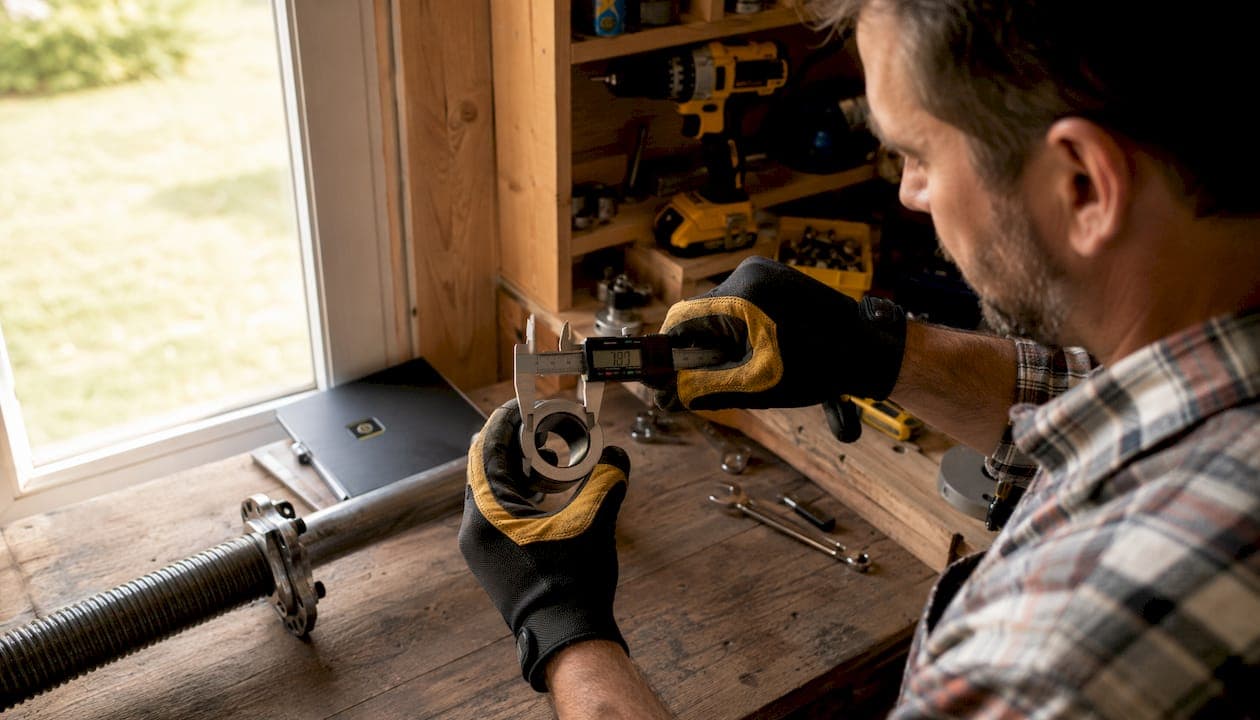
A garage door bearing supports the torsion shaft so it can rotate smoothly during every open-and-close cycle. The most common residential size is a flanged bearing sized to fit a standard torsion shaft with dimensions typical for residential garage doors, featuring a raised lip to seat it in the bracket or cone. If your door is grinding, wobbling, or leaving black powder near the shaft, check the shaft diameter first, match it to a replacement bearing, then decide: order the part yourself or call a technician if torsion springs are involved.
Quick action steps:
- Listen and look: grinding, squeaking, or metal dust near the shaft are your first clues.
- Measure the shaft diameter (typically 1" for residential, 1-1/4" for heavier commercial doors).
- Match the I.D., O.D., and flange style to a replacement part before ordering.
- If the job requires releasing torsion-spring tension, stop and call a pro.
Table of Contents
- What counts as a garage door bearing, and where does each one sit?
- Common sizes, specs, and SKU examples for torsion-shaft systems
- How to tell when a bearing is failing
- DIY replacement: what's involved and where to stop
- How to choose the right replacement bearing
- Typical prices and where to buy in the U.S.
- What a technician inspects — and why they often replace more than just the bearing
- Key Takeaways
- The detail most homeowners miss
- Same-day bearing service in Northern Colorado
- Useful sources and supplier references
- FAQ
What counts as a garage door bearing, and where does each one sit?
Not every part called a "bearing" in a torsion system is the same component. Knowing what you're looking at saves you from ordering the wrong part.
Center bearing: Sits in the center bracket between the two torsion springs. Its job is to keep the shaft aligned and distribute spring tension evenly. When this one fails, the shaft sags and the door moves unevenly — a symptom many homeowners misread as a spring problem. Center-bearing failure commonly causes torsion shaft sag and uneven spring tension.
The four main components you'll encounter:
- Center bearing: Flanged ball bearing or nylon bushing in the center bracket; supports shaft mid-span.
- End bearing (flanged ball bearing): Located at each end of the shaft, adjacent to the cable drums; carries the door's weight load and takes the most wear.
- End bearing plate / bearing plate assembly: The stamped-steel bracket that holds the end bearing in place and mounts to the wall or header. The plate and bearing are sometimes sold as a unit; on some designs the bearing is pressed or riveted directly into the plate.
- Plain bushing: A nylon or plastic sleeve used in lighter-duty center-bracket applications where combined spring weight is low.
Where to measure before you order: slide a caliper across the shaft where the bearing seats (that's your I.D.), then measure the bore of the existing bracket to confirm O.D. and lip clearance. Note whether the bearing is a removable cartridge or stamped into the plate — that determines whether you replace the insert alone or the whole assembly.
Common sizes, specs, and SKU examples for torsion-shaft systems
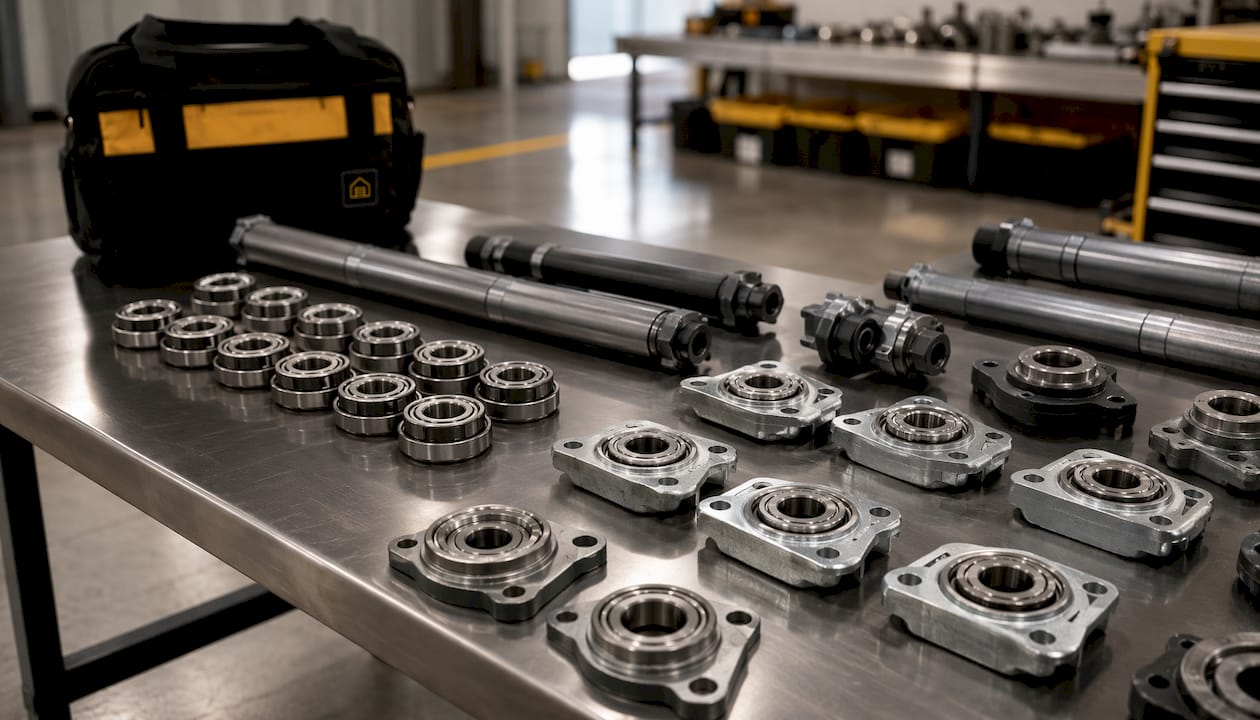
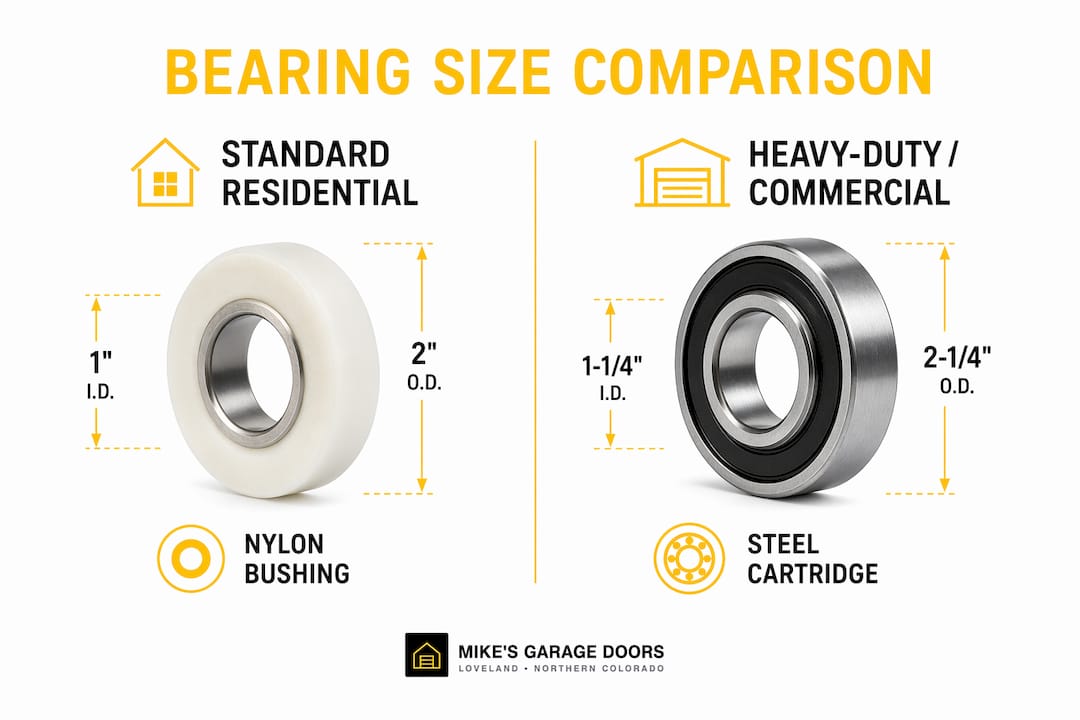
Most residential torsion systems use a 1" I.D. × 2" O.D. bearing. Heavy doors and commercial applications step up to 1-1/4" I.D. with the same 2" O.D. shell. The 1/16" raised lip is standard across both sizes and keeps the bearing from walking inside the bracket.
Spec reference table
| Spec | Standard Residential | Heavy-Duty / Commercial |
|---|---|---|
| Inner diameter (I.D.) | 1" | 1-1/4" |
| Outer diameter (O.D.) | 2" | 2" |
| Lip height | 1/16" | 1/16" |
| Typical door weight | Up to 250 lbs | 250 lbs+ |
| Bearing type | Sealed or standard ball | Flanged radial or precision flanged |
| Grease fitting | No (sealed) | Optional (greaseable) |
SKU-style examples from DDM Garage Doors
DDM Garage Doors catalogs bearings by load rating and application. Here are the key SKUs:
| SKU | Description | Best For |
|---|---|---|
| — | 1" Nylon Bushing, 2" O.D. | Light-duty center support, springs under 30 lbs combined |
| BE-110 | 1" Standard Ball Bearing, 2" O.D. | Doors up to 250 lbs, up to 2,000 cycles/year |
| BE-100 | 1" Freeway Heavy-Duty, 2" O.D. | Doors over 250 lbs or higher-cycle residential |
| BE-150 | 1" Flanged Radial Extra Heavy-Duty, 2" O.D. | Heavy or high-cycle doors |
| — | 1-1/4" Flanged Radial Extra Heavy-Duty, 2" | Heavy commercial, 1-1/4" shaft |
| BEF-UCF100 | Precision Flanged Bearing, 1" I.D., 2" O.D. | Very high-use doors, parking garages |
On Amazon, brands like XiKe and DURA-LIFT offer 1" × 2" flanged bearings that match the standard residential spec. Always confirm the lip height and flange bolt pattern before purchasing, since mounting hole spacing varies between manufacturers.
Measurement checklist before ordering
- Measure shaft diameter with a caliper — don't guess from the door size.
- Confirm the O.D. of the existing bearing or the bore of the bracket.
- Check whether the bearing is a press-fit cartridge or stamped/riveted into the plate.
- Note flange bolt spacing if you're replacing the entire end bearing plate.
- Verify whether the bracket uses a grease port — if so, match a greaseable bearing.
Supplier catalogs at American Door Supply and Action Direct list flanged end bearing plate sets alongside individual bearings, making it straightforward to match plate style to existing hardware.
How to tell when a bearing is failing
Bearings rarely blow out without warning. The door usually tells you something is wrong for weeks before it gets serious.
Common signs of failing bearings include:
- Grinding, squeaking, or scraping near the torsion shaft during operation.
- Shaft wobble or lateral play when you grab the shaft by hand with the door closed.
- Black metal dust or debris collecting on or below the bearing plates — a sign of advanced race wear.
- Uneven cable tension where one cable appears tighter or the door tilts slightly as it rises.
- Door jerking or hesitating mid-travel, especially near the top of the stroke.
- Slower-than-normal operation as friction increases and the opener works harder.
The subtler early warning is shaft play. If you can move the shaft noticeably by hand, the bearing is already compromised — waiting for loud grinding often means the shaft or drum has already taken damage.
Stop and call a technician immediately if you see: visible scoring or gouging on the shaft, severe wobble that shifts the cable drum out of alignment, or metal-on-metal grinding that doesn't stop when you apply lubricant. These signs mean the system is close to failure and poses a real safety risk.
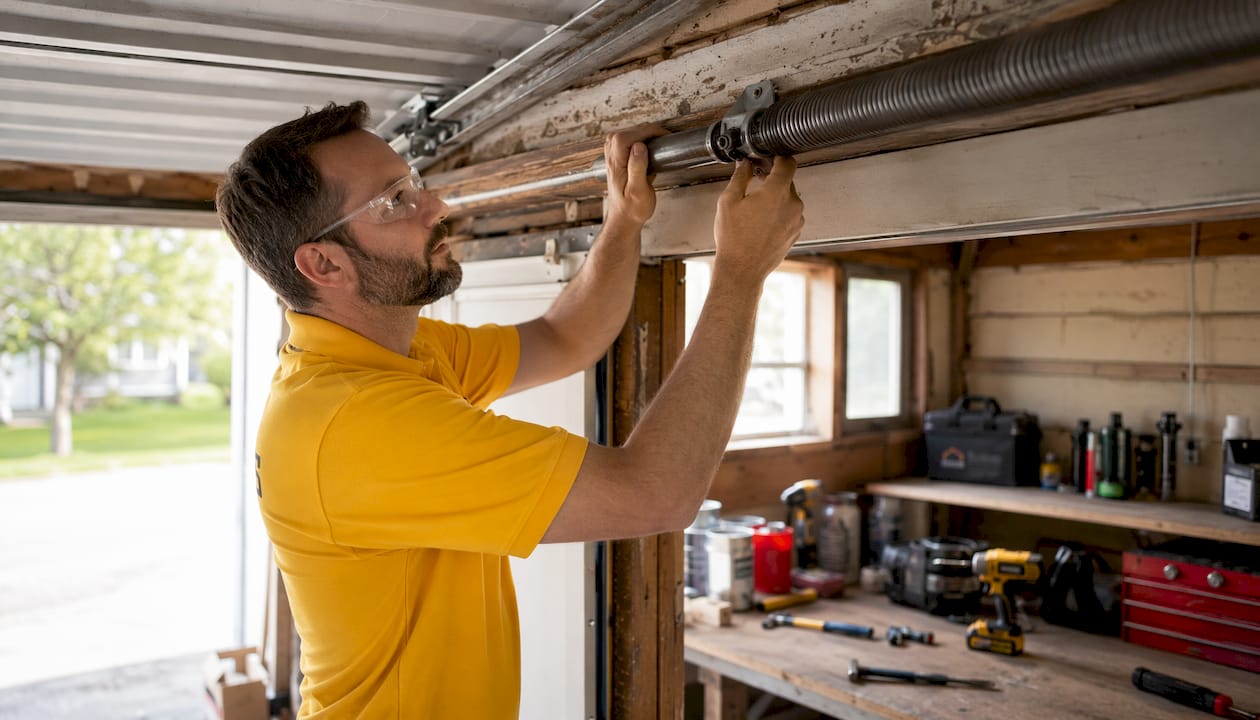
Pro Tip: Run the door manually (disconnect the opener) and listen from each end of the shaft. A bearing that's only starting to go will often squeak on one side only — that tells you exactly which end bearing to replace first.
For a broader symptom checklist, the 9 signs your garage door needs repair guide covers bearing-related symptoms alongside other common failure points.
DIY replacement: what's involved and where to stop
Replacing an end bearing on a torsion system is a moderate DIY job — but only when the springs are already wound down or the door is fully open and secured. The moment the job requires releasing spring tension, the risk level jumps sharply.
High-level replacement sequence
- Secure the door in the fully open position and clamp the tracks to prevent movement.
- Disconnect the opener and unplug it from power.
- Assess spring tension. If the springs are still loaded, stop here unless you have winding bars and real experience with torsion systems. Torsion-spring work is one of the most hazardous DIY tasks in home maintenance.
- Remove the cable drum by loosening the set screws, then slide the shaft to access the bearing.
- Press or pull the old bearing out of the bracket. If the plate is bent or the bearing is riveted in, replace the whole plate.
- Press the new bearing into the bracket, reinstall the drum, and re-tension cables evenly.
- Test the door balance by disconnecting the opener and lifting manually — it should hold at mid-travel with no drift.
Tool checklist
- Winding bars (correct length for your spring size — never substitute a screwdriver)
- Socket set and adjustable wrench
- Shaft puller or bearing press (for stubborn cartridges)
- Level and tape measure
- White lithium grease or silicone-based lubricant
- C-clamps or locking pliers to secure the door
Time estimate: An experienced DIYer typically needs 2–3 hours for a single end bearing swap when springs don't need adjustment. A professional technician completes the same job in under an hour, including a full system check.
Safety warning: Torsion springs store enormous energy. A spring that releases unexpectedly can cause serious injury. If your bearing replacement requires loosening or re-tensioning the springs, call a technician. Attempting spring work without proper training and winding bars is not a calculated risk — it's a dangerous one.
For step-by-step lubrication and maintenance guidance, the DIY garage door service guide walks through safe procedures homeowners can handle on their own.
How to choose the right replacement bearing
The right bearing depends on your door's weight, how often it cycles, and how much maintenance you're willing to do.
Material options
- Nylon bushing (plain): Lowest cost, suitable only for light-duty center-bracket use where spring weight is minimal. Not appropriate for end positions.
- Stamped steel / standard ball bearing: The workhorse for most residential doors. The BE-110 from DDM, for example, is rated for doors up to 250 lbs at up to 2,000 cycles per year and is expected to last 20–30 years with minimal lubrication.
- Precision flanged bearing (greaseable): For heavy or high-cycle doors. Bearing choices range from nylon bushings to sealed ball bearings and heavy-duty greaseable flanged bearings, with rated load and cycle life varying widely.
Sealed vs. greaseable
Sealed bearings are lower maintenance and keep contaminants out of the race — a real advantage in dusty garages. The trade-off is that you can't add lubrication as they age. Greaseable bearings extend service life when maintained correctly, but in cold climates, lubricant choice matters. Use a low-temperature, all-weather grease to prevent thickening and seizure during Colorado winters.
Flange and plate compatibility
- Confirm the bolt pattern on the end plate before ordering a flanged bearing.
- Check whether the existing plate is straight and undamaged. A bent or cracked plate transfers load unevenly and will wear the new bearing faster.
- If the bearing is stamped into the plate, replacing just the cartridge isn't always possible — the correct repair is a full plate assembly swap.
Pro Tip: Before ordering a cartridge bearing, look at the back of the plate. If you see rivets or a pressed-in race with no snap ring, you need the whole plate, not just the bearing. Ordering the wrong part costs you a second shipping wait.
Typical prices and where to buy in the U.S.
Bearing parts themselves are inexpensive. Labor and the scope of the surrounding repair are where costs climb.
Typical price ranges:
- Single bearing (cartridge): $5–$25 depending on type and rating.
- End bearing plate assembly: $15–$60 for the plate; flanged precision units run higher.
- Full hardware set (bearings, plates, drums): $50–$150.
- Professional labor for bearing replacement: $100–$250, depending on scope and whether spring work is included.
Where to buy
- DDM Garage Doors (ddmgaragedoors.com): Detailed SKU listings with load ratings and application notes. Good for matching the exact bearing type to your door weight and cycle count.
- American Door Supply (americandoorsupply.com): Stocks flanged end bearing plate sets and greaseable options for torsion setups.
- Amazon (XiKe, DURA-LIFT): Fast shipping on standard 1" × 2" bearings. Verify the lip height and confirm the seller lists the O.D. and I.D. explicitly — generic listings sometimes omit the lip dimension.
Before you order, check the supplier's return policy. Some bearing plates are non-returnable once installed. Confirm shaft diameter and plate bolt pattern first, and save a photo of the existing hardware so you can match it exactly.
High-cycle commercial doors need higher-rated bearings and more frequent inspections than standard residential doors — factor that into your purchasing decision if the door runs more than a few times a day.
What a technician inspects — and why they often replace more than just the bearing
Bearing failure is rarely isolated. It's usually a symptom of a wider lubrication or alignment problem. Replacing only the bearing without checking the surrounding system is often a temporary fix.
Technician inspection checklist
- Shaft straightness: A bowed or bent shaft accelerates bearing wear and indicates the door has been operating under stress.
- Spring balance: Uneven spring tension puts asymmetric load on the center bearing and drums.
- Cable drum wear: Grooved or cracked drums change how the cable wraps, creating uneven lift.
- End plate condition: Misaligned end plates or a bowed torsion tube increases pressure on the bearing races and accelerates wear.
- Complete system re-tensioning: After any bearing or plate replacement, spring tension must be verified and cables re-equalized.
Common pro findings: a failed center bearing often reveals shaft sag that has been stressing the springs for months. A worn end plate may show hairline cracks invisible until the plate is removed. Drums with cable-groove wear usually need replacement at the same time as the bearing to prevent a repeat failure within a year.
Pro Tip: Ask your technician two specific questions: "Are you replacing the bearing cartridge or the full plate?" and "What's the warranty on parts and labor?" A shop that replaces only the cartridge in a bent plate is setting you up for a callback.
What to ask before the technician starts:
- Whether they stock cycle-rated bearings (not just generic hardware-store parts).
- Whether the job includes a spring balance check or just the bearing swap.
- What the warranty covers and for how long.
For guidance on what questions to bring to a service visit, the questions to ask your technician resource is worth a read before you book.
Key Takeaways
Replacing a garage door bearing correctly means matching the right I.D., O.D., and bearing type to your door's weight and cycle count before ordering a single part.
| Point | Details |
|---|---|
| Match specs before ordering | Confirm 1" or 1-1/4" I.D., 2" O.D., and lip height; measure the shaft, don't estimate. |
| Sealed vs. greaseable matters | Sealed bearings need no maintenance; greaseable bearings last longer in high-cycle or cold-climate use with the right low-temp grease. |
| Plate condition determines repair scope | A bent or riveted plate requires a full assembly swap, not just a cartridge replacement. |
| Torsion-spring work requires a pro | Any bearing job that involves releasing or re-tensioning springs is not a safe DIY task. |
| Mikes garage doors Loveland | offers same-day bearing replacement and full torsion-system inspection in Northern Colorado with upfront phone estimates. |
The detail most homeowners miss
Here's what I see on nearly every bearing call: the homeowner noticed the grinding weeks earlier and assumed it was the rollers. By the time they call, the shaft has developed enough play that the cable drum is slightly out of position, and what should have been a $40 bearing swap turns into a bearing, plate, and cable re-equalization job.
The single check that changes everything is the shaft wiggle test. Grab the shaft with the door closed and try to move it laterally. Any noticeable movement means the bearing race is worn through. Catching it at that stage, before the grinding starts, keeps the repair simple and cheap.
The other thing I'd push back on is the instinct to replace only the cartridge when the plate shows any deformation. A slightly bent plate looks minor but transfers load unevenly across the new bearing's race from day one. Replace the plate, not just the insert, and the repair lasts. Skimping there costs more in the long run. And if your door is more than 10–12 years old and you're already into the bearing, a full hardware refresh — bearings, plates, and drums together — often makes more economic sense than replacing components one at a time.
Same-day bearing service in Northern Colorado

When the bearing job involves torsion springs, a bowed shaft, or a plate that needs full replacement, the safest move is a professional with the right tools and the experience to catch what's hiding behind the obvious problem. Mikes garage doors Loveland handles bearing replacements, full torsion-system inspections, spring work, and cable re-equalization — with 90% of repairs completed the same day they're scheduled.
The team is family-owned, gives upfront estimates over the phone before anyone shows up, and backs their work with solid warranties. Veterans receive a 10% discount. Before you call, have your shaft diameter, a photo of the existing bearing plate, and your door model handy — that information lets the technician arrive with the right parts the first time. Schedule your garage door repair in Loveland and get the job done right, without the guesswork.
Useful sources and supplier references
Save these links before you order parts or book a service call. Each one covers a specific piece of the research behind this guide.
- DDM Garage Doors — Bearings & Bushings: Full SKU catalog with load ratings, O.D./I.D. specs, and application notes for residential and commercial torsion systems.
- Garage Door Bearing Plate Inspection and Replacement Guide: Covers warning signs, plate inspection steps, and typical cost ranges for bearing plate work.
- Bearings & End Plates — Action Direct: Supplier catalog for flanged end bearing plate sets and greaseable bearing options.
- Bearings — Garage Doors Guide: Load and cycle-life guidance for choosing between nylon, standard, and precision flanged bearings.
- Garage Door Bearing Replacement Guide — Advanced Door: Explains why bearing failure signals systemic issues and when a full alignment check is necessary.
- Family Garage Door Repair — Center Bearings: Focused coverage of center-bearing failure, shaft sag, and spring-tension effects.
Before ordering: confirm your shaft diameter and plate bolt pattern, check the supplier's return policy, and save a photo of the existing hardware. That 60 seconds of prep prevents a second order and a second wait.
If your garage has other structural concerns alongside the door hardware, the garage floor crack repair guide from Foundation ResQ covers a common companion issue worth addressing at the same time.
FAQ
What is a garage door bearing?
A garage door bearing is a small component that supports the torsion shaft and allows it to rotate smoothly during door operation. The most common residential size is 1" I.D. × 2" O.D. with a 1/16" raised lip.
How much does it cost to replace garage door bearings?
Parts typically run $5–$60 per bearing or plate; a full hardware set costs $50–$150. Professional labor for a bearing replacement ranges from $100–$250, depending on whether spring work is included.
How often should garage door bearings be replaced?
Standard residential bearings on doors up to 250 lbs can last 20–30 years with minimal lubrication at normal usage rates. High-cycle or heavy doors need higher-rated bearings and more frequent inspections.
What are the first signs of bearing failure?
Grinding or squeaking near the torsion shaft, metal dust collecting at the bearing plates, and noticeable shaft play when you grab the shaft by hand are the earliest reliable indicators.
Can I replace a garage door bearing myself?
You can swap an end bearing when the springs are already relaxed and the door is secured, but any job requiring torsion-spring release or re-tensioning should be handled by a professional. Mikes garage doors Loveland offers same-day service for exactly this kind of repair in Northern Colorado.