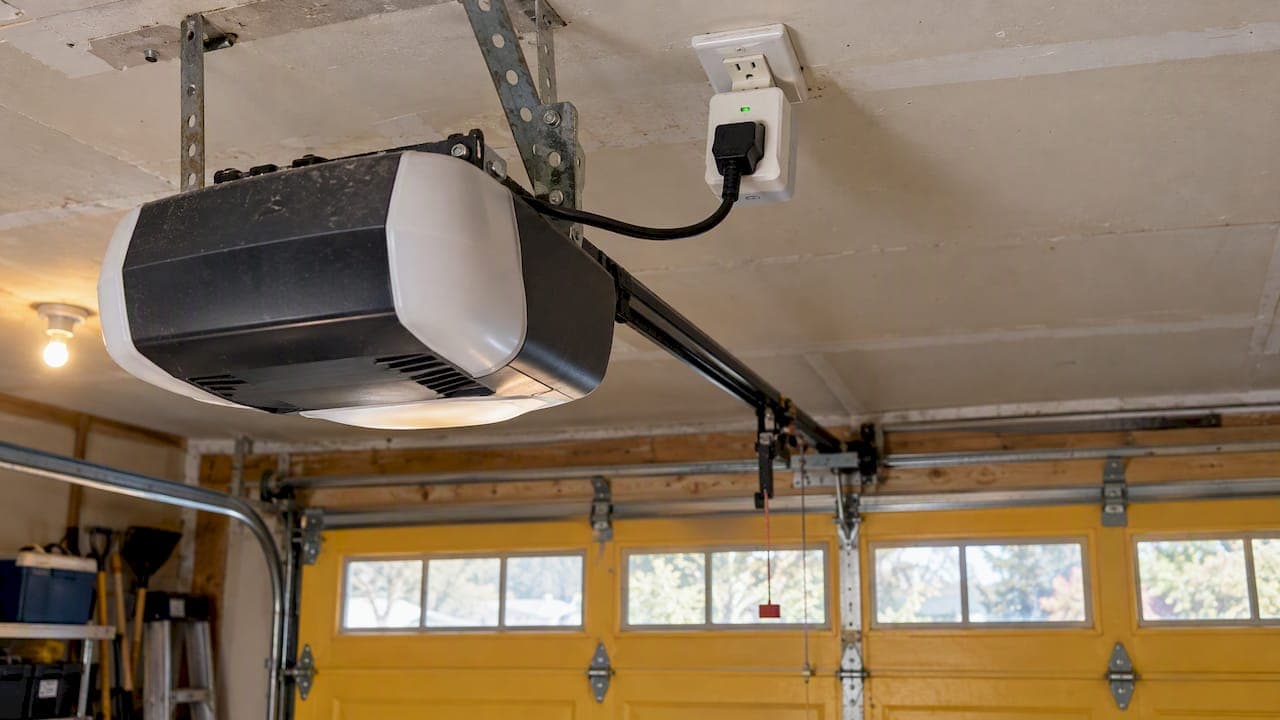
Yes, a garage door opener is worth protecting from power surges. A plug-in surge protector with an indicator light is the cheapest way to do it, and it takes about two minutes to install. A power strip won't do the same job, and no protector survives a direct lightning strike. Below we cover what to buy, how to plug it in, why your GFCI outlet may start tripping, and what to check if you think a surge already got to your opener.
TL;DR
- A surge can damage or upset the electronics in your opener, and a plug-in surge protector is a low-cost layer of defense.
- Buy a real surge protector, not a plain power strip. Look for a UL listing, a joule rating, a clamping voltage and an indicator light.
- Plug it into a properly grounded 120-volt outlet close to the opener, then plug the opener into the protector.
- If the protector sits on a GFCI outlet, a surge can trip that outlet. Reset it before the opener will run again.
- If the opener acts strangely after a storm or outage, check the protector's light first, then call a pro.
Table of Contents
- Why a power surge can hurt your opener
- Does your opener already have built-in protection?
- Surge protector vs. power strip
- What to look for when you buy
- How to install it
- The GFCI problem
- What to do after a surge or storm
- Our take on opener surge protection
- When the opener is already damaged
- FAQ
- Sources
Why a power surge can hurt your opener
Your opener is not just a motor. It has a circuit board, a wall control, safety sensors and a receiver, and all of that is sensitive electronics. The Electrical Safety Foundation International describes a power surge as a sudden, unwanted rise in voltage that can damage, degrade or destroy sensitive electronic equipment.
The damage is not always dramatic. Sometimes the opener dies on the spot. More often a surge weakens a component, and the opener starts to misbehave weeks later: the remote works only sometimes, the light flashes, the door reverses for no clear reason. If your light is blinking right now, our guide to why the opener light flashes walks through the common causes.
NIST, the federal standards agency, lists garage door openers among household control-system appliances in its guide to surges. It also notes that every appliance connection gives a surge a path in, and that different connections can need different protection. For an opener, that matters because power is not the only way in. Wires run from the opener to the wall button and to the safety sensors by the door.
Surges come from lightning, but also from the grid itself: utility switching, a downed line, a power restoration after an outage. Northern Colorado gets its share of summer thunderstorms, and outages are common enough that it pays to plan. If you want a wider checklist for the hours when the power is out, a 72-hour power outage plan is a good place to start, and our own page on garage door safety during a power outage covers the door itself.
Does your opener already have built-in protection?
Some do, to a degree. The Genie Company's accessory page says most openers have some built-in surge protection, and it describes its external protector as additional protection on top. That fits what we see in the field. Built-in protection is usually modest, and it ages with the opener. An older unit may have little or none.
A plug-in protector also guards against something the opener's own circuitry can't: it sits upstream and takes the hit before the opener does. When a protector has absorbed all it can, it is built to cut power to the connected equipment rather than pass the surge along. That is its whole job, and it is why the indicator light matters.
So is it required? No. Is it smart? For most homes, yes. A protector costs far less than a replacement logic board or a new opener, and it takes a few seconds to check.
Surge protector vs. power strip
This is the mistake we see most. Someone plugs the opener into a power strip and assumes it's protected.
UL Solutions explains that a surge protector has an internal element that clamps a surge and diverts it away from downstream equipment. A power strip is simply an extension cord with several outlets. UL also points out that you can't tell them apart by looks. The clamping circuit inside is the difference, so read the label for a surge rating and a UL listing.
Before you buy, check the packaging for these:
- A surge rating in joules
- A UL 1449 listing
- A clamping or let-through voltage
- An indicator light or alarm that shows when protection is gone
ESFI recommends that point-of-use protectors have an indicating light or audible alarm so you know when to replace them. Skip any unit without one. A protector that has quietly worn out is worse than none, because you think you're covered.
What to look for when you buy
You don't need a fancy unit. You need the right basics.
Rating and clamping voltage
Joules measure how much energy a protector can absorb before it gives out. Higher is generally better, but only compare ratings within the same kind of product. Genie's single-outlet opener protector, model GSP2-R, is listed on its store page at 900 joules, 500 volts clamping, UL and cUL approved, with EMI/RFI filtering and a 1-year warranty. Genie's accessory page lists a higher figure of 1,960 joules for its protector, so ratings differ by model. Read the label on the exact one you're buying.
Grounding and outlet position
A surge protector only works if it has a proper ground to send the surge to. Genie's installation instructions call for a properly grounded 120-volt AC outlet within 4 to 6 feet of the opener. The LiftMaster 990LM manual asks for a grounded three-wire 120-volt receptacle within four feet. Follow the manual that comes with your protector. If your garage outlet has only two slots, don't force it. Have an electrician look at it.

Does it work with your brand?
Genie lists its GSP2-R as compatible with all brands of openers. Brand-specific units also exist. The LiftMaster 990LM is meant for LiftMaster openers, and its manual says it is designed to guard against surges coming in through the AC line, the wall-control wires and the safety-sensor wires. That last part is worth knowing: wire-side surges are a real entry point, and not every generic protector addresses them.
Quick comparison
| What you're comparing | Opener-specific protector | General-purpose protector (small, metal-housed) |
|---|---|---|
| Example | Genie GSP2-R, 900 joules | Tripp Lite by Eaton Isobar ISOBLOK2-0, 1,410 joules |
| Outlets | One | Two |
| Clamping | 500 V clamping in the listed modes | 330 V UL 1449 let-through rating |
| Indicator | LED | Diagnostic LEDs for protection, line fault and line OK |
| Listing | UL and cUL | UL Listed, UL 1449 |
| Warranty | 1 year | Isobar range lists a limited lifetime warranty |
The Genie details come from its store page. It lists the unit at $9.99, though the page showed it sold out when we checked, so prices and stock will vary. The Eaton details come from its product page, and the warranty from the Isobar range page. The Eaton unit plugs straight into the wall and measures about 2.5 by 2.5 by 4 inches, so it fits where space is tight.
Either route can work. The opener-specific unit is simple and cheap. The two-outlet unit gives you a spot for a second device and a metal housing built for tougher environments, according to Eaton. Check the current price and stock at the maker's page before you shop.
How to install it
This is a plug-in job, not an electrical project. Never open the opener or work on wiring yourself.
- Unplug the opener from the outlet.
- Plug the surge protector into the grounded outlet near the opener.
- Plug the opener's power cord into the protector.
- Check the indicator light. It should show normal protection.
- Run the door through a full open and close cycle and test the safety reversal.
Genie's instructions say that if the LED stays unlit, the outlet may not be grounded, or the protector may have already taken a substantial surge and need replacing. In that case the opener may still get ordinary power through it, so a working door does not prove you're protected. Check the light, not just the door.
If your opener is hardwired into a junction box rather than plugged in, a plug-in protector isn't an option. That's an electrician's call, and it's one of the cases where we'd rather you phone a pro than improvise.
The GFCI problem
Many garage outlets are GFCI protected, and a GFCI is a different safeguard from a surge protector. A GFCI shuts off power when it detects current leaking where it shouldn't, to protect people from shock. A surge protector deals with voltage spikes to protect equipment. You may have one, both or neither.
Here's where they collide. The LiftMaster 990LM manual says a surge may trip a GFCI. It allows plugging the protector into a GFCI outlet but doesn't recommend it, and it notes the outlet has to be reset before the opener will operate.
If your opener goes dead after a storm or an outage:
- Look for a tripped GFCI outlet, in the garage or elsewhere on the same circuit, and press reset.
- Check the protector's light.
- If the GFCI trips again right away, stop. Repeated tripping points to a fault, and an electrician should look at it.
If the GFCI keeps tripping only when the protector is plugged in, that is also worth an electrician's time. Don't just swap outlets to get the door working.
What to do after a surge or storm
If you suspect a surge hit your garage, run through this short list:
- Check the protector's light. If it's dark, the outlet may be ungrounded or the unit may have done its job and need replacing.
- Reset any tripped GFCI and confirm the outlet has power.
- Test the wall control and remotes. Dead buttons or intermittent response can mean a damaged board.
- Watch the safety sensors. If the door won't close, or the lights on the sensors are dark or blinking, the sensor circuit may have taken the hit.
- Test the auto-reverse by placing a roll of paper towels under the door as it closes. It should reverse on contact. If it doesn't, stop using the opener in automatic mode.
If the door is stuck partway, don't force it. Our stuck-half-open safety rules apply: keep clear and keep people and cars out of the way until it's checked. And if the door won't open at all, the manual lift test is the first step, covered in our guide on what to do when a garage door won't open.
One more honest point. ESFI says no surge-protection device can handle a direct lightning strike, and it recommends unplugging devices when a surge may be coming. If a bad storm is rolling through, pulling the opener's plug is a free extra layer.
Our take on opener surge protection
We fix openers all week, and the pattern is plain. The boards that fail after storms are rarely the ones with a decent protector in front of them. Most people never think about it until the opener quits.
Our advice is simple. Buy a UL-listed protector with an indicator light, plug it into a grounded outlet near the opener, and look at that light every few months, the same time you test your auto-reverse. Replace the protector after a big surge, even if the door still works. Don't pay for a power strip dressed up as protection.
We also want you to know what a protector can't do. It won't fix a worn spring, a bad sensor alignment or a failing motor. It won't save a board from a direct strike. And it won't make a faulty circuit safe. When symptoms show up, we'd rather you call and describe them. We give upfront estimates over the phone, so you know the number before anyone drives out, and about 90% of our repairs are finished the same day.
— Eddie
When the opener is already damaged
If a surge has already done its work, we can sort out whether you need a repair, a new board, or a new opener, and we can install a protector at the same time. We handle opener repair and installation, spring repair, tune-ups, commercial doors and 24-hour emergency calls across Loveland and Northern Colorado, with written warranties on parts and labor. Veterans get an automatic 10% discount. See everything on our garage door services page.

Stuck with a dead opener right now? Call us, describe what you see, and we'll tell you what it likely costs before we head out.
FAQ
Should a garage door opener be on a surge protector?
It's a good idea for most homes. Many openers have some built-in protection, but an external protector adds a layer and tells you through its light when it has been used up. It costs little compared with a replacement board or opener.
Can a power surge damage a garage door opener?
Yes. A surge can damage or destroy the sensitive electronics inside, and it can also enter through the wall-control and safety-sensor wires. Damage may show up right away or as odd behavior weeks later.
What is the best surge protector for a garage door opener?
There's no single winner. Look for a UL-listed unit with a joule rating, a clamping voltage, an indicator light and a grounded plug, and one that fits your outlet location. Opener-specific units and compact two-outlet units with metal housings both meet that bar, so compare current specs and prices on the maker's page.
Do garage door openers need to be GFCI protected?
That depends on your outlet and local electrical code, which your electrician or building department can confirm. A GFCI protects people from shock, while a surge protector protects equipment. A surge can trip a GFCI, and you'll need to reset it before the opener works.
Can I use a power strip instead?
Not as protection. A plain power strip is an extension cord with extra outlets, and only a true surge protector has the clamping element that diverts a surge. Check the label for a surge rating and UL listing.
Sources
- NIST: Surges Happen! recommended practice guide
- ESFI: Surge and Protect
- UL Solutions: Guide to Power Strips and Surge Protectors
- The Genie Company: Surge Protector accessory page
- Genie store: Garage Door Opener Surge Protector
- Genie store: surge protector installation instructions
- LiftMaster 990LM installation manual
- Eaton: ISOBLOK2-0 Isobar surge protector
- Eaton: Isobar surge protectors range
- Power outage plan for solo seniors