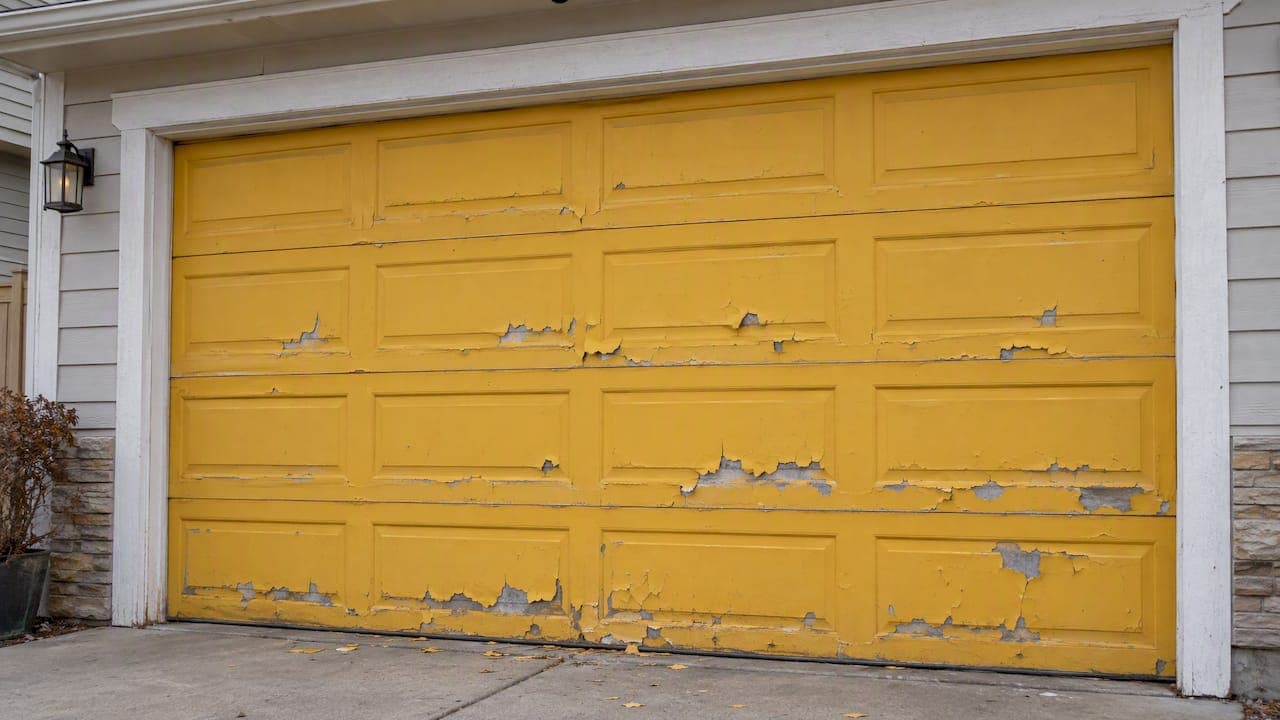
Peeling paint on a garage door almost never means the paint was bad. It usually means the paint never bonded to the surface, or moisture got behind it. Fix that cause first, scrape off everything loose, prime bare spots, and repaint in the right conditions. Skip any of those steps and the new coat will peel just like the old one.
We're a family-owned garage door company in Loveland, and we see peeling, bubbling and flaking doors all over Northern Colorado. Below is what causes it, how to tell steel problems from wood problems, how to prep and repaint, and when peeling is a sign the door needs more than a paint job.
TL;DR
- Peeling on a steel door usually points to leftover factory wax, oil or zinc treatment under the paint. Peeling on a wood door usually points to moisture.
- Never paint over peeling paint. Scrape and sand back to sound paint or bare surface first.
- Use 100% acrylic latex exterior paint on steel doors. Most manufacturers say no to oil-based paint, and a non-factory paint job can void a paint-finish warranty.
- Paint when the door is dry, the weather is mild, and within 24 hours of prep.
- If the panels are rusted, swollen or rotting, repainting won't hold. That's a repair or replacement question.
Table of Contents
- Why garage door paint peels
- Read the pattern on your door
- Can you paint over peeling paint?
- How to remove peeling paint and prep the door
- Choosing primer and paint
- Our take: peeling paint is a symptom
- Keep the paint from peeling again
- When the door needs a technician, not a paintbrush
- What we can do for you
- FAQ
- Sources
Why garage door paint peels
Paint peels when the bond between the coating and the surface fails. What breaks that bond depends on what your door is made of.
Steel doors: wax, oil and zinc
Most steel doors leave the factory with a baked-on finish. Some come with a wax coating to protect them in transit. The AkzoNobel care guide for garage doors says factory wax left on a steel door can cause poor adhesion between coats and lead to peeling or flaking. It recommends lightly scuffing with a gray synthetic pad and soapy water, then rinsing with clean water. Wayne Dalton's instructions for pre-painted steel give the same warning about surface wax.
If the door is galvanized (zinc-coated) steel, there are more traps. Sherwin-Williams lists several ways paint fails on galvanized metal:
- Oil or passivator is still on the new metal.
- Alkyd (oil-based) paint reacts with the zinc.
- White rust was left on the surface.
- Cold, humid conditions interfered with curing.
That last one matters in Colorado. A cool fall morning with dew on the panels is a bad time to paint.
Wood doors: moisture and sun
On wood, water is the usual culprit. Purdue Extension says moisture is the most common cause of early paint failure on wood, whether it comes from rain, dew or moisture moving through the building.
Overhead Door's finishing guidelines name moisture and sunlight as the major threats to a wood door's finish. They also point out that the bottom section is the most likely place for moisture to get in, because water wicks upward or pools on horizontal members. That's why the bottom panel is often the first to flake. If you want the wood-specific chemistry, this piece explains why paint peels on wood surfaces in general.
Dirty surface, heat and timing
Some failures are simply application mistakes. A door that was dirty, still damp, or hot from direct sun when it was painted can bubble and peel within a couple of years. Dust, chalky residue and cleaner left on the surface do the same thing. Paint labels set the temperature and dryness conditions for a reason. AkzoNobel says the steel must be completely dry, advises against painting below 50°F, and wants the prepared door coated within 24 hours.

Read the pattern on your door
Before you scrape anything, look at how the paint is failing. It tells you where to start.
| What you see | Likely cause | First move |
|---|---|---|
| Paint lifts in sheets, bare shiny metal underneath | Wax, oil or zinc treatment never removed | Scrape, scuff, clean, prime with a metal-appropriate primer |
| Small bubbles that pop and flake | Dirt, damp or heat at the time of painting | Remove bubbled areas, clean, dry, repaint in mild weather |
| Flaking along the bottom edge of a wood door | Water wicking up from the floor or pooling | Fix the water source, dry fully, seal and prime all edges |
| Peeling plus orange or brown spots on steel | Rust under the paint | Remove paint and rust, spot-prime, repaint |
| Fading and chalking but paint still tight | Normal sun wear | Wash first, test adhesion, recoat only if needed |
| Peeling, swollen or soft wood | Rot or long-term moisture | Inspect the door; repainting alone won't hold |
The last two rows are the ones that save you money if you catch them. A door that's chalky but bonded may only need a good wash. AkzoNobel notes that cleaning can restore a weathered factory finish and sometimes avoid repainting, and that testing adhesion before a full recoat is prudent.
Can you paint over peeling paint?
No. New paint sticks to old paint, so it peels when the old coat lets go. The Minnesota Department of Health says plainly not to paint over chipping or peeling paint, because the new paint will chip off with the old. Fix the cause, scrape the loose paint, and lightly sand the edges first.
Sherwin-Williams gives the same advice for metal: remove all peeling or cracked paint before repainting, because painting over damage can preserve poor adhesion and leave visible texture.
There is a flip side. If the existing coat is sound, you can repaint it. The National Park Service explains that paint can bond to an old coat when it is uniformly tight and the surface is clean and properly prepared, but extensive blistering or peeling should be removed, and moisture problems corrected first. Benjamin Moore says the same for doors: sound coatings can be repainted once loose paint is removed and glossy surfaces are dulled.
So the rule is simple. Tight paint gets cleaned and dulled. Loose paint comes off.

How to remove peeling paint and prep the door
Plan on a full dry weekend, or at least a day for prep and a day for paint. Here's the sequence we'd follow.
- Disconnect the opener. Benjamin Moore's prep steps start with disconnecting the opener so the door can't move while you work. Pull the release cord with the door fully closed. Don't touch the springs, cables or brackets at the sides. They're under heavy tension, and that's a job for a technician.
- Find and fix the cause. Wet bottom edge? Sprinkler hitting the door? Failed bottom seal letting water in? Solve that now, or the next coat fails too.
- Wash the door. Doors On-Line suggests mild detergent or a household-ammonia solution, rinsed thoroughly. Never mix cleaners with bleach. Wayne Dalton specifically cautions against it.
- Scrape what's loose. Valspar's instructions call for a flat scraper on blistering, flaking or bubbling paint, then sanding the remaining surface. A wire brush helps on metal.
- Sand the edges. Feather the border between bare spots and good paint so you don't see a ridge through the new coat. Benjamin Moore suggests 80- to 220-grit paper for rough edges.
- Treat rust. Spot-prime rust on metal after removing it. Protect glass, trim and hardware with tape.
- Rinse and let it dry completely.
A word on older homes
If your house is older, the paint on the door or trim could contain lead. The Minnesota Department of Health recommends controlling dust and chips and using wet methods when lead-based paint may be present: wet the surface, scrape, bag the scraps, and keep kids and pets away. Don't dry-sand or use a heat gun on paint you can't identify.
Choosing primer and paint
Steel doors
Manufacturers agree on the basics. Amarr recommends high-quality 100% acrylic exterior latex paint and no oil-based paint. Raynor says previously factory-painted steel doors can be repainted after cleaning and preparing the surface, with acrylic-latex exterior paint, and no oil-based or rust-inhibitive paint. Wayne Dalton likewise says oil-based paint is not recommended and to follow the paint label's conditions.
For bare or exposed galvanized steel, use a primer made for that metal. Dunn-Edwards recommends a primer for the specific metal, then exterior metal paint in two thin coats. Thin coats dry harder and bond better than one thick one.
Sherwin-Williams says primer may be unnecessary over a sound existing coating, but it recommends primer for better adhesion or when covering a dark color with a lighter one. Clopay suggests testing a small area first for blistering, peeling and tape adhesion, and using a bonding primer.
Two warranty catches
Check your paint-finish warranty before you buy a can. Amarr says non-factory painting voids its paint-finish warranty, and Clopay warns that oil-based or alkyd-modified acrylic paints can void its warranty. Amarr also warns that dark colors can cause thermal bowing. In Colorado sun, that's worth taking seriously. Pick a color close to the factory shade or lighter.
Wood doors
Overhead Door says the interior, exterior and all edges should be primed, painted and maintained. Amarr's wood guidance is exterior primer or stain and two coats of exterior paint or sealer. The bottom edge is the one people skip, and it's the one that soaks up water.
Brush, roll or spray?
Both work. Spraying is faster on raised panels and gives an even coat, but you'll mask a lot. Graco's guidance says to clean the whole surface, remove dirt, mildew and peeling paint, repair damage, and prime uneven scraped areas before the finish coat. Whichever you pick, the prep matters more than the tool.
Our take: peeling paint is a symptom
We fix garage doors for a living. We don't repaint them, but we're under them every day, and we see what peeling paint is hiding.
A peeling door is a door telling you something. Sometimes it's just a bad paint job from ten years ago. Often it's moisture getting in at the bottom section from a worn seal. Sometimes it's rust creeping under the finish, or a panel that has been dented and flexed until the coating cracked. And sometimes the door is simply tired.
Here's how we'd think about it as a homeowner:
- If the damage is cosmetic and limited, a careful prep and repaint is a fair weekend project. Do it right and it'll hold.
- If the peeling follows a dent, a crease or a sagging panel, paint isn't the fix. The panel is stressed. Our piece on DIY garage door dent repair helps you judge what's cosmetic.
- If the bottom of the door is soft, swollen or rusted through, you're better off pricing a repair or a new door than stacking paint on a failing panel. We walk through that decision in repair vs. replacement.
- If the door is heavy, noisy or out of balance, stop. Don't paint a door with a spring problem. Call us.
We give honest estimates over the phone, before anyone drives out. If a repaint is all you need, we'll tell you that.
— Eddie
Keep the paint from peeling again
Purdue's advice boils down to three things: eliminate moisture problems, prepare the surface properly, and apply paint as the manufacturer directs. For a garage door, that looks like this:
- Wash once a year. Wayne Dalton recommends annual washing of factory-finished steel doors with mild detergent.
- Inspect twice a year. Overhead Door recommends preventive maintenance at least every six months, and more often when local conditions call for it. For wood doors it recommends an annual look for fading, peeling, chipping, buildup or a thin, eroded finish.
- Refinish early. A thin finish is cheaper to refresh than a failed one is to strip.
- Keep water off the bottom. Check the bottom seal, redirect sprinklers, and clear snow and ice from the base of the door. Our guide to replacing a garage door weather seal covers that part, and our Colorado winter prep tips cover the cold months.
- Put it on a schedule. Our garage door maintenance schedule lays out what to check and when.
If your door seems to wear out faster than your neighbors', premature door wear is worth a read too.
When the door needs a technician, not a paintbrush
Paint is the visible part. The system behind it is what keeps you safe. While you're prepping, watch for these:
- Panels that have bent, cracked or separated at the hinges
- Rust at the bottom corners or along the track
- A door that stops unevenly or feels heavy when you lift it by hand
- A bottom seal that's torn, flattened or missing
Overhead Door advises that loose hardware be inspected by a trained door-systems technician before the door is operated. That's good advice. Broken or worn hardware doesn't get better with a fresh coat.
What we can do for you
Mike's Garage Door Repair serves Loveland and Northern Colorado homes and businesses. About 90% of our repairs get finished the same day. We give upfront estimates by phone, so you know the number before we arrive, and our work is backed by written warranties. Veterans get 10% off.
If your inspection turns up a sagging panel, worn hardware, a noisy opener or a broken spring, we handle tune-ups, spring repair, opener repair and install, commercial doors, custom doors and parts, and 24-hour emergency repair.

Call us with what you're seeing. We'll tell you honestly whether it's a paint job, a repair, or time for a new door. You can also start at garagedoorrepairsloveland.com.
FAQ
Can I paint over a painted garage door?
Yes, if the existing paint is sound. Wash it, dull any glossy areas, remove anything loose, and spot-prime bare metal. Check your manufacturer's painting instructions first, because non-factory paint can void some paint-finish warranties. Raynor, for example, allows steel doors to be repainted by following its instructions.
Is it okay to paint over peeling paint?
No. The new coat will lift with the old one. Scrape loose paint, sand the edges smooth, fix any moisture source, and prime bare spots before you repaint. If the paint could contain lead, use wet methods and contain the debris.
How long will a painted garage door last?
There's no single number, because it depends on the material, the sun and moisture exposure, and how well the prep was done. What manufacturers do agree on is inspecting regularly. For wood, Overhead Door says to check annually and refinish when the finish looks thin or eroded, before peeling spreads.
Is it better to roll or spray a garage door?
Either works if the door is clean, dry and primed where needed. Spraying gives a smooth, even coat on raised panels but takes more masking. Rolling and brushing take longer but need less setup. Thin coats beat one thick coat with either method.
Can I fix peeling paint in cold weather?
It's risky. Cold, damp conditions can keep paint from curing properly, and AkzoNobel advises against painting steel doors below 50°F. Wait for a dry, mild stretch, and always follow the temperature range on the paint label.
Sources
- Care & Maintenance Guide, Entry & Garage Doors (AkzoNobel)
- Maintenance and Painting Instruction for Pre-Painted Steel (Wayne Dalton)
- How to Fix Peeling Paint on Galvanized Metal (Sherwin-Williams)
- NCR-133 (Purdue Extension)
- Wood Door Finishing Guidelines (Overhead Door)
- Why paint peels on wood
- Exterior Lead Paint Removal (Minnesota Department of Health)
- Preservation Brief 10: Exterior Paint Problems (National Park Service)
- How To Paint A Garage Door (Benjamin Moore)
- Painting Garage Doors (Doors On-Line)
- How To Paint A Metal Garage Door (Valspar)
- Painting Your Garage Doors (Amarr)
- Residential Doors (Raynor)
- How to Fix Peeling Paint on Metal (Dunn-Edwards)
- How to Paint a Garage Door (Sherwin-Williams)
- Painting Doors (Clopay)
- How to Paint a Garage Door Using a Paint Sprayer (Graco)