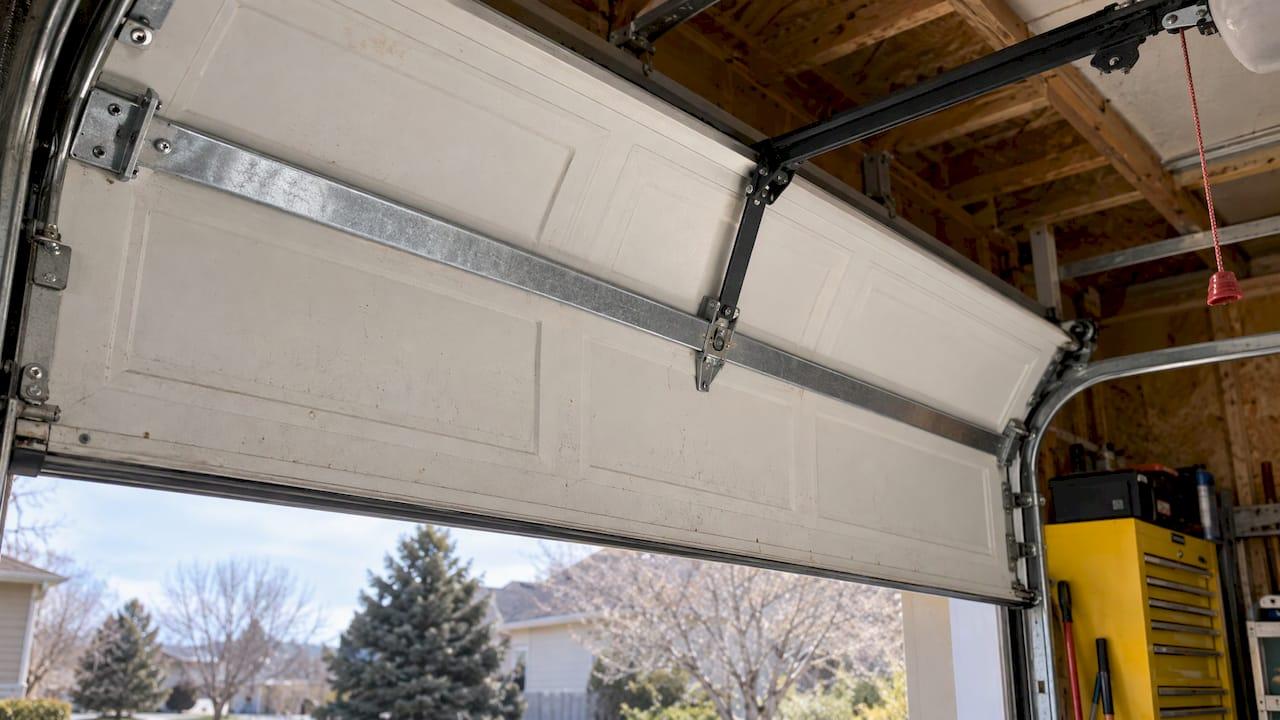
A garage door strut is a steel bar that runs across a panel and keeps it from bending. Its job is to make the section stiff enough to handle wind pressure and the pull of an automatic opener. The strut is a small part, but it is a structural one. When it is missing, loose or the wrong size, the door tells you with bowing panels and an opener arm that flexes the metal. Spotting those signs early is how you avoid a bigger repair, and our technicians at Mike's Garage Door Repair in Loveland handle struts alongside springs, openers and panels, so one visit sorts out the whole door.
TL;DR
- A strut is a horizontal steel reinforcement bar fastened to a door section to add rigidity, per a US strut manufacturer.
- On a door with an electric opener, the top section needs a strut so the opener arm has a solid lift point.
- Struts are not springs and not brackets. Springs carry the weight; struts stiffen panels.
- The right strut depends on the door's brand, model, width and wind-load rating, not width alone.
- Struts sit near spring hardware, so have a pro handle replacement.
Table of Contents
- What a garage door strut actually does
- Why the top section needs one if you have an opener
- Strut, bracket, spring: what each part does
- How many struts does a door need?
- Where struts go on the door
- Signs a strut is missing, loose or not doing its job
- Choosing the right strut
- Why strut work belongs with a professional
- How we handle strut and panel problems in Loveland
- Our view on struts
- FAQ
- Sources
What a garage door strut actually does
A steel garage door is built from thin, hinged sections. Thin steel flexes. On a wide door, the panels can bow in the middle, especially when wind pushes on them or when an opener pulls from a single point at the top.
The strut fixes that. It is a hemmed steel bar, commonly 2-1/4 or 3 inches wide and made from 20- or 22-gauge galvanized steel, that is screwed across the inside of a section. It does three things:
- Stops flexing. It keeps panels from bowing, especially on wider doors, and the top panel almost always carries one, particularly where the opener attaches.
- Spreads load. Struts distribute load evenly across each section, which helps the door move smoothly.
- Resists wind. In windy regions, extra reinforcement helps the door hold up to pressure.
Gauge is worth knowing. A lower number means thicker steel, so 20 gauge is stiffer than 22 gauge. Where wind-load building codes apply, 20-gauge struts are frequently required.
Why the top section needs one if you have an opener
The opener pulls the door up through an arm attached to the top section. All that force lands on one spot. Without reinforcement, the metal can crease or tear around the bracket.
Door makers say so plainly. Amarr's instructions state that when an electric opener is installed, the top section must include a strut spanning its entire length to reinforce the opener arm lift point. Clopay's manual likewise says a door used with an electric operator needs its top section reinforced before it goes into the opening.
Skipping it has a cost beyond a bent panel. Damage from an improperly installed or adjusted opener is not covered under Amarr's warranty, and skipping the top strut can void an opener maker's warranty.
Strut, bracket, spring: what each part does
These parts get mixed up all the time, and it matters when you describe a problem on the phone.
| Part | What it does | Where it is |
|---|---|---|
| Strut | Stiffens a panel so it does not bow | Horizontal, across a section |
| Opener reinforcement bracket | Spreads opener force into the panel's structural stiles | Vertical or punched angle at the opener arm |
| Wind-load reinforcement | Added struts, heavier track and hardware, jamb brackets or posts | Door and opening |
| Spring | Counterbalances the door's weight | Above the door or beside the tracks |
The first three distinctions come from a breakdown of door reinforcement types. One point from the same source: a top strut does not remove the need for the correct opener bracket. DASMA, the garage door industry association, calls for top-section reinforcement according to the door manufacturer with drawbar-type openers.
If your question is really about the bracket at the opener arm, our guide to choosing a garage door reinforcement bracket covers it, and the role of garage door brackets explains the rest of the hardware.
How many struts does a door need?
It depends on width, thickness, model and wind rating. Here is what two manufacturers publish as minimums.
Amarr (older model schedule): doors 6' to 14' wide need no struts. Doors 15' to 16' need one at the top of the top section. Doors 17' to 18' need three: top section, third section and middle of the bottom section.
Clopay Classic Steel (1-3/8" doors): up to 15' wide need none, 15'2" to 16' need one on top, and 16'2" to 18' need struts on the bottom, third and top sections.

Those are minimums, and they apply to those models. Amarr itself recommends checking with the local building official about wind load. Clopay's WindCode doors are sorted into nine wind-load categories, each with its own strut configuration.
Northern Colorado gets real wind along the Front Range, so a Loveland door may carry more reinforcement than a bare width chart suggests. Check the label and manual for your own door.
Where struts go on the door
Placement varies by manufacturer and model:
- When only one strut ships with the door, it goes on the top section. Clopay specifies its top edge sits 1/4 inch down from the top of the door, above the top bracket.
- Bottom-section struts, when the schedule calls for one, go below the hinges, about 1/4 inch from each end.
- Midland's owner's manual places struts differently by series: top of the section on some, mid-section on others.
Struts are screwed into the end and center stiles, the vertical ribs of the panel. Pre-punched holes do not always line up with the stiles, so the fit takes care. That is one reason a strut is not a match-it-by-eye part.
Signs a strut is missing, loose or not doing its job
You can check from the floor with the door closed and the opener unplugged. Look for:
- A top panel that bows or ripples near the opener arm.
- A strut that is loose, bent or has missing screws. DASMA's homeowner checklist says that if the door has operator reinforcement, check that it is securely attached.
- Creases or cracks in the panel near the opener bracket.
- A section separating at a stile.
- A door that rubs the track or travels crooked.
A strut helps a sound section. It does not repair damage already done. A creased or cracked panel, a failed joint or a crooked-travel door should be taken out of service for inspection rather than fixed with a new bar. Our write-up on a sagging garage door panel walks through causes and safety checks.
While you are looking, a quick balance test tells you whether the springs are doing their share, since a poorly balanced door puts extra strain on panels and the opener.
Choosing the right strut
Buying by width alone is the common mistake. The right profile, gauge, length, location and fasteners depend on the door model, section construction, opener and wind-load configuration. Write down these from the door's label: manufacturer, model, serial number and wind-load information.
On length, a strut is typically ordered about 1/2 inch shorter than the door width so it clears the end hinges. Then match gauge and count to the maker's strut chart.
Getting those details wrong gives you a bar that fits poorly or fails to meet the door's rating. When you call us, give us the label details and we can sort out the part from there.
Why strut work belongs with a professional
A strut sits on a door that is tied to a spring system under heavy tension. Installers fasten struts while a section is laid across sawhorses, not hanging in the opening, and the manuals describe sagging the section about 1/2 inch under the strut as part of the process, per Midland's manual.
Manufacturers are direct about the risk. One installation guide states that installation and repair should be done only by a qualified installer, and that loosening fasteners tied to the spring system or bottom fixtures could cause severe injury or death.
So the safe homeowner routine is simple. With the door closed and power off, you can look and take photos of the label, the strut, the stiles and the screws. Do not remove or adjust springs, cables or bottom brackets. If a section is creased, cracked or traveling crooked, stop using the door and book an inspection. A track alignment check is another safe look-only step.

How we handle strut and panel problems in Loveland
We are a family-owned garage door company serving Loveland and Northern Colorado, and 90% of our repairs are completed the same day. You get a clear estimate over the phone before anyone shows up, and our work carries written warranties. Our technicians handle springs, openers, panels and hardware for homes and commercial properties, and we run a 24-hour emergency line when a door will not close. Veterans get a 10% discount.

If your top panel is bowing, a strut is loose, or you are not sure what your door needs, see our garage door services and call. For property managers, one visit that covers the strut, opener and springs keeps downtime short.
Our view on struts
Most strut trouble we hear about starts with a door that has been opened by an opener for years on a panel that was never built for it. The panel flexes a little more every cycle until it creases.
A strut is cheap compared to a new section. The part that matters is fitting the right one for that door, in the right place, with the right screws. That is why we want the model label before we talk parts.
We also look at the whole system. A strut will not make up for a bad balance, a worn opener bracket or a bent track. When we are out, we check them together so you only pay for the fix the door needs.
Eddie
FAQ
What is the purpose of a garage door strut?
It is a steel bar that stiffens a door section so the panel does not bow or flex. It matters most on the top section, where the opener pulls, and on wide doors facing wind.
Is a strut the same as a reinforcement bracket?
No. A strut runs horizontally across a section. A reinforcement bracket is a vertical bracket or punched angle at the opener arm that spreads the opener's force into the panel's stiles. A top strut does not remove the need for the right bracket.
Does every garage door need a strut?
Not always. Manufacturer schedules show narrow doors needing none, while wider doors need one or three, and any door with an electric opener needs a top-section strut per the maker's instructions. Wind-load areas may require more.
Can I install a strut myself?
Manufacturers say installation and repair should be done by a qualified installer, because the door is connected to a high-tension spring system. You can safely look and photograph with the door closed and power off. Leave the fitting to a pro.
Sources
- Garage Door Strut Manufacturer, Minnesota Metals
- Amarr residential installation instructions
- Clopay installation and maintenance manual
- Clopay strutting schedule
- Clopay Classic Steel installation manual
- Clopay WindCode installation supplement
- Amarr model installation instructions
- Midland residential owner's manual
- DASMA residential door and operator checklist
- Garage Door Strut: Purpose, Sizing, and Safe Replacement
- ServiceSpring guide to garage door struts
- Garage door struts, 2-1/4" and 3" reinforcement
- Frenchporte installation guide