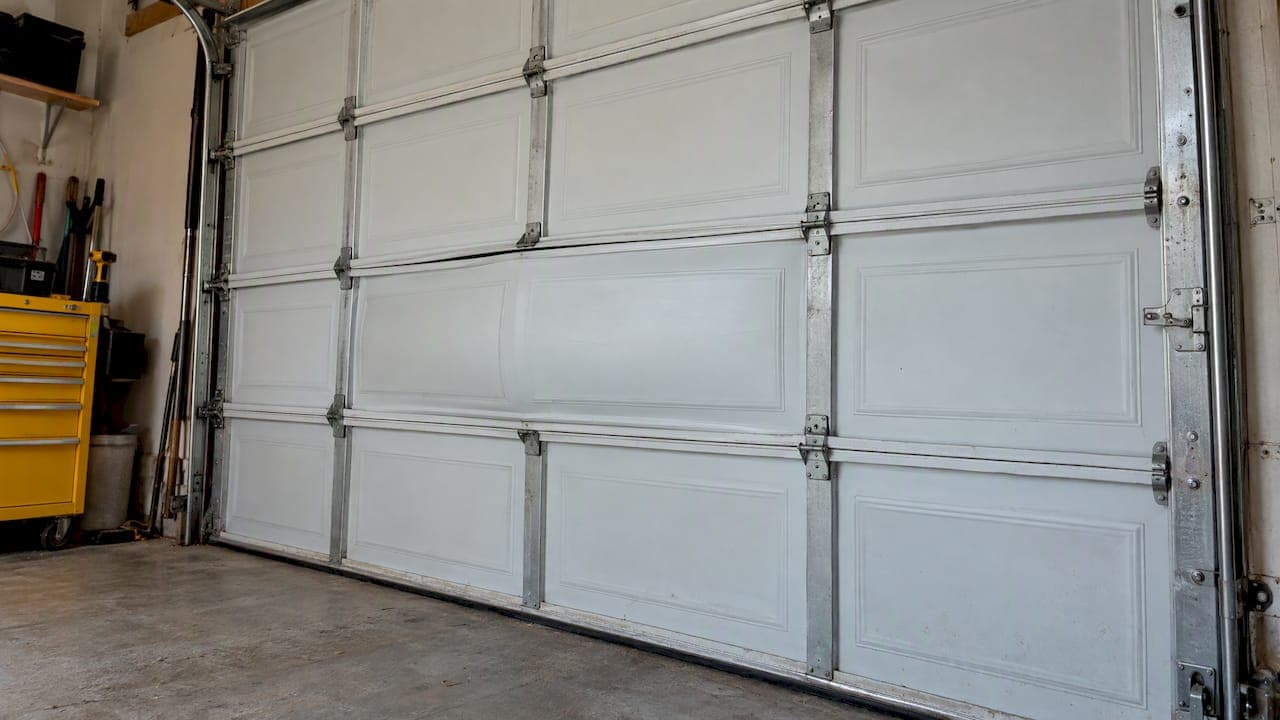
A sagging garage door panel usually comes from one of four things: heat-driven bowing, loose or broken hinges, a failing track or bracket, or an old panel that has simply lost its stiffness. The first job is not the fix. It is deciding whether the door is safe to run. If it binds, sways, or will not stay put when it is half open, stop using it and call a trained technician. Here in Loveland, we walk homeowners through exactly this every week.
Below, we cover what causes the sag, how to check the door from the floor without taking risks, what a reinforcement strut can and cannot do, and how to decide between fixing one panel and replacing the door.
TL;DR
- Sagging usually traces to bowing from heat, worn or detached hinges, shifted tracks or brackets, or age and damage to the panel itself.
- Look, do not touch: inspect visually from the floor. Do not adjust springs, cables, or brackets yourself. Those parts are under extreme tension.
- If the door binds, sways, or will not hold still halfway up, stop using it and call a pro.
- One or two damaged panels can often be replaced. Widespread damage, a damaged frame, or an old door with no matching panels points toward a new door.
- We give upfront estimates over the phone, and we complete about 90% of repairs the same day.
Table of Contents
- What a sagging garage door panel actually looks like
- What causes a panel to sag or bow
- Is it safe to use? A five-minute visual check
- Fixes, from least to most involved
- What about dents?
- Quick decision guide
- For property managers and commercial doors
- Our perspective
- Get a sagging panel looked at
- Keeping panels from sagging in the first place
- FAQ
- Sources
What a sagging garage door panel actually looks like
Sagging is not always a droop in the middle. Homeowners describe it in a few ways:
- The top edge of a panel curves downward between the hinges, so the door looks like a shallow smile.
- A gap opens at the top or bottom seal when the door is closed, usually in the center.
- One section sits visibly out of line with the others when you stand to the side and look along the door.
- The door looks fine closed, but a panel flexes or rattles while it travels.
- The door tilts, with one side lower than the other. That is a related problem, and our guide to a crooked garage door walks through safe checks for it.
A door is a stack of long, thin sections hinged together. Each section is only as stiff as its skin, its core, and the hardware holding it. When any of those weaken, the panel gives where it is longest and least supported: the middle.
What causes a panel to sag or bow
Heat and temperature differences
Insulated doors with a bonded core can bow without anything being broken. The Door & Access Systems Manufacturers Association explains that when the inside and outside skins sit at very different temperatures, the warmer skin grows relative to the cooler one, and the door bows toward the warmer skin. Color matters too. The same technical bulletin notes that a brown insulated door facing the sun on a hot day, with an air-conditioned garage behind it, will bow outward more than an equivalent white door.
On the Front Range, big swings between a cold night and a bright afternoon are normal. A door that looks bowed in the afternoon and flatter in the morning is a clue that temperature is the driver, not damage.
Loose, bent, or detached hinges
Hinges let the panels fold and roll along the track. When they loosen, bend, or pull out of the section, the panel loses support at that joint and starts to droop. This is common on doors that have been run hard for years or that took a bump from a bumper or a bike. We cover the details in our garage door panel hinges guide, but note that hinges near the spring and cable system are not a casual weekend job.

Track and bracket problems
If the tracks have shifted or the mounts have loosened, the whole door runs out of square and the panels carry loads they were never meant to. Tracks that are not secure can let a door come down. That is why inspection guidance from InterNACHI tells inspectors not to operate a door until they have checked the track mounts and bracing. Our article on garage door track alignment covers the two checks homeowners can make without touching anything under tension.
Damage and age
Impact dents, cracked skins, rust at the bottom edge, and years of flexing all weaken a panel. Clopay notes that damaged panels can throw off the balance of the door and make other components work harder, and that deeper dents, cracks, or warped panels can compromise structural integrity. A weak panel also stresses the opener, which is often the first thing to complain.
Balance problems
A door that is out of balance, because a spring is worn or a cable is off, leans on its panels and hardware unevenly. Sag can be a symptom of this, not the cause. That is one reason we look at the whole door and not just the panel you point at.
Is it safe to use? A five-minute visual check
Garage doors are among the heaviest moving parts in a house. A standard door is easily a couple hundred pounds, and a broken spring turns that weight into dead weight in your hands. So the check is visual, and you stay on the floor.
- Disconnect nothing. Do not remove, adjust, or repair springs, cables, brackets, or anything they are fastened to. DASMA's guidance for building occupants says the springs are under extreme tension and can cause serious injury or death.
- Look at the door closed. Stand to the side and sight along the panels. Note where the sag is and whether any hinge looks bent, cracked, or pulled away.
- Look at the hardware. Check the springs, cables, rollers, pulleys, and mounting hardware for fraying, gaps, rust, or anything out of place. The International Door Association recommends a visual look at these parts every month and a trained technician when in doubt.
- Listen. Scraping, popping, or a shudder as the door moves means stop.
- Watch for the red flags. DASMA's checklist says not to operate a door that binds, sways, or puts stress on rollers, brackets, hinges, sections, or tracks, or one that will not stay still when half open. Stop the inspection and contact a trained technician.
If the door is already stuck partway, read our five safety rules for a garage door stuck half open before you do anything else. Our list of nine signs your door needs repair now is a good companion for deciding how urgent your situation is.
Fixes, from least to most involved
Hardware tightening and hinge replacement
If a loose or bent hinge is the cause, replacing it and securing the fasteners can bring a panel back into line. A technician will also check that the hinge placement suits the door and that the neighboring sections are not damaged. When the failing hinge sits near the bottom of the door, it is under extra load from the cables, so we treat it as a professional job.
Reinforcement struts
A strut is a long, stiff bar fixed across the width of a panel to keep it from flexing. You will see do-it-yourself videos online using full-width struts bought from a home center, and the idea is sound for some panels: it adds stiffness where the panel has lost its own. In our experience, though, a strut is a way to support a panel that is still basically sound. It is not a cure for a door that is out of balance, has a failing track, or has a cracked or rusted skin. Also, extra weight on the door changes how it balances, which matters for the springs and the opener.

If you want a strut, we suggest having it fitted as part of a full door inspection so the balance is checked afterward. A door that lifts evenly and stays put halfway up is the standard to aim for.
Replacing one or two panels
When damage is confined to a section or two, replacement is often realistic. Clopay's guidance says panel replacement is likely feasible when damage is limited to one or two panels. Amarr's guidance adds that isolated damage works when the door otherwise functions, while a door that cannot close or has a large opening may need major repair or full replacement.
Two practical catches: a new panel has to match the old ones in design, size, and color, and on older or discontinued doors it may not exist. For local numbers, our panel replacement guide for Loveland homeowners puts the average at $860 and explains what pushes a job above or below that. Your actual cost depends on the door, the panel, and the labor, which is why we quote after you describe it to us.
Replacing the door
A new door makes sense when:
- The door is more than about 15 years old and matching panels are not available. Clopay lists this among the reasons to consider full replacement.
- Damage spans several panels.
- The frame or jamb is damaged.
- The door will not close, or leaves a large opening.
If you are replacing anyway, it is the time to think about insulation, color, and lift-capacity upgrades. A lighter-colored door facing the afternoon sun is less prone to thermal bowing, per the DASMA bulletin above.
What about dents?
Dents and sag often show up together, since an impact can crease the skin and weaken the panel. Clopay says minor dents on an uninsulated door may be pushed out from the inside, while heavily dented doors should be inspected by a dealer. If the dent has creased the panel, a straightened skin will not bring back the lost stiffness. Our garage door dent repair article lays out the repair range and when a pro is the better call.
Quick decision guide
| What you see | Likely cause | What to do |
|---|---|---|
| Door bows outward in afternoon sun, flatter at night | Thermal bowing on an insulated door | Note the pattern, then ask us whether it is cosmetic or a sign of a weak panel |
| One section droops near a hinge | Loose, bent, or detached hinge | Stop using the door and have the hinge replaced |
| Sag plus rattling or scraping | Track or bracket movement | Do not operate. Call a technician |
| Door will not stay halfway up | Balance or spring problem | Stop. Call a technician right away |
| Dent with a crease and a sagging panel | Impact damage | Have the panel inspected for replacement |
| Several sagging panels on an old door | General wear | Ask about door replacement |
For property managers and commercial doors
On a commercial building, a sagging panel is a downtime problem as much as a safety one. A door that cannot be trusted to close is a security gap, and a door that binds is a liability. Build a habit of monthly visual checks, log the results, and call for service at the first red flag, not after it fails during a delivery. If you oversee several properties, a maintenance coordination system for property managers can help route tenant reports of door trouble to a technician quickly, while the inspection itself stays visual and the repair stays with a professional.
Our perspective
We have seen the same story many times in Northern Colorado: someone notices a panel drooping, watches a video, and wonders whether a strut and an afternoon will sort it out. Sometimes a stiffening piece is part of the answer. But the panel is rarely the whole story.
A door is a system. The springs carry the weight, the cables and tracks guide it, the hinges join it, and the opener only nudges it along. When one part weakens, the others take the strain. A sagging panel is often the first thing you can see of a problem that started somewhere you cannot.
That is why we start with the whole door. We check balance, hinges, tracks, rollers, and the panel itself, tell you what we find, and give you an upfront estimate over the phone so there are no surprises when we arrive. About 90% of our repairs are finished the same day, and our work is backed by written warranties on parts and labor.
The best result is a door that lifts evenly, holds still halfway, and closes tight. If we can get you there with a hinge and a tune-up, we will say so. If a panel or a door needs replacing, we will explain why in plain terms.
Eddie
Get a sagging panel looked at
If your door is drooping, binding, or just does not look right, we can take it from here. Mike's Garage Door Repair is a family-owned team serving Loveland and Northern Colorado, handling spring repair, opener repair and installation, tune-ups, custom doors and parts, commercial doors, and 24-hour emergency repair. Veterans get an automatic 10% discount.

See everything we do on our garage door services page, or call for a phone estimate and we will tell you what to expect before anyone drives out.
Keeping panels from sagging in the first place
- Do the monthly look. Springs, cables, rollers, pulleys, and mounting hardware, from the floor, as the IDA suggests.
- Mind the sun. On insulated doors, darker colors facing strong afternoon sun are more prone to bowing, so factor that in when choosing a new door.
- Protect the edges. Most impact damage happens near the bottom corners. A little care when backing out saves a panel.
- Schedule a tune-up. Lubrication, hardware tightening, and a balance check catch loosening hinges and shifting tracks before the panels pay for it.
- Do not ignore noise. New rattles, scraping, or popping are early warnings.
FAQ
How do you fix a sagging garage door panel?
The fix depends on the cause. Loose or bent hinges are replaced, a stiff reinforcement strut can support a panel that is otherwise sound, and a damaged section can be swapped for a new one. Because balance and track problems can look the same, have a technician inspect the door before any repair.
Can I fix a sagging panel myself?
Do not adjust springs, cables, or brackets. DASMA's guidance for building occupants warns that the tension in these parts can cause serious injury or death. Limit yourself to visual checks and call a trained technician for the repair.
How much does it cost to replace a garage door panel?
It varies with the door's size, insulation, design, and whether a matching panel is available. Our own Loveland guide puts the average at $860. For your door, we give an upfront estimate over the phone after you describe it.
Is a sagging garage door dangerous?
It can be. If the door binds, sways, or will not stay still when half open, stop using it and contact a technician. A sag can signal loose hardware or a balance problem, and a door that falls is a serious hazard.
Can you get dents out of a garage door panel?
Minor dents on an uninsulated door may be pushed out from the inside. Heavily dented doors should be inspected by a professional, since a creased panel can stay weak even after it looks straight.
Sources
- Thermal Bowing of Garage Doors with Bonded Core Sections (DASMA TDS185)
- Building Occupant: Checking a Garage Door for Damage (DASMA TDS174)
- Garage Doors and Openers (InterNACHI)
- Common Garage Door Repairs: What You Need to Know (Clopay)
- Can I Replace My Garage Door Panels? (Clopay)
- Garage Door Replacement Panels: When to Repair or Replace (Amarr)
- Garage Door Replacement Parts Guide (Clopay)
- Safety and Maintenance (International Door Association)