
What is garage door torque and why does it matter?
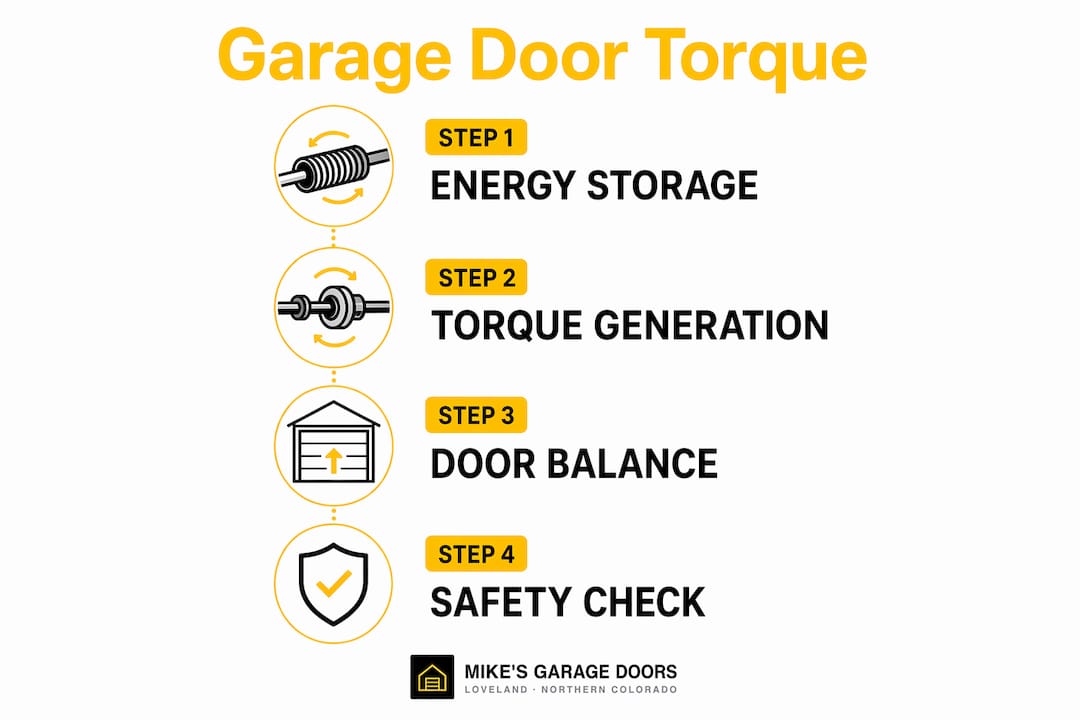
Garage door torque is the rotational force your torsion springs generate to counterbalance the weight of the door, making a 200-pound slab feel like almost nothing when you lift it. Without the right amount of torque, your door either fights you on the way up or slams shut on its own. Three components work together to make this happen:
- Torsion springs wind up and store energy when the door closes, then release it as rotational force when the door opens
- Cable drums sit at each end of the torsion shaft and convert that rotational force into the linear pull that actually lifts the door
- The torsion shaft transfers torque evenly from the springs to both drums simultaneously
Get the torque right and your opener barely works. Get it wrong and you're burning out motors, snapping cables, and putting yourself at risk.
Table of Contents
- How torsion springs actually generate and deliver torque
- How TorqueMaster springs compare to traditional torsion springs
- Why garage door torque is a serious safety issue
- Why Mikes garage doors Loveland is the right call for torque issues
- Key Takeaways
- FAQ
How torsion springs actually generate and deliver torque
Torsion springs store potential energy through bending, creating torque via tensile stress on the outer coils and compressive stress on the inner coils. When the door drops and the spring winds up, that stress builds into stored elastic energy. The moment the opener releases the door, the spring unwinds and that energy becomes rotational force on the shaft.
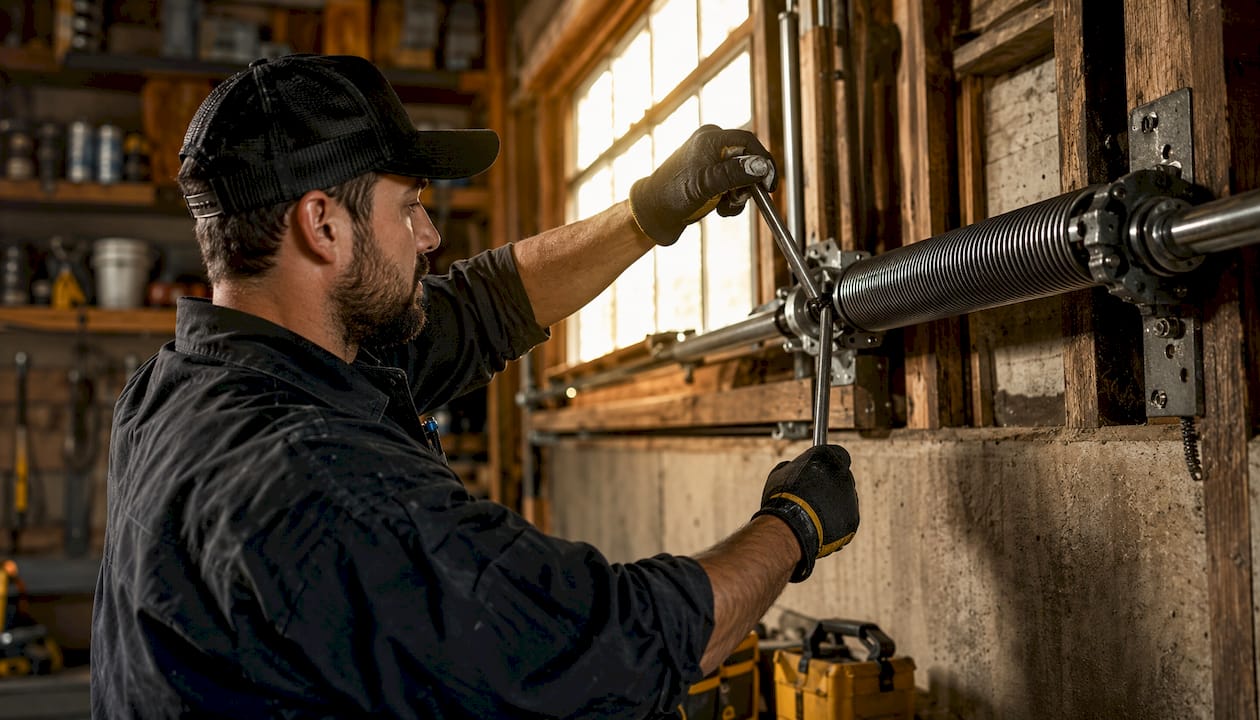
The physics behind spring sizing follows Hooke's Law for torsion: τ = κθ, where torque (τ) equals the spring constant (κ) times the angular displacement (θ). The spring constant itself depends on four variables: wire diameter, coil diameter, number of active coils, and the shear modulus of the steel. Of those four, wire diameter dominates everything else because it appears in the formula raised to the fourth power. Wire diameter raised to the fourth power controls torque output, meaning a tiny change in wire gauge can nearly double or halve what the spring delivers.
| Variable | Effect on Torque | Why It Matters |
|---|---|---|
| Wire diameter (d) | Scales by d⁴ | Smallest change = biggest torque shift |
| Coil diameter (D) | Inversely proportional | Larger coil = lower spring constant |
| Active coils (N) | Inversely proportional | More coils = softer spring |
| Shear modulus (G) | Directly proportional | Steel grade affects energy capacity |
The cable drum converts constant spring torque into a variable lift force that matches the door's changing weight as it travels up the track. The drum's spiral shape is engineered so the effective radius increases as the door rises, compensating for the fact that a door on horizontal tracks requires less lift force than one hanging vertically. Mismatched springs and drums break that balance and cause the door to feel heavy at one point in travel and light at another.
A properly balanced door feels nearly weightless. When torsion springs are correctly sized, they nearly cancel the door's full weight, leaving your opener to handle only a fraction of the load. As springs weaken over time, that balance shifts and the opener bears more and more of the burden until something fails.
Pro Tip: Test your door's balance by disconnecting the opener and lifting the door manually to waist height. Let go. It should stay put. If it drifts up or drops, the torque is off and the springs need professional attention.
How TorqueMaster springs compare to traditional torsion springs
Both systems generate torsion-based torque, but they do it differently, and the difference matters for safety and serviceability.
TorqueMaster springs are enclosed in a steel tube with plastic drums, while traditional torsion springs wrap around an exposed shaft with metal drums. Here's what that means in practice:
- TorqueMaster (Wayne Dalton system): The spring lives inside a steel tube, so a broken spring stays contained rather than flying across the garage. Plastic drums are lighter but can crack over time. Servicing requires a special winding tool and specific expertise because the enclosed design limits access.
- Traditional torsion springs: Mounted on an exposed shaft above the door with metal cable drums on each end. More universally serviceable by qualified technicians. A broken spring can whip violently if it lets go, though proper containment hardware reduces that risk significantly.
- Torque delivery: Both systems transfer torque through a shaft to cable drums, but TorqueMaster's plastic drums can wear unevenly, sometimes causing slight torque inconsistency over the door's travel. Metal drums on traditional systems tend to hold their geometry longer.
- Replacement: TorqueMaster springs are spring-type specific and require matching components. Traditional torsion springs offer more sizing flexibility when replacing.
- Homeowner takeaway: Neither system is DIY-friendly. Both store dangerous amounts of energy, and both require a technician who knows the specific system.
Why garage door torque is a serious safety issue
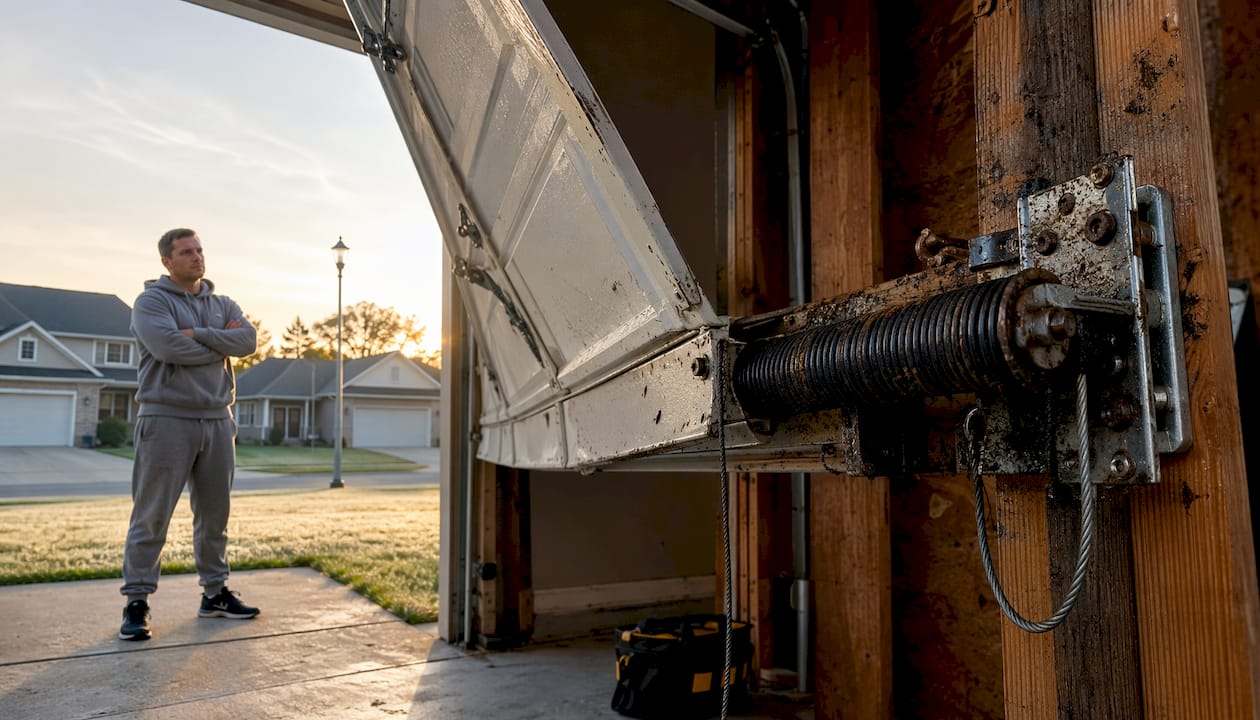
A fully wound residential torsion spring stores between 200 and 300 foot-pounds of energy, enough to cause serious injury. Picture a car jack under full load, except the energy releases in a fraction of a second if something slips. That's what you're dealing with when you touch a wound spring.
The most common injury scenarios involve winding bars slipping off winding cones mid-adjustment, or a spring snapping while someone is working nearby. The bar becomes a projectile. The spring itself can whip with enough force to break bones or worse. Spring tension adjustment is one of the most dangerous DIY tasks a homeowner can attempt, and most hardware stores don't stock the right winding bars anyway.
Incorrect torque doesn't just feel wrong. It damages your entire system. An incorrectly sized spring overworks the opener motor, accelerates cable and roller wear, and can cause the door to slam or bind. What starts as a torque problem becomes a full system repair.
Signs your torque is off:
- Door feels heavy when lifted manually
- Opener strains or slows noticeably during operation
- Door doesn't stay in place when stopped mid-travel
- Cables look slack or have jumped off the drums
- You hear grinding or popping during operation
Pro Tip: If your door sounds like it's working harder than it used to, don't wait. Check the warning signs of spring failure before a small torque issue becomes an emergency.
Why Mikes garage doors Loveland is the right call for torque issues
Torque calibration isn't guesswork. It's a precise calculation based on door weight, height, spring dimensions, and drum geometry. Getting it right requires both the right tools and the experience to use them correctly.
At Mikes garage doors Loveland, we complete 90% of repairs the same day you call. Our technicians size springs by the numbers, not by feel, and we back every job with warranties that protect you long after we leave.
Here's what working with Mikes garage doors Loveland looks like:
- Upfront phone estimates so you know the cost before anyone shows up
- Same-day service for the majority of spring and torque-related repairs
- 10% veteran discount as a thank-you to those who served
- Warranties on parts and labor covering both the spring and the full system balance
Professional installation means your opener runs at the load it was designed for, your springs last their full cycle life, and your door operates safely every time. Skipping professional calibration to save money almost always costs more in opener repairs and premature spring replacement.
Pro Tip: Ask your technician to perform a balance test after any spring replacement. A properly calibrated door should hold steady at waist height with the opener disconnected. If it doesn't, the torque isn't right yet.

Ready to get your garage door torque dialed in? Visit our services page or call Mikes garage doors Loveland for a same-day estimate.
Key Takeaways
Garage door torque is a precise physics calculation, not a setting you adjust by feel, and getting it wrong puts your opener, your hardware, and your safety at risk.
| Point | Details |
|---|---|
| Torque counterbalances door weight | Torsion springs generate rotational force that nearly cancels the door's full weight for easy lifting. |
| Wire diameter dominates spring output | Because it scales to the fourth power, even a small wire gauge change can double or halve torque. |
| Cable drums complete the system | The spiral drum converts constant spring torque into variable lift force matched to the door's travel. |
| Stored energy is genuinely dangerous | A wound torsion spring holds between 200 and 300 foot-pounds of energy, enough to cause serious injury if mishandled. |
| Professional calibration protects everything | Correct torque extends opener life, prevents cable damage, and keeps the door balanced and safe. |
FAQ
How much tension should be on a garage door?
The correct tension depends on the door's exact weight, height, and spring specifications. A properly tensioned spring will hold the door stationary at waist height when the opener is disconnected.
What is the difference between a torque spring and a torsion spring?
"Torque spring" is an informal description of what a torsion spring does. Torsion spring is the correct industry term for the coiled steel spring above your garage door that stores and releases rotational energy to lift the door.
How much force does a garage door have?
A standard residential torsion spring stores 200 to 300 foot-pounds of potential energy when fully wound. That force releases almost instantly if the spring fails or is mishandled.
What is the life expectancy of a garage door torsion spring?
Most residential torsion springs are rated for a typical number of cycles corresponding to several years of average daily use. Springs that are incorrectly sized or poorly maintained tend to fail well before that mark.
Can I adjust garage door torque myself?
No. DIY torque adjustment is one of the most dangerous home repair tasks because of the extreme energy stored in wound springs. Always call a qualified technician.