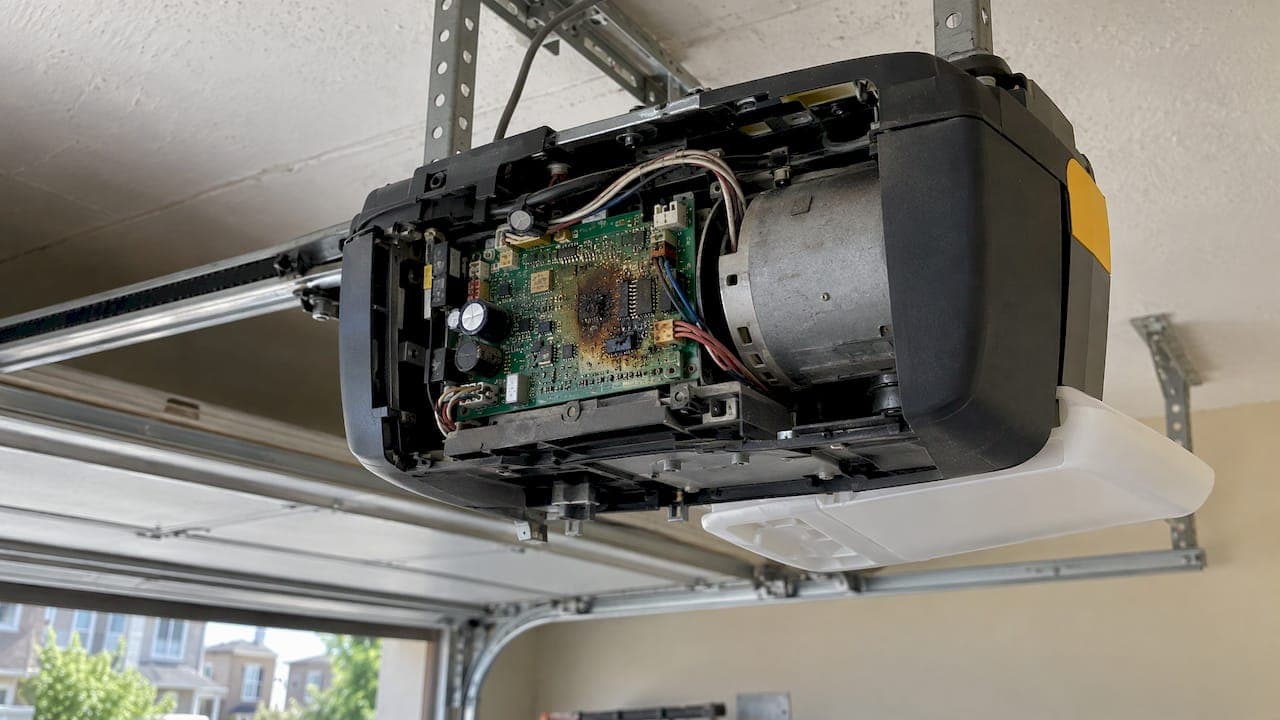
If your garage door opener died or started acting strange right after a storm, lightning or a power surge is the likely suspect. Lightning does not have to hit your garage. A strike on a nearby pole or line can send a surge through your wiring and fry the opener's logic board. The safe move is to check the outlet and breaker, run the door by hand only if it is safe, and call a technician to test the opener before you replace anything.
We are Mike's Garage Door Repair in Loveland, and we see this after every summer storm season along the Front Range. Here is what lightning does to an opener, how to tell, what to check, and what to leave alone.
TL;DR
- Lightning damages openers through the power line, not just direct hits. The logic board is the usual casualty.
- Typical signs: no power, no response from remotes or the wall button, a door that moves on its own, or error codes on the opener.
- Check the outlet, breaker and GFCI first. Do not keep unplugging and replugging the opener.
- Use the emergency release only when the door is closed and the doorway is clear. Never pull the door by the handle.
- If the board is fried, a repair or an opener replacement is the fix. We give upfront estimates over the phone.
Table of Contents
- How lightning damages a garage door opener
- Signs your opener took a hit
- What to check first, safely
- Running the door by hand without getting hurt
- When it needs a professional
- Why insurance and surge protection matter here
- Protecting the new opener from the next storm
- Our perspective
- Need it fixed? Call Mike's
- FAQ
- Sources
How lightning damages a garage door opener
An opener is a small computer wired to a motor. It plugs into household power, often on an overhead outlet with no surge protection, and it listens for radio signals from your remotes and keypad. That makes it an easy target.
The National Institute of Standards and Technology notes that indirect lightning can cause unwanted effects, including unwanted opening of a garage door and surges coming from the power company during a lightning storm. The same guide lists appliances tied into a household control system, such as a garage door opener, as a specific concern for surge upset and damage.
In plain terms, three things can happen:
- A surge through the power line. Lightning hits a transformer or line near your street. The spike travels into your home and hits whatever is plugged in. The opener's logic board takes the hit.
- A surge through the wiring in your own home. The wall button runs on low-voltage wire, which can carry a spike back to the board.
- Electrical interference from a nearby strike. This can scramble the receiver or the board without leaving anything visibly burned.
That is why neighbors often have the same problem on the same night. If your dryer, TV or router also quit, a surge came through the house, and the opener was one of several victims.
Signs your opener took a hit
Lightning damage rarely looks the same twice. These are the patterns we see most.
- Dead opener. No light, no click, no hum when you press the wall button.
- Remotes and keypad stop working, but the wall button does. The receiver in the opener is damaged, or the remotes lost their programming.
- The opener works on its own schedule. The door opens, closes halfway, or stops at odd points without you pressing anything.
- Lights flash or the motor hums but nothing moves. The board is sending partial signals.
- Error codes or blinking diagnostic lights. Many openers flash a pattern when the board has a fault.
- Burn smell or scorch marks at the opener or outlet. Stop here and see the safety note below.
None of these proves lightning on its own. A stuck door, a bad spring or a dead remote battery can look similar, so the checks in the next section are worth doing in order.
What to check first, safely
Start at the outlet and work toward the door. Keep it to a few minutes.
Step 1: Look for a burn smell or scorching
If you smell burning, see black marks on the outlet or plug, or the breaker will not reset, stay away from the opener and call a licensed electrician. A strike can damage house wiring, and that is not a garage door job.
Step 2: Check the breaker and GFCI
Surges trip breakers and GFCI outlets. Reset the garage breaker, and press the reset button on any GFCI outlet that feeds the garage. Some GFCI outlets for the garage are in another room or on the exterior wall, so look around.
Step 3: Confirm the outlet has power
Plug in a lamp or a phone charger. If it works, the outlet is fine and the problem is in the opener. If it does not, you have a house wiring problem rather than an opener problem.
Step 4: Read the lights and codes
Look at the opener's diagnostic LED and note any flash count or code. Chamberlain's support page explains that certain codes can still point to a logic board failure, and it warns against repeatedly unplugging and plugging in the opener because that can damage internal components. Power it up once, note what you see, and stop cycling it.
Step 5: Swap remote batteries and test the wall button
A dead remote battery can mimic storm damage. If the wall button works and the remotes do not, the opener is powered and the receiver or programming is the issue. If neither works, the board is likely down.
Step 6: Check the safety sensors
The small eyes near the floor on each side of the door should show steady lights. Storms can knock them out of alignment or damage their wiring. If the opener hums and the door will not close, sensors are a common culprit, and so is the board.

Running the door by hand without getting hurt
If the opener is dead and your car is inside, you may need to open the door manually. This is where people get hurt, so slow down.
The LiftMaster manual says to use the emergency release only when the doorway is clear, not to pull the door open or closed with the handle, and to use it only with the door closed if possible. Weak or broken springs, or an unbalanced door, could let the door fall rapidly.
A typical residential door weighs well over a hundred pounds. If the springs are not doing their job, it turns that door into dead weight. Our guide on only pulling the emergency release when the door is closed walks through why. If the red cord will not budge, see what to do when the emergency release is stuck.
Once the door is disconnected from the opener, lift it slowly, from the bottom, with the doorway clear of kids and pets. If it feels heavy or drops when you let go, stop. That points to a spring or balance problem, which has nothing to do with the storm. Our balance test explains what you are feeling for. Do not touch the springs, cables or the brackets they sit on. Those are under high tension and are for a trained technician.
If the storm also knocked out your power, we cover that case in our power outage garage door safety guide.

When it needs a professional
Here is a simple way to decide.
| What you see | Likely cause | Next step |
|---|---|---|
| Outlet has no power, breaker keeps tripping | House wiring | Licensed electrician |
| Burn smell or scorched outlet | Electrical damage | Stay away, call an electrician |
| Opener has power but dead or erratic | Logic board or receiver | Call a garage door technician |
| Remotes dead, wall button works | Receiver or programming | Technician |
| Motor runs, door does not move | Disconnected trolley, spring or drive issue | Technician |
| Door heavy or falls when released | Spring or balance problem | Technician, do not use the door |
We see two outcomes most often. In one, the board or receiver is the only casualty, and a repair gets the opener working again. In the other, the opener is older, parts are hard to find, or more than one component took the surge, and replacement makes more sense. A technician can test the opener and tell you which side you are on without guessing. We do not push a new opener when a repair will do the job.
If you want a second set of eyes on how the whole system held up after the storm, an inspection like the one described in this guide on inspecting storm-affected doors covers the types of damage worth looking for, from the door itself to its hardware.
Why insurance and surge protection matter here
If lightning damaged your home, ask your insurance company how it handles electrical surge damage to garage door openers and other equipment. Policies differ, so take photos of the opener, any error codes and the outlet, and keep your repair invoice. We give written estimates and invoices that you can pass along.
Protecting the new opener from the next storm
No device makes a home lightning-proof, and it helps to know what protection does and does not do. NIST explains that surge protectors cannot suppress a surge altogether. They divert the surge to ground so it cannot do harm.
Genie's installation instructions describe a point-of-use surge protector as a device that helps keep equipment safe from voltage spikes by blocking or grounding them. They add that a surge protector can be ineffective against direct lightning strikes, but a quality one can stop most strong power surges before they reach the equipment plugged into it.
For most Loveland homes, a few layers make sense:
- A point-of-use surge protector at the opener's outlet. UL 1449 describes Type 3 devices as point-of-utilization protection, installed at least 30 feet of wire from the service panel, such as cord-connected or plug-in types.
- Panel-level protection. The same standard describes Type 1 devices for installation ahead of the service equipment's main overcurrent device and Type 2 devices on the load side. A licensed electrician installs these and can tell you which fits your panel.
- Unplugging during a close storm if you are home and can reach the plug safely. Do it once, not repeatedly.
We break down what actually works in our post on garage door opener surge protection. If we install or replace your opener, ask us about adding protection at the outlet.
Our perspective
We have walked into a lot of garages where the homeowner was sure the door was broken, and the real story was a surge that took out a $20 component's worth of board and a whole afternoon of plans.
Our approach is simple. We start with the opener, the outlet and the door's balance, because a storm can leave you with more than one problem. A dead opener on a door with a worn spring is a different job than a dead opener on a healthy door, and you should know which one you have before anyone quotes you a price.
That is why we give transparent, upfront estimates over the phone. About 90% of our repairs are finished the same day, and our work is backed by written warranties on parts and labor. We are family-owned, we live here, and we would rather earn your next call than oversell this one. Veterans get an automatic 10% discount.
If the board is gone, we will say so. If a repair gets you back on the road, we will do that instead of selling you a new opener. Either way, we will talk through surge protection so the next storm is less of a problem.
Eddie
Need it fixed? Call Mike's
We repair and install openers, replace springs and hardware, and handle 24-hour emergency calls for homes and businesses in Loveland and across Northern Colorado. For a storm-damaged opener, we test the opener and the door, tell you what failed, and give you the cost over the phone before we roll out. See everything we do on our garage door repair and opener services page.

Businesses with a dock or bay door that quit after a storm can call us too. We know downtime costs money, and we work to get commercial doors moving fast.
FAQ
Can lightning damage a garage door opener if it did not hit my house?
Yes. A strike on a nearby line or transformer can send a surge into your home's wiring. NIST lists surges from the power company during a lightning storm among the effects of indirect lightning, and a garage door opener is one of the devices it flags as a concern.
Should I keep unplugging the opener to reset it?
No. Check the outlet, breaker and any codes first. Chamberlain's support page warns that repeated unplugging and plugging in can damage internal components. If one restart does not bring it back, the board likely needs a technician.
Is it safe to open the door by hand after a storm?
Only if the door is closed, the doorway is clear and you use the emergency release as the manufacturer says. Never pull the door with the release handle. If the door feels heavy or drops, leave it alone and call us, because a broken spring can make the door fall quickly.
Will a surge protector stop lightning damage?
It can stop most strong power surges, but it may not protect against a direct strike. That is why we suggest a quality protector at the opener's outlet, and a talk with an electrician about whole-home protection.
Do I need a new opener or just a repair?
It depends on what failed. If only the logic board or receiver was damaged, repair may do it. If the opener is old or more than one part was hit, replacement can cost less over time. We test it first and quote you by phone.
Sources
- NIST SP 960-6: Surges Happen!
- Chamberlain support: no power to the garage door opener
- LiftMaster owner's manual
- Genie garage door opener surge protector installation instructions
- UL 1449 Rev. 5