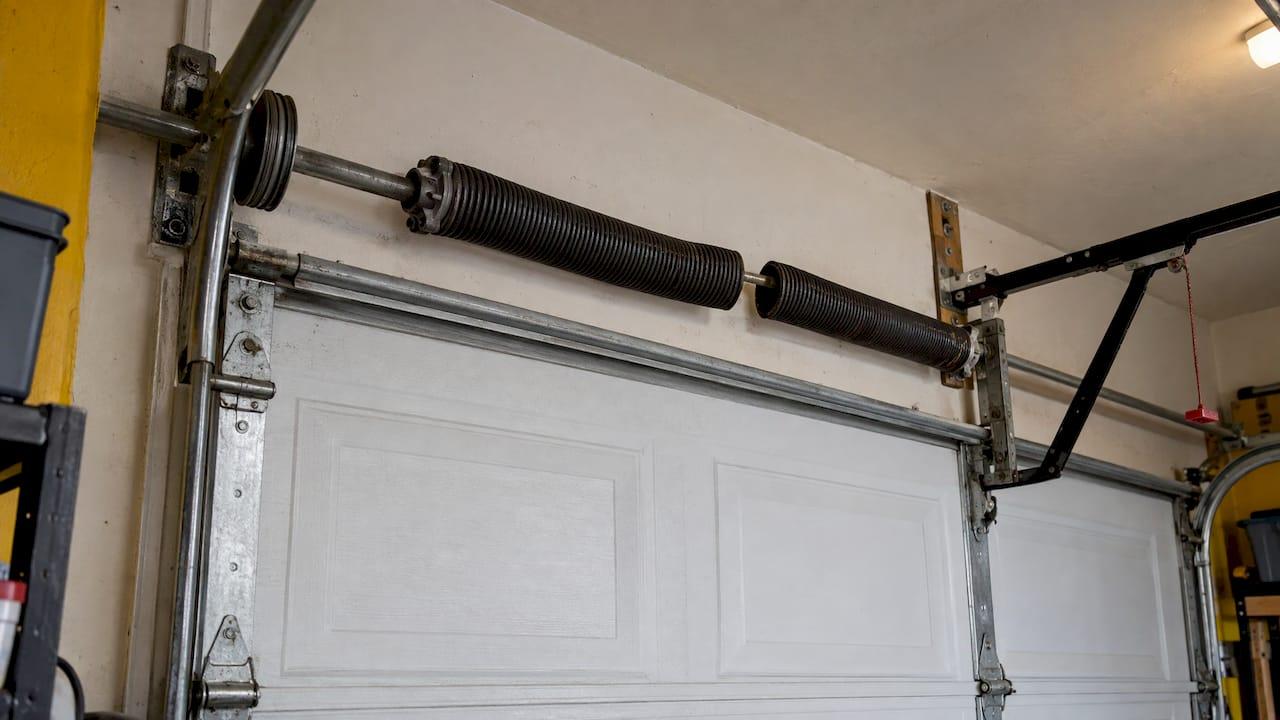
A single loud bang from your garage door almost always means a spring just broke. Stop using the door, leave the springs and cables alone, and call a trained technician. The door may look fine, but a broken spring turns your heavy door into dead weight, and trying to force it can hurt you or damage the opener.
We repair garage doors in Loveland and across Northern Colorado, and this is one of the calls we hear most. Below we walk through what the bang usually is, what you can safely look at from the floor, what to leave alone, and what happens when we show up.
TL;DR
- One sharp bang, like a gunshot, from the garage is most often a broken torsion or extension spring.
- Do not run the door until the spring is replaced. DASMA's consumer checklist says to leave spring repair and adjustment to a trained door systems technician.
- Look, don't touch: you can safely check for a gap in the spring, a door that sits crooked, or cables hanging loose.
- If your door has two springs, replace both, even if only one broke.
- Call us for a clear, upfront estimate over the phone. 90% of our repairs are finished the same day.
Table of Contents
- What a loud bang usually means
- What to do right after the bang
- Why you should not fix the spring yourself
- How to tell what broke without putting yourself at risk
- Other noises that sound like a bang
- What happens if the door is stuck shut with the car inside
- What we do when we arrive
- How long springs last, and why they break
- Perspective
- Get it fixed fast in Loveland and Northern Colorado
- Keep it from happening again
- Quick reference: do and don't
- FAQ
- Sources
What a loud bang usually means
Garage doors are heavy. A typical residential door is balanced by springs that carry most of its weight, so the opener only has to guide it. Those springs are wound tight, and over time the metal fatigues. When one lets go, all that stored energy releases at once. That is the bang.
It often sounds like it came from inside the house, not the garage. People describe it as a gunshot, a firecracker, or something heavy hitting the floor. Many homeowners walk out, see nothing on the floor, and assume it was a neighbor. Then they press the button later and the door will not lift, or the opener strains and stops.
Here are the usual suspects, from most to least likely:
- A broken torsion spring. This is the spring mounted on a metal bar above the door opening. It is the most common cause of a single loud bang.
- A broken extension spring. These run along the horizontal tracks on either side of the door. When one snaps, it can whip around. Doors with extension springs should have safety cables, and a snapped spring is a good reason to have the whole setup looked at.
- A snapped or slipped cable. The lift cables run from the bottom corners of the door up to the drums. If one breaks or jumps off, the door can hang crooked in the tracks.
- A door coming down too hard. A bang right as the door hits the floor can mean the springs are losing strength or the door is out of balance.
- A panel, hinge or track failure. Less common, but a cracked hinge or bent track can pop loudly and leave the door stuck.
If the noise was one loud event, treat it as number one until a professional says otherwise.
What to do right after the bang
Keep it simple and keep your hands off the hardware.
- Don't press the wall button again. The opener is built to move a balanced door. With a broken spring it can strain, burn out its gear, or push a crooked door further off its track.
- Keep people and pets away from the door. If the door is partway up, don't walk or park under it.
- Look from a distance. Check whether the door is sitting crooked, whether cables are hanging, and whether a coil above the door has a visible gap.
- Don't try to lift it by hand just to see. A door with a broken spring can feel extremely heavy and can drop fast if you let go.
- Call a technician. Tell them what you heard, what the door is doing now, and whether the car is stuck inside.
According to DASMA, the Door & Access Systems Manufacturers Association, if a spring is broken the homeowner should not operate the door until the spring is replaced, and should not try to remove, repair or adjust springs or mounting parts. That work belongs to a trained door systems technician with the right tools and instructions.
Why you should not fix the spring yourself
We know the videos make it look quick. A torsion spring is not a casual part. It is wound under high tension, and the winding bars, set screws and drums are all part of one system that can release suddenly.
DASMA's safety tips warn that springs wear out and that injury can result when they break. The risk is real in medical records too: a case report in a peer-reviewed journal describes serious eye injuries, including open globe injuries, when garage door springs dislodged at high speed during repair attempts.
That is why our line is simple. You can look, listen and take notes. We handle anything that involves winding, unwinding, or removing a spring. If you want more background, read why spring repair needs a professional and why spring replacement is urgent.

How to tell what broke without putting yourself at risk
You do not need tools for this. Stand well back and use your eyes.
Check the spring above the door (torsion systems)
Look at the metal bar over the door opening. A healthy torsion spring is one continuous coil. A broken one usually shows a gap of an inch or more somewhere along the coil, where the two halves have separated. Some doors have two springs. One may look fine while the other has a gap.
Check the tracks (extension systems)
If your springs run alongside the horizontal tracks, look for a spring that is stretched out, hanging loose, or missing a piece. A safety cable should run through the center of each spring. If you do not see one, mention it to your technician.
Check the cables and the door's position
A door that sits higher on one side, or has loose cable lying near the bottom corner, tells us a cable has come off or snapped. That can come with a spring failure or on its own.

Listen to what the opener does
With a broken spring, many openers hum or start to lift and then stop. Others will lift the door a few inches and quit. That is the opener protecting itself from a load it was never designed to carry. Don't keep pressing the button to confirm it.
Note the sound and the moment
The details help us diagnose by phone:
- Was it one bang or many pops?
- Did it happen while the door was moving or sitting still?
- Did it happen as the door hit the floor?
- Has the door been getting louder for weeks?
Other noises that sound like a bang
Not every loud noise is a broken spring. Here is how we think about the different sounds, based on what we see on service calls.
| Sound | Often points to | What to do |
|---|---|---|
| One sharp bang, then the door won't lift | Broken spring | Stop using the door, call a pro |
| Bang when the door reaches the floor | Door coming down too fast, weak springs or imbalance | Stop using it regularly, schedule an inspection |
| Repeated popping as the door travels | Dry or binding spring coils, or hinges | Schedule a tune-up |
| Grinding or squealing | Worn rollers, dry hinges or bearings | Schedule a tune-up |
| Rattling | Loose hardware, nuts and bolts | Have the hardware checked and tightened |
| Clunk from the opener when starting | Worn opener gear or chain slack | Opener repair |
One caution. A bang as the door lands can feel harmless because the door still works. But a door that slams shut is often telling you the spring is weakened, and a door that is out of balance puts stress on the opener. DASMA's checklist says safe operation depends on a balanced door, a working operator, and working entrapment protection. If something is off, contact a trained technician.
What happens if the door is stuck shut with the car inside
This is the most stressful version. Your car is in the garage, you need to leave, and the door will not move.
Many openers have a release cord with a red handle. Pulling it disconnects the door from the opener so it can move by hand. With a broken spring, though, that is the wrong move. The door is no longer counterbalanced, so it can be very heavy to lift and can slam down if it slips. Releasing the opener on a door with a broken spring is how fingers, feet and cars get hurt.
Instead:
- Call us and say the car is inside. We treat that as urgent, and we offer 24-hour emergency repair.
- If you have a side door or a second garage bay, use it.
- Don't drive anything toward a partly open door.
What we do when we arrive
We take a methodical approach so you know exactly what is being replaced and why.
- Confirm the failure. We look at the springs, cables, drums, rollers and tracks together, because a bang can come with more than one problem.
- Secure the door. Before anything is touched, the door is made safe.
- Replace the spring correctly. Springs are matched to the weight and size of your door. We don't guess.
- Replace both springs when the door has two. One broke, the other has done the same number of cycles. DASMA advises replacing both even if only one is broken, which can prevent damage from the second one failing and keep the door working efficiently.
- Check cables, rollers and hinges. A broken spring often puts stress on the rest of the system.
- Balance the door and test the opener. The door should stay put partway up when the opener is disconnected, and the opener's safety reverse should work as designed.
On the last point: the safety reverse feature is described in DASMA's sectional door checklist, which says photoelectric sensor height and contact reversal should be verified, and notes the feature is required on residential operators manufactured after 1992. We walk through our version of this in our guide on what to do when your door reverses.
How long springs last, and why they break
Springs are rated for a number of cycles. One cycle is the door going up and back down. A basic spring is often built for roughly 10,000 cycles, and a family that uses the garage as the main entrance can burn through that in a handful of years. Higher cycle springs exist, and if your door gets heavy daily use, that is a conversation to have when it is replaced. We explain the numbers in how homeowners should replace torsion springs safely.
A few things speed up wear:
- Heavy daily use, especially with several drivers in a house.
- Dry, unlubricated coils that rub and bind.
- Cold swings. Loveland winters are hard on metal, and a spring that has been quietly fatiguing may let go on the first cold morning.
- Adding weight to the door, like a new insulated panel or a decorative overlay, without rebalancing.
- Never having had a tune-up.
The spring that breaks is rarely a surprise to the technician. It has just been waiting for its last cycle.
Perspective
We get this call all the time, and the story is nearly always the same. Someone heard a bang, figured it was nothing, and then pressed the button and the door wouldn't go. Or they pulled the red cord with the car inside and found out the hard way how heavy a door really is.
Our view is simple. A loud bang is information, and the best thing you can do with it is stop and phone someone. We give honest, upfront estimates over the phone, so you aren't guessing at a cost before we arrive. We are a family-owned local company, and that matters to us: we live here, and we would rather earn a second call than squeeze out a bigger first invoice.
The other thing we push is replacing springs as a pair when your door has two. It is the sensible fix, and it means we are not back next month for the other one. We back our parts and labor with written warranties, and 90% of repairs get done the same day. If you are a veteran, the 10% discount applies automatically.
If you take one thing from this article: don't try to wind or unwind a spring yourself. Everything else on this page is something you can do from the floor with your eyes. That one is ours.
Eddie
Get it fixed fast in Loveland and Northern Colorado
When the bang is a broken spring, the sooner it is replaced the sooner you have a working door again. We handle garage door spring repair, opener repair and installation, tune-ups, commercial doors, custom doors and parts, and 24-hour emergency repair for homes and businesses across Loveland and Northern Colorado.
Call us, describe what you heard and saw, and we will give you a clear estimate over the phone before anyone drives out. Property managers get the same quick response, with an eye on keeping downtime short.

Veterans receive a 10% discount, and our work comes with written warranties on parts and labor.
Keep it from happening again
You cannot make a spring last forever, but you can avoid being surprised.
- Schedule a yearly tune-up. We lubricate the moving parts, check the springs and cables, tighten hardware and look at the rollers and hinges. A worn spring is easier to catch before it fails.
- Replace springs on a schedule, not on failure. If your door is old or you don't know when the springs were last changed, have them inspected. DASMA recommends professional inspection of older springs and replacement if needed.
- Watch for early signs. A door that feels heavy, a door that closes faster than it used to, uneven movement, or a visible gap in the coil are all reasons to call.
- Know your balance. A balanced door stays put when it is halfway open. We cover how to do a basic check in our balance test guide, but if the door fails it, stop and call us. Don't adjust spring tension on your own, and see our notes on spring tension adjustment to understand why a pro does it.
- Keep sensors clear. Make sure photo eyes near the floor aren't blocked or knocked out of line.
Quick reference: do and don't
Do
- Stop using the door after a single loud bang.
- Look at the spring, cables and door position from a safe distance.
- Write down what you heard and saw.
- Call a technician and mention a trapped car if there is one.
- Replace both springs when the door has two.
Don't
- Press the opener button repeatedly to "test" it.
- Pull the release cord on a door you suspect has a broken spring.
- Stand or park under a partly raised door.
- Loosen set screws or wind a spring.
- Hang weight on the door to hold it open.
FAQ
Why did my garage door make a loud bang and now won't open?
The most likely cause is a broken torsion spring. The spring carried most of the door's weight, and the opener can't lift that on its own. Stop pressing the button and call a technician to inspect and replace the spring.
Is it safe to use the door after a loud bang?
No. DASMA guidance says a door with a broken spring should not be operated until the spring is replaced. Running it can strain the opener and drop the door unexpectedly.
Why does my garage door bang when it closes?
A bang as the door reaches the floor often means it is coming down too hard, which can come from weakened springs or an out-of-balance door. Repeated popping along the way can be dry or binding parts. Either way, a technician should check the balance and springs rather than waiting for it to fail.
Can I replace just one broken spring?
If your door has two springs, replace both. DASMA says this can prevent damage from the second spring breaking and keeps the door working efficiently. The unbroken spring has been through the same number of cycles.
How fast can you get to a broken spring in Loveland?
We offer 24-hour emergency repair, and 90% of our repairs are completed the same day. Call with a description of the problem and we will give you an upfront estimate over the phone.
Sources
- DASMA: Residential One-Piece Garage Door and Electric Operator Checklist
- DASMA: Residential Sectional Garage Door and Electric Operator Checklist
- DASMA: Garage Door Safety Tips
- DASMA: Garage Doors safety tips
- Open globe injuries from garage door springs (PMC)