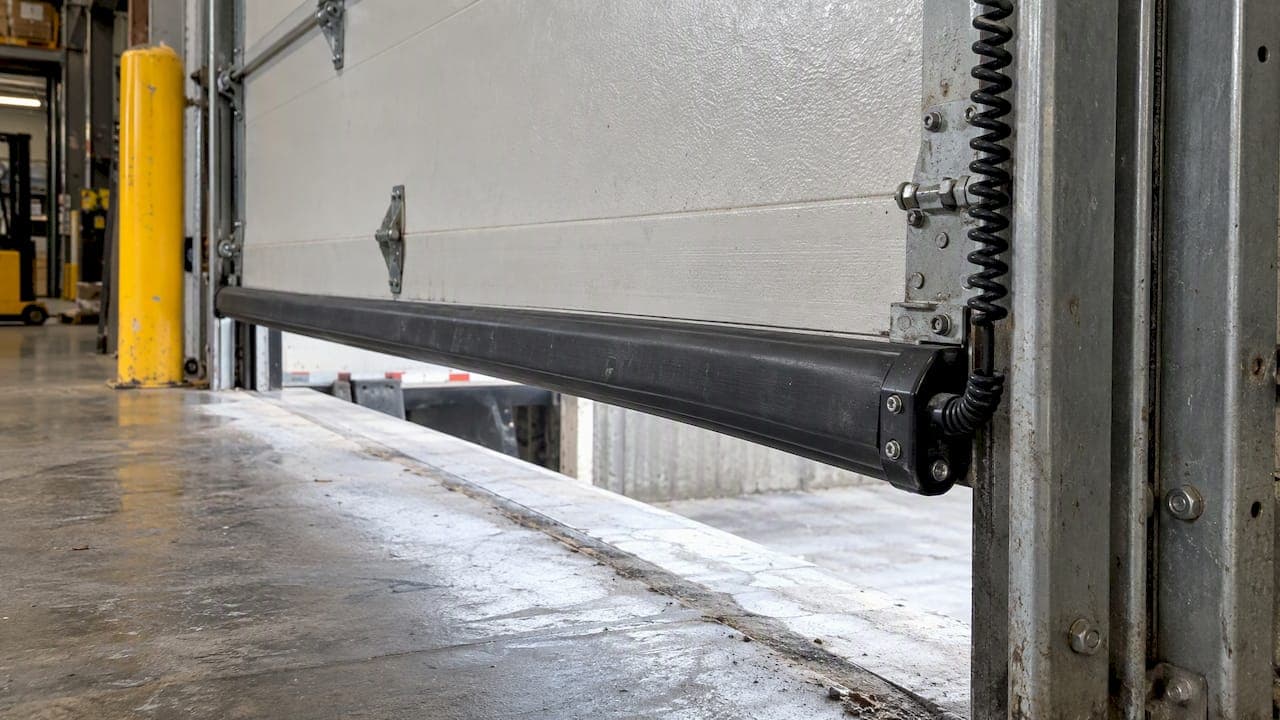
An overhead door safety edge is a touch-sensitive strip along the bottom of a powered door. When it bumps something, it tells the opener to stop or reverse. It is the backup that works by contact, after the photo eyes, and it matters most on commercial doors, rolling doors and any door that closes automatically. Below we cover how edges work, which types exist, what the U.S. standards expect, and how to test yours safely.
TL;DR
- A safety edge is a contact sensor on the bottom bar. Pressing on it completes a signal to the operator, which then stops or reverses the door.
- Photo eyes catch obstructions before contact. The edge reacts on contact. Many doors need both.
- Under ANSI/CAN/UL 325, commercial doors that can close without constant pressure need an external entrapment-protection device that is continuously monitored.
- Test monthly with two people and a 2-inch block of wood. The door should stop or reverse within 2 seconds.
- If the edge fails, stop using the door under power and call a professional. Do not bypass the edge.
Table of Contents
- What an overhead door safety edge actually does
- Safety edge vs. photo eyes
- Types of safety edges
- Monitored vs. non-monitored: the part owners miss
- What the U.S. standards expect
- How an edge is installed and connected
- How to test a safety edge
- Common reasons an edge fails or misbehaves
- Residential or commercial: what to expect
- Our perspective
- Need an edge checked or replaced in Loveland?
- FAQ
- Sources
What an overhead door safety edge actually does
The edge is a flexible strip, usually rubber or a similar material, mounted across the full width of the bottom bar. Inside the strip sits the sensing mechanism. In most electrically activated designs, conductive elements are separated by a small gap inside a flexible exterior. When the strip is compressed, the elements touch, complete a circuit and signal the control system.
One point trips people up. A sensing edge sends a signal to the operator and does not control the door itself. The operator is the part that stops or reverses. So the edge is only as good as the wiring, the control board and the opener behind it.
That is why a safety edge never stands alone in our shop. We look at the edge, its cord, the connection to the operator and the operator's response as one system.

Safety edge vs. photo eyes
Both devices protect people, pets and vehicles. They work at different moments.
| Photoelectric sensor (photo eye) | Safety edge | |
|---|---|---|
| Detects | An interrupted beam before anything touches the door | Physical contact on the bottom bar |
| Where it sits | On each side of the opening, a few inches off the floor | Along the bottom of the door |
| Typical weakness | Misalignment, dirt, sun glare, a bumped bracket | Damaged strip, pinched or cut cord, loose connection |
| Best at | Catching a child, pet or bumper early | Catching an obstruction the beam missed, such as something above beam height |
Photo eyes are proactive. The edge is the second chance. Both devices signal the opener, so light-beam sensing is itself one of the recognized sensing-edge configurations, and the line between the two blurs on some commercial systems.
Neither device holds a door up. If a spring breaks or a cable snaps, the opener's sensors cannot stop the fall. That is a separate hazard, covered in our guides on what causes garage door springs to break and what to do when a garage door cable snaps.
Types of safety edges
Not every edge is a rubber strip with wires. The industry association DASMA lists several configurations: pneumatic, electric, optical electronic, capacitance and light-beam. They are used on garage doors, rolling doors, grilles and gates.
Pneumatic edges
A pneumatic edge holds an air chamber, often a hose set in the weatherstripping at the bottom of the door. Compression raises the air pressure, which trips an electric switch. These are common on wide commercial doors and in wet or dirty locations, since the sensing happens at a switch rather than along the strip.
Electric (contact) edges
These use the conductive-element design described above. They are slim, widely available and easy to replace in sections. Most will have a coiled cord or a junction box that carries the signal from the moving door to the operator.
Optical and light-beam edges
Optical electronic and light-beam edges use a transmitter and receiver to sense an obstruction. They are found where a rubber strip would not hold up or where a non-contact option is preferred.
Which one do you have?
Look at the bottom of the door. A thick rubber or vinyl strip with a cord running up the side is almost always an electric edge. A hose fitting and a small switch box point to pneumatic. If you cannot tell, send us a photo before you order a replacement, because the type and the operator brand decide what fits.
Monitored vs. non-monitored: the part owners miss
A monitored system keeps checking its own safety device. It confirms that the device is present and working, including detecting a short or an open circuit. A non-monitored system does not check. If a wire is cut in a non-monitored setup, the door can keep closing with no edge protection and nobody knows.
Monitored edges often use a resistor at the end of the cord. Miller Edge, for one manufacturer, marks its monitored edges with a colored band near the termination, and the color identifies the configuration, for example green for an 8.2K-ohm resistor. Operators expect a particular resistance or signal. Mix a mismatched edge with the wrong operator and the door may refuse to close, or worse, appear to work with no real protection.

What the U.S. standards expect
The core document is ANSI/CAN/UL 325, a binational U.S.-Canada standard for door and gate operators. For commercial doors that can close without constant pressure on a button, it calls for an external entrapment-protection device and continuous monitoring of that device's proper operation. A safety edge or a photo eye can be that device, depending on the door and operator.
Homes follow a related track. The Consumer Product Safety Commission's rule for automatic residential garage door operators, 16 CFR part 1211, incorporates UL 325's entrapment protection requirements. In plain terms, openers built for homes carry reversing and entrapment protection from the factory. Our overview of garage door safety codes for homeowners walks through the examples a Loveland homeowner is likely to run into.
A few practical takeaways:
- Do not mix and match blindly. The edge, the operator and the door type have to be compatible.
- Do not remove or jumper a sensing device to stop nuisance reversals. Find the cause instead.
- Ask about monitoring whenever you replace an edge or an operator on a commercial door.
- Local requirements can add to the standard. If you manage a commercial building in Loveland, check your building and fire requirements as well, or ask us what we see on similar jobs.
How an edge is installed and connected
Installation sounds simple: mount a channel on the bottom bar, slide in the sensing edge, and wire it to the operator through junctions or coiled cords. The details are where jobs go wrong. The manufacturer's monitoring and logic requirements vary by operator brand, so the wiring that works on one operator can fail on another.
Here is the order we follow on an edge replacement:
- Identify the operator and the existing edge type. Model numbers matter.
- Power down the operator before touching any wiring.
- Check the door's balance. An out-of-balance door makes the edge and the opener work harder and trip falsely. See our garage door balance test.
- Remove the old edge and channel, and inspect the bottom bar for bends or corrosion.
- Mount the new channel and edge, keeping the cord free of pinch points as the door travels.
- Wire to the operator per the operator's instructions, including any resistor or monitoring module.
- Run the full test described below, then record the result.
The spring system carries the door's weight, and it is not a place for guessing. We cover why in our spring tension adjustment guide. Leave springs and cables to a trained technician.
How to test a safety edge
The manufacturer's sample procedure calls for a monthly test with two people. One person operates the controls while the other places a 2-inch wood block under the open door; the door should stop or reverse within 2 seconds.
A simple monthly routine
- Clear the area of people, vehicles and stored items.
- Open the door fully.
- Have the first person stand at the controls, clear of the door's path.
- Have the second person place the wood block on the floor under the door's centerline, from the side and without reaching under the door.
- Close the door. It should stop or reverse once the edge meets the block.
- Repeat near each end of the door, since a damaged strip often fails only in one spot.
- Write down the date, who tested, and the result.
For a residential door, our walk-through of how to pass the UL 325 2-second test when your garage door reverses covers the homeowner version in detail, including what a failed reversal usually points to.
If the door does not reverse
The same source says to notify a supervisor, disconnect power, operate the door manually if necessary, and contact a door professional. Do not keep cycling the door to see if it "catches" this time. If the door is stuck and the manual release is jammed, read what to do when the emergency release is stuck before you pull on anything.
Common reasons an edge fails or misbehaves
- Door reverses for no reason. Look for a crushed or cracked strip, moisture in the edge, or a pinched cord.
- Door will not close at all. On a monitored system, a cut wire, a loose terminal or a failed edge can look like this, because the operator can no longer confirm protection. That is the system working as designed.
- Edge works near one end only. The strip may be damaged internally or have a break in the conductive element.
- Intermittent faults in cold weather. Northern Colorado winters stiffen rubber and cords. A strip that is brittle or a cord with cracked insulation is a replacement candidate.
- Edge never trips. A bypassed or incorrectly wired edge. Treat this as unsafe until a technician checks it.
Most of these are quick to fix when we see them early. A cracked strip left for a season turns into a door that will not close on a Friday night.
Residential or commercial: what to expect
Homeowners mostly rely on photo eyes and the opener's built-in force sensing, so a separate bottom edge is less common on a standard residential setup. Commercial doors are different: wide openings, heavy traffic, forklifts, delivery vehicles, and doors that may close on a timer. That is where edges, monitoring and a written test log earn their keep. Property managers should also keep in mind that photo eyes and edges both signal the opener. If the operator or mechanical parts fail, they cannot stop a falling door in the way a sound spring and cable system does, which is why springs, cables and the opener should be inspected on the same visit.
Our perspective
We repair and install doors for a living, and the safety edge is the part we most want people to take seriously. It is cheap compared with the door, and it is the piece that decides whether a bad moment ends with a startled reverse or an injury.
Here is what we see. Owners test the opener once, never again. A cord gets pinched, a strip gets cracked by a cold January, and nobody notices until the door fails to reverse. Or someone gets tired of nuisance reversals and bypasses the edge. We never do that, and we ask you not to.
Our approach is simple. We give you an honest estimate over the phone before anyone shows up, so you are not guessing at cost. About 90% of our repairs are finished the same day. Our work comes with written warranties on parts and labor, and we are a family-owned company, so the person you talk to answers for the work. We would rather replace a worn edge now than get an emergency call later.
A monthly two-minute test and a technician's eye once a year catch most problems. If you manage a commercial building, put the test in writing and keep the log.
Eddie
Need an edge checked or replaced in Loveland?
We service residential and commercial doors across Loveland and Northern Colorado: sensor and edge faults, opener repair and installation, tune-ups, springs and 24-hour emergency repair. Call for an upfront estimate over the phone, and ask about our automatic veteran discount. See everything we handle on our garage door services page.

If your opener is the real problem, our guide on the role of the opener in installation explains what to look for before you replace one.
FAQ
How often should I test my garage door safety edge?
Monthly is the interval in the manufacturer's sample procedure. Use two people and a 2-inch block of wood, and keep a written record on commercial doors. Test again any time the edge, the operator or the door has been serviced.
Is a safety edge the same as a photo eye?
No. A photo eye uses a beam to sense something before it touches the door. A safety edge reacts when the bottom of the door physically meets an obstruction. Both signal the opener, and many doors use one or both, depending on the door type and the operator.
Can I replace a safety edge myself?
The parts are small, but the edge has to match your operator's wiring and monitoring requirements, and the door's balance affects how it behaves. We recommend having a technician handle the replacement and run the reversal test. Never work on springs or cables yourself.
Why will my door not close after the edge was damaged?
On a monitored system, the operator checks that the safety device is present and working. A cut cord, a short or a failed edge can make the operator refuse to close the door. That is a safety feature, so have the edge and wiring repaired rather than bypassed.
Do residential garage doors need a safety edge?
Residential openers are covered by the CPSC rule that incorporates UL 325 entrapment protection, and most homes meet it with photo eyes plus the opener's reversing function. A bottom edge is more common on commercial doors. Check your opener's manual or call us if you are unsure what your door has.
Sources
- Safety Edge Sensors: How They Work & Install, Miller Edge
- Sensing Edges, DASMA Technical Data Sheet 368
- Frequently Asked Questions, Miller Edge
- Sample Test Procedure for Edge Sensors, Miller Edge
- New US and Canada Binational Standard for Door and Gate Operators, UL
- Safety Standard for Automatic Residential Garage Door Operators, Federal Register