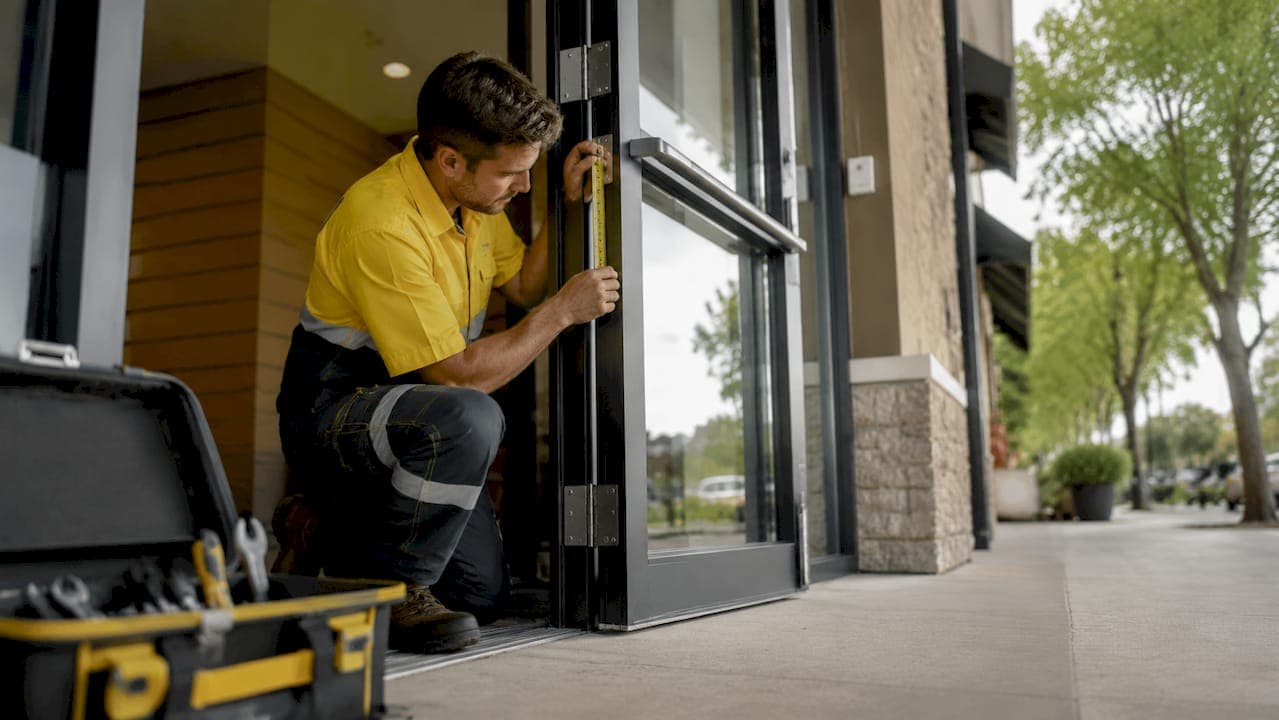
Automatic door systems are defined as motorized entrance solutions that open and close without direct physical contact, and choosing the right type is one of the most consequential decisions a facility manager makes. The three primary types used in commercial settings are sliding, swinging, and revolving doors, each built for specific traffic volumes and building layouts. ANSI/BHMA standards and ADA requirements govern how these systems must perform, covering everything from opening force to sensor response time. Getting the match right between door type and business environment affects energy costs, foot traffic flow, security, and long-term maintenance budgets.
1. What are the main automatic door system types businesses rely on?
Commercial automatic door systems fall into four broad categories. Each one solves a different problem, and picking the wrong type wastes money fast.
- Sliding doors move horizontally along a track. They suit wide, high-traffic entrances where clearance space is limited on the swing side.
- Swinging doors operate like a traditional hinged door but with a motorized operator. They work best for retrofits, interior passages, and moderate-traffic areas.
- Revolving doors rotate continuously around a central axis. They create a near-permanent seal between indoors and outdoors, making them the top pick for energy-efficient entrances in hotels, airports, and office towers.
- Specialty doors include folding, telescopic, and hermetic types. Folding doors compress into a smaller footprint than standard sliders. Telescopic doors use multiple overlapping panels to open a wide passage in a tight wall space. Hermetic doors create an airtight seal, which is critical for hospitals, cleanrooms, and food processing facilities.
The right category depends on your traffic count, your floor plan, and your compliance obligations. Each type also carries a different price point for installation and ongoing service.
2. How sliding automatic doors benefit commercial spaces

Sliding doors are the most common choice for high-volume entrances because they handle large crowds without forcing anyone to slow down or step aside. A standard pair of sliding panels opens in under a second and requires no clearance arc on either side of the doorway. That matters enormously in a busy grocery store or hospital lobby where carts, wheelchairs, and stretchers move through constantly.
Sliding doors require less clearance than swinging alternatives and provide smooth operation with seals that improve energy efficiency. Sealed sliding models with brush or rubber perimeter gaskets reduce air infiltration significantly, which lowers heating and cooling loads in extreme climates. Retail stores, airports, and emergency departments all rely on this combination of speed and thermal performance.
Key advantages for commercial operators:
- Wide clear opening without swing clearance requirements
- Smooth, quiet operation that handles continuous foot traffic
- Sealed models reduce HVAC load in cold or hot climates
- Compatible with motion sensors, push-plate activators, and access control systems
- Available in single-slide, bi-parting, and telescopic configurations
Pro Tip: Specify a bi-parting sliding door for entrances wider than 6 feet. Two panels meeting in the center open faster and put less strain on each individual motor than a single large panel.
3. When businesses should choose automatic swinging doors
Swinging automatic doors are the right call when a sliding door simply will not fit. A sliding door needs wall space on at least one side to park the panel when open. If your entrance has a window, a column, or a storefront display right next to the doorway, a swinging operator is often the only practical option.
Low-energy automatic operators help swinging doors meet the ADA's 5-pound force limit and offer push-plate activation for users who cannot grip a handle. That makes them a reliable path to ADA compliance without a full entrance redesign. The ADA does not require automatic doors on every accessible entrance, but interior hinged doors on accessible routes must not exceed 5 pounds of opening force, which is why low-energy operators are so common in office corridors and medical facilities.
Here is when a swinging automatic door makes the most sense:
- Retrofit projects where the existing frame and hardware stay in place and only the operator is added.
- Interior passages between departments, such as a pharmacy counter or a server room entrance.
- Moderate-traffic areas where a full-power sliding system would be over-specified and over-budget.
- Security-controlled zones where the door needs to integrate with a keycard or biometric reader and remain locked until access is granted.
Automatic doors integrate with keycards and biometric scanners, making swinging operators a practical choice for labs, private offices, and any space that needs controlled access alongside ADA compliance.
4. What makes revolving doors the top pick for energy efficiency
Revolving doors create a continuous barrier between the inside and outside of a building. Because at least one panel is always blocking the opening, air exchange between the conditioned interior and the outdoor environment drops dramatically compared to any door that swings or slides fully open. That physical reality translates directly into lower HVAC costs, which is why hotels, airports, and large office towers specify revolving doors at their main entrances.
Revolving doors minimize air exchange, making them an energy-smart choice for high-footfall buildings. The savings compound quickly in climates with harsh winters or intense summers, where every degree of temperature bleed through an entrance costs real money. A revolving door also projects a premium aesthetic that suits upscale retail, corporate headquarters, and hospitality venues.
| Feature | Revolving door | Sliding door | Swinging door |
|---|---|---|---|
| Air exchange control | Excellent | Moderate (with seals) | Low |
| Throughput at peak traffic | High | Very high | Moderate |
| ADA accessibility | Requires bypass door | Full compliance | Full compliance |
| Installation cost | High | Moderate | Low to moderate |
| Best environment | Hotels, towers, airports | Retail, hospitals, transit | Offices, interiors, retrofits |
One important note: revolving doors require a compliant bypass door alongside them for wheelchair users and anyone who cannot use the revolving panels. That adds to the total installation footprint and cost, so plan the entrance layout before committing.
5. How to evaluate and choose the right automatic door for your business
Choosing the right system comes down to five practical factors. Work through each one before you call for a quote.
Traffic volume and duty cycle. High-traffic retail entrances require continuous-duty full-power operators, while low-use doors perform well with affordable low-energy operators. A door that cycles hundreds of times per day needs a motor rated for that load. Undersizing the operator leads to premature failure and costly repairs.
Space and architecture. Measure the wall space beside the opening before selecting a sliding door. Check the swing arc before specifying a swinging door. Revolving doors need a larger floor diameter than most people expect, typically 6 to 10 feet across.
Safety sensors and compliance. Safety sensor calibration is critical to meet ADA and UL 325 guidelines. Sensors must detect users early, reverse the door quickly on obstruction, and hold the door open long enough for a person using a mobility device to clear the threshold. Skipping proper calibration creates liability.
Emergency egress. Sliding and folding automatic doors must include breakout features so panels can swing open in the direction of egress during a power failure or fire event. This is a fire code requirement, not optional. Check your local jurisdiction's requirements before finalizing the specification.
Security integration. Automatic doors pair with access control systems including keycards, PIN pads, and biometric readers. Define your security zones before choosing a door type, because some operators integrate more easily with third-party access hardware than others.
Key questions to answer before purchasing:
- How many cycles per day will this door complete?
- Does the entrance need ADA-compliant activation hardware?
- Is emergency breakout functionality required by local fire code?
- Will the door connect to an existing access control system?
- What is the realistic maintenance budget for the first five years?
Pro Tip: Ask your installer for the operator's rated duty cycle in cycles per hour. Match that number to your actual peak-hour traffic count. A mismatch in either direction costs you money.
Key takeaways
Matching the automatic door type to your specific traffic volume, space constraints, and compliance requirements is the single most important decision in any commercial entrance project.
| Point | Details |
|---|---|
| Match door type to traffic | High-volume entrances need full-power sliding or revolving doors; low-use areas suit low-energy swinging operators. |
| ADA compliance is non-negotiable | Interior doors on accessible routes must not exceed 5 pounds of opening force, driving low-energy operator use. |
| Revolving doors cut HVAC costs | Their continuous barrier reduces air exchange, lowering heating and cooling loads in extreme climates. |
| Breakout features are mandatory | Sliding and folding doors must swing open in the egress direction during power failures or fire events. |
| Sensor calibration protects users | Properly calibrated presence sensors and hold-open timings are required under ADA and UL 325 guidelines. |
What I've learned from watching businesses get this wrong
After years of working on commercial door systems, the pattern I see most often is over-specification on the wrong axis. A business owner sees a revolving door at a luxury hotel and wants that same look for a 2,000-square-foot retail shop. The revolving door eats 30% of the entrance width, requires a bypass door for ADA compliance, and costs three times what a sealed bi-parting slider would. The energy savings are real, but they take a decade to offset the installation premium at that traffic volume.
The opposite mistake is just as common. A facility manager installs a residential-grade low-energy swinging operator on a door that cycles 400 times a day. The motor burns out in 18 months. The commercial door repair call costs more than the difference between the residential and commercial-grade unit would have.
The detail most people miss is sensor calibration. A door that opens too slowly, or holds open too briefly for a wheelchair user, creates an ADA liability even if the hardware itself is compliant. I have seen facilities pass a hardware inspection and then face a complaint because the hold-open timer was set to 3 seconds instead of the required 5. Calibration is not a one-time task. It needs to be checked after every service call and every seasonal temperature swing, because sensor sensitivity drifts.
My honest recommendation: get a professional installation from a team that works on commercial systems daily, not a general contractor who handles one automatic door a year. The difference in outcome is not subtle.
— Eddie
Commercial automatic door services in Loveland, CO
Mikes garage doors Loveland works with business owners and facility managers across Northern Colorado on automatic door installation, configuration, and ongoing maintenance. Whether you need a sealed sliding system for a high-traffic retail entrance, a low-energy swinging operator for an interior ADA-compliant passage, or a specialty hermetic door for a controlled environment, the team brings the same same-day commitment and upfront pricing that local businesses count on.
Mikes garage doors Loveland handles the full scope of commercial door services, from initial site assessment and operator selection to sensor calibration and compliance verification. Veterans receive a 10% discount on all services. Call for a transparent phone estimate with no hidden costs, and get your entrance working the way your business needs it to.
FAQ
What are the three main types of automatic doors for businesses?
The three main types are sliding, swinging, and revolving doors. Each suits different traffic volumes, space constraints, and energy management needs.
Do automatic doors have to meet ADA requirements?
Automatic doors on designated accessible routes must meet ADA force and activation standards. Interior doors on those routes must not exceed 5 pounds of opening force, which typically requires a low-energy automatic operator.
What is a breakout feature on an automatic sliding door?
A breakout feature allows sliding or folding door panels to swing open in the direction of egress during a power failure or fire event. Fire codes require this function on most commercial automatic sliding doors.
How do I know which door operator duty cycle I need?
Count your peak-hour door cycles and match that number to the operator's rated duty cycle. High-traffic entrances need continuous-duty full-power operators; low-use interior doors work well with low-energy models.
Can automatic doors connect to access control systems?
Automatic doors integrate with keycards, PIN pads, and biometric scanners. This makes them practical for secure zones like labs, server rooms, and private offices where controlled access is required alongside hands-free operation.