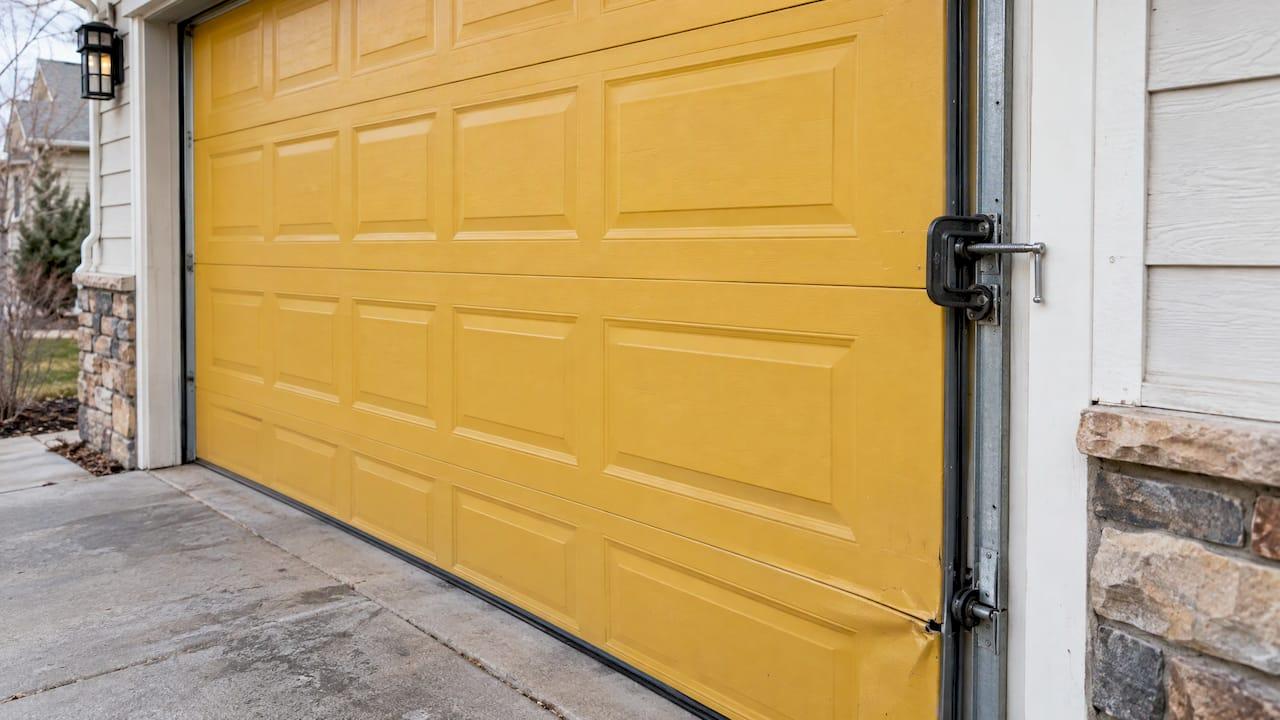
When a garage door is hit, bent or knocked off its track, secure the house first and the door second. Lock the door between the garage and your home, take the remotes out of reach, photograph everything before you move anything, and keep your hands off the springs and cables. Then call a technician. Our Loveland team completes 90% of repairs on the same day and gives upfront estimates over the phone, so an open or unsafe garage rarely has to stay that way for long.
This guide walks through the first hour, the insurance steps that protect your claim, and how to tell a repair from a replacement. It is written for homeowners, property managers and business owners in Loveland and Northern Colorado.
TL;DR
- Lock the garage-to-house door right away and keep remotes out of cars and out of reach.
- Photograph and video the damage before any cleanup or repair, then call your insurer if the repair may exceed your deductible.
- Never touch the springs, cables or lower brackets. They hold enough tension to injure you.
- Make only temporary repairs to stop further damage and keep the receipts. Do not make permanent repairs before the insurer inspects.
- Call a professional for the real fix. We offer 24-hour emergency repair and a 10% veterans discount.
Table of Contents
- The first 15 minutes: make people and property safe
- Lock the door between the garage and your house
- Keeping the damaged door closed overnight
- What not to touch
- Document everything before you touch anything
- Insurance: what to do and in what order
- Repair or replace: how to tell
- If the door will not close, or reverses at the floor
- For property managers and businesses
- Get it fixed: what we do
- Our view: secure first, then repair, never improvise
- Preventing the next failure
- FAQ
- Sources
The first 15 minutes: make people and property safe
A damaged door is a hazard first and a security problem second. A door that is off track, bent or hanging by one cable can move without warning. The U.S. Consumer Product Safety Commission (CPSC) notes that a severely unbalanced door could unexpectedly crash to the floor, and that doors which bind, stick or sit unevenly should be serviced by a professional.
So start with these steps:
- Keep people and pets away from the door and the area beneath it. Do not walk or park under a door that is partly open.
- Stop using the opener. Pressing the button on a damaged door can strain the motor, twist the door further or drop it.
- Look, don't touch. Note bent tracks, gaps between panels, frayed cables, a sagging side or a spring that has separated. A broken torsion spring often makes a loud bang, and the door is then far heavier than it looks.
- Check the vehicle and the contents. If a car or stored items are exposed, move them only if you can do so without standing under or beside the damaged door.
If the door is fully closed and still seems stable, you have time to work through the security steps below. If it is open, hanging crooked or stuck partway, leave it alone and call for emergency help.
Lock the door between the garage and your house
An open or weakened garage is a way into your home. The door that connects the garage to the house is your second line of defense, and it is the first thing to secure.
- Lock the entry door and the deadbolt if it has one.
- Take every garage remote out of cars parked in the driveway. A Lexington County, South Carolina, police chief's August 2026 crime-prevention advice is to keep the garage-to-house door locked and never leave a remote inside a vehicle in the driveway.
- Keep valuables, tools and ladders out of an exposed garage if you can retrieve them safely.
- If your keypad or wall button is damaged, pause any shared codes until the system is repaired.
This takes two minutes and protects the part of your property that matters most.
Keeping the damaged door closed overnight
If the door is down and closed, you can keep it from being forced open until a technician arrives. There are two ways homeowners commonly do this.
Use the door's built-in lock. Many doors have a lock whose bars slide into the tracks. Engaging that lock prevents the door from being lifted.
Clamp the track. A C-clamp or locking pliers placed on the track just above a roller can stop the door sliding upward. The same source gives an important warning: do not block or physically lock a door while it is still connected to the opener, because running the opener against the block can damage both the door and the opener. Disconnect the opener with the red emergency release cord only when the door is fully closed, and keep the opener switched off.
Two cautions apply here. First, never pull the release cord on a door that is open or partly open, because it can fall. Second, if the tracks are bent or the door is off its rollers, a clamp will not hold it reliably. In that case, do not force the door. Call us and we will secure it properly.
This is a stopgap for one night, not a repair. Your goal is a closed, locked garage until a technician can look at it.

What not to touch
Some parts of a garage door are under serious tension, and damage makes them less predictable.
- Torsion and extension springs. They store the force that lifts a door weighing a couple hundred pounds. Do not loosen, adjust or try to rewind them.
- Lift cables and the brackets at the bottom corners. These are under load even when the door is closed.
- Bent tracks. Hammering a track straight rarely works and can leave the door unstable.
The CPSC says springs, hardware and fittings should be checked to keep the door on track, and that this is work for a trained professional. Our own write-up on track alignment checks that prevent spring injury shows what to look at from a safe distance.
Document everything before you touch anything
The time between the damage and the repair is when your insurance claim is won or lost. The National Association of Insurance Commissioners (NAIC), which represents state insurance regulators, advises you to list all damaged property and take photos and videos of the damage.
Get these in your phone before anything moves:
- Wide shots of the whole door from inside and outside, then close-ups of each damaged panel, track, spring, cable and opener part.
- The surrounding area: the frame, the garage floor, the wall, any vehicle or stored items that were hit.
- The cause: a storm, hail, a vehicle strike, a fallen branch. Capture the object or the scene if it is safe.
- Date and time stamps, which your phone adds automatically.
- The door's label, model or serial number if you can see it, and the opener's label.
The New Mexico Office of Superintendent of Insurance, in an advisory published through the NAIC, adds the same rule: take photographs and video before any cleanup or repairs. Storm damage is rarely limited to the door, so it helps to look elsewhere too. A guide on spotting hurricane roof damage signs shows how to record what you can see from the ground without climbing, and the same habit works for any property damage.
Insurance: what to do and in what order
Whether homeowners insurance pays for the door depends on your policy and on the cause. Hail, wind or a fallen tree are commonly claimed. Ordinary wear is not. Our page on homeowners insurance and garage doors explains why an estimate is a good place to start.
Here is the sequence regulators recommend:
- Check your deductible. The NAIC says that if damage is minor, paying out of pocket may be better. If repairs will exceed the deductible or the damage is extensive, file a claim and notify your insurer right away. The time allowed to report varies by state, so do not wait.
- Call with your details ready. Have your policy number, name, address and phone number, and describe what happened and how far the damage extends.
- Make temporary repairs only. The NAIC states that policies may require you to protect the property from further damage, that the policy should cover the cost of those repairs, and that you should keep all receipts.
- Wait for inspection before permanent repairs. The same guidance warns that an insurer may deny a claim if permanent repairs are made before the damage is inspected.
Note the deductible on wind and hail. The New Mexico advisory points out that wind and hail deductibles can be higher than your primary deductible, so read your policy before deciding whether to file.
How we help with the claim
We give honest, upfront estimates over the phone, so you can compare the repair cost with your deductible before you decide. Securing the door the same day is a temporary protective step. Tell your adjuster what was done, and keep the paperwork.
Repair or replace: how to tell
Most homeowners ask whether it is cheaper to repair or replace. The answer depends on what failed, not on the headline price.
| Damage | Usually points to |
|---|---|
| One dented or cracked panel on an otherwise straight door | Panel or section repair |
| Bent track or loose rollers | Track and hardware repair |
| Broken spring or snapped cable | Spring or cable replacement |
| Opener not responding or running but not lifting | Opener repair or replacement |
| Several buckled panels, a twisted frame or a door that has lost its shape | Full door replacement |
| Older door with damage across multiple sections | Replacement, often with a better-insulated or wind-rated door |
The more panels that are damaged, the more sense replacement makes, because a new door comes with fresh hardware and a new warranty. A tech who looks at the door can tell you in minutes which side of that line you are on, and on a phone call we give you an upfront figure for the likely scope so there are no surprises.
If you replace, pay attention to the door's wind rating. The Texas Department of Insurance reports that in recent hurricanes, garage door failures contributed to 80% of home failures, and it stresses published wind ratings and installation exactly to the manufacturer's instructions. Colorado's Front Range wind is not a hurricane, but the logic holds. We explain how to read the label in our guide to wind-rated garage doors. If a driveway gate is part of your property plan, types and costs of automatic gates is a good overview of another way to add protection at the entry.
If the door will not close, or reverses at the floor
Sometimes the damage is a sensor knocked out of line, a bent track edge or a lightning-fried opener. The door comes down, touches the floor and goes back up. That is the safety system acting, but it also leaves you with an open garage.
The CPSC recommends testing the reversing function by laying a 2x4 flat on the floor in the door's path. If the door does not reverse when it hits the board, disengage the opener until it is adjusted, repaired or replaced. The agency also advises inspecting the door and opener every 30 days. Our guides to the UL 325 two-second reversal test and the balance test explain what the results mean.
A door that is balanced stays where you leave it when you stop it halfway, according to the CPSC. If yours drifts or slams down, the springs or cables are the issue. Stop using it and call.
After a lightning strike or power surge, the opener may be the only casualty. Our page on a lightning-damaged garage door opener lists what to check before you call.
For property managers and businesses
A damaged commercial door is a liability and a downtime problem at the same time. Loading docks, shop bays and tenant garages cannot sit open overnight.
- Close off and mark the area, and keep staff and tenants away from the door.
- Photograph the damage and write down how it happened, who was present and the time. Send this to your insurer or the building owner.
- Lock all interior doors that connect to the damaged opening and move cash, inventory or equipment if it is safe to do so.
- Call for commercial service the same day. We handle commercial garage doors and can arrange emergency repair at any hour.
Keep the incident report, estimate and invoice together. They form the paper trail for a claim or for a tenant dispute.
Get it fixed: what we do
We are a family-owned garage door company serving Loveland and Northern Colorado. We repair broken springs, bent tracks, damaged panels and faulty openers for homes and businesses, and our 24-hour emergency repair line is built for the situation this article describes: a door you cannot safely leave as it is. About 90% of our repairs are completed on the same day, and we give upfront estimates over the phone. Our work is backed by written warranties, and veterans receive a 10% discount.
See everything we do on our garage door services page, or call us with the damage photos you took.

Tell us what happened, what the door is doing and whether anyone has used the opener since. That is usually enough for a phone estimate and a plan for getting the garage closed and safe.
Our view: secure first, then repair, never improvise
We get these calls after a car backs into a door, after a windstorm, after a spring lets go in the middle of the night. People are shaken, and the instinct is to fix it right now with whatever is in the garage.
Here is what we tell them. Lock the house door. Take the photos. Leave the springs alone. A door that is off its track is not a puzzle to solve with a hammer. It is a heavy object that can move when you least expect it, and the parts holding it up are under real tension.
We built our service around that moment. Honest, upfront estimates on the phone mean you know the likely cost before anyone arrives. Same-day repair for most jobs means the garage is not left exposed for a week. Written warranties mean the repair stands behind itself. And because we are a local, family-owned shop, the person you reach is the person who answers for the work.
If you have damage, send us the photos and call. We will tell you what we see and get the door closed and safe.
Eddie
Preventing the next failure
Once the repair is done, a few habits lower the odds of a repeat.
- Test every 30 days. The CPSC recommends a monthly inspection of the door and opener, including the reversing test.
- Schedule a tune-up. Lubrication, hardware tightening and a spring check catch problems before they grow. We offer garage door tune-ups and preventive maintenance.
- Keep the house door locked. Treat the garage as part of your home's perimeter, not as a shed.
- Keep remotes out of vehicles. That is the advice from the Lexington County police chief too.
- Choose a rated door if you replace. The label and installation drawing tell you what wind load a door is built for.
FAQ
How do I lock a garage door to keep it from opening?
If your door has a built-in lock, engage it so the bars slide into the tracks. If it does not, a clamp on the track above a roller can stop the door from sliding up. Do not block the door while the opener is still connected, and call us if the tracks are bent.
Will homeowners insurance cover garage door damage?
It depends on your policy and the cause, so read it or ask your insurer. Compare the repair cost to your deductible first. If you file, photograph the damage, make only temporary repairs and keep receipts, because the NAIC warns that permanent repairs made before inspection can lead to denial.
Is it cheaper to repair or replace a garage door?
Repair is usually cheaper when damage is limited to one panel, a spring, a cable or part of the track. Replacement makes more sense when several panels are buckled or the door has lost its shape. Call us with photos and we will give you an upfront estimate over the phone.
Can I use my opener after the door is damaged?
No. Running the opener on a bent, off-track or unbalanced door can worsen the damage or drop the door. Switch the opener off, keep the door closed and locked if possible, and call for repair.
Do you offer emergency service?
Yes. We offer 24-hour emergency repair in Loveland and Northern Colorado, and 90% of our repairs are completed on the same day. Veterans receive a 10% discount.
Sources
- CPSC: Non-Reversing Automatic Garage Door Openers
- NAIC: What you need to know when filing a homeowners claim
- NAIC: Get smart about your insurance coverage
- New Mexico Office of Superintendent of Insurance storm tip, via NAIC
- Texas Department of Insurance: Making repairs after a storm
- Bob Vila: How to lock your garage door
- Lexington County Chronicle: Prevent crime by closing garage doors